
HYBRID BUS FEASIBILITY STUDY REPORT
Report to/Rapport au :
Transportation Committee
Comité des transports
and Council / et au Conseil
25 October 2005 / le 25 octobre 2005
Submitted by/Soumis par : R.G. Hewitt,
Acting Deputy City Manager/Directeur municipal adjoint intérimaire,
Public Works and Services/Services et Travaux publics
Contact Person/Personne ressource : Ron Gillespie, Director/Directeur
Fleet Services/Service du parc automobile
(613) 842-3636 x2215, ron.gillespie@ottawa.ca
SUBJECT: | |
| |
OBJET: |
REPORT RECOMMENDATIONS
That the Transportation Committee recommend that Council approve:
1. The procurement of diesel-electric hybrid propulsion drive technology for all replacement and growth transit bus requirements for 2006, 2007 and 2008 budget years, estimated at 226 buses in accordance with the approved Long Range Financial Plan-2 (LRFP-2).
2. The release of the Request for Proposal (RFP) for the bus acquisition prior to budget 2006 approval and to be exempted from the provisions of the City’s Purchasing By-Law No. 50 (2000), as amended.
RECOMMANDATIONS DU RAPPORT
Que le Comité des transports recommande au Conseil municipal d'approuver:
1. L'achat du système de propulsion hybride diesel-électrique pour satisfaire aux exigences de remplacement et de croissance du transport en commun au cours des exercices 2006, 2007 et 2008; elles sont estimées à 226 autobus selon le Plan financier à long terme 2 (PFLT-2) approuvé.
2. La libération d’un appel d’offre pour cet achat d’autobus avant l’approbation du budget 2006 et une exemption aux provisions du règlement municipal sur les achats No. 50 (2000), tel que modifié.
EXECUTIVE SUMMARY
Assumptions and Analysis:
As part of the City's Fleet Emission Reduction Strategy approved by Council in 2002, a four-phase program to acquire diesel-electric technology was recommended as the next significant step towards a zero-emission fleet. Phase 1 of the Hybrid Bus Implementation project (the Hybrid Bus Feasibility Study) has now been completed. The study demonstrated that implementation of diesel-electric hybrid buses in Ottawa is feasible and economical. In the trial, the Allison Electric Drive and the BAE HybriDrive systems demonstrated similar performance, improved fuel economy and lower life cycle costs than conventional diesel systems. The business case for diesel-electric hybrid technology indicates a per-bus operating cost savings of $20,864 per year. With the current Ontario Transit Vehicle Program (OTVP) subsidy, the payback period for the increased capital cost is under six years with $261,025 per bus saved over the expected 18-year life of the bus. Without the OTVP subsidy, the payback period is estimated at 16 years with a life cycle cost saving of $64,800 per bus.
Financial Implications:
The Long Range Financial Plan 2 requirements for 226 hybrid buses by 2009 will have a potential unscheduled capital impact totalling $14.5 million for the 2006 to 2008 budget envelopes. Under the existing OTVP subsidy program, two thirds of this impact is eligible for subsidy, reducing the impact to $5.5 million as an unfunded residual. The 01 June 2005 federal announcement of an additional $800 million for public transit under Bill C-48 of the 2005 Federal Budget, of which $40 million would be allocated to Ottawa, could be used to fund the residual amount. Funding requirements will be submitted to Council for approval as part of the annual budget process and will reflect changes to requirements from on-going transit and fleet needs analysis.
Public Consultation/Input:
The Environmental Advisory Committee and the Pedestrian and Transit Advisory Committee have reviewed this report and each passed motions in support of this report to Committee and Council. The Fleet Emission Reduction Strategy, the umbrella under which the Hybrid Bus Project operates, was approved in 2002. Since then, the Fleet Services Branch has contributed to a number of events celebrating green initiatives where public verbal comments and perspectives on the Hybrid Bus Implementation Program have been favourable.
Adoption of hybrid technology into the City’s fleet will provide significant contributions to meeting Ottawa's commitments to maintain and enhance air quality and to reduce greenhouse gas emissions, as stated in the City of Ottawa Air Quality and Climate Change Management Plan approved by Council in January 2005. The City will also be demonstrating strong environmental leadership to other vehicle fleet owners within the community.
BACKGROUND
The aim of this report is to present the findings and recommendations of the hybrid bus feasibility study conducted by the National Research Council (NRC) of Canada and seek direction on proceeding with Phases 2 and 3 (procurement and introduction) of the project.
The Fleet Emission Reduction Strategy (FERS) was approved by Council in 2002, and updated in 2004. The introduction of diesel-electric hybrid buses was identified as a mid-term objective toward a zero-emission fleet. In 2003, City Council approved a new capital project (Hybrid Bus Implementation Program), which included four phases to acquire diesel-electric transit bus technology. This report marks the completion of Phase 1 - the feasibility study and selection of the preferred technology.
In January 2005, City Council approved the “Air Quality and Climate Change Plan” where the Hybrid Bus Implementation Program of the FERS was identified as a key initiative to meet air quality and climate change targets. The 2004 LRFP-2 included the cost impact of implementing a hybrid bus fleet starting in 2006 for 2007 bus deliveries, but was underestimated at the time.
DISCUSSION
The Hybrid Bus Feasibility Study was contracted in the fall of 2004 to the National Research Council’s Centre for Surface and Transportation Technologies (CSTT), a world-class research and development facility in Ottawa. As a third party, CSTT provided an independent evaluation of the two commercially available hybrid systems for the Ottawa-specific transit system network (including transitway) and climate (winter).
Feasibility Study Report: The CSTT developed a comprehensive performance test and in-service trial to characterize independently the operating differences of the two hybrid systems against existing diesel transit buses. The systems are the "Electric Drive" from Allison Transmission of General Motors Corporation and the "HybriDrive" from BAE Systems. The study analyzed the life cycle cost of each technology over the expected 18-year life of the bus, which included the initial capital costs. The details of the performance test and the life cycle costs were submitted in a comprehensive report to the Fleet Services Branch. The executive summary of the NRC report is attached as Document 1. The report’s conclusions and recommendations are summarized below:
- When hybrid buses are purchased by the City of Ottawa, CSTT recommends the buses be targeted to specific routes in Ottawa: such as the 2, 85, 18 and 14. Failure to do so will negate the potential 17% to 26% fuel savings realized during the trials.
- Based on the calculated fuel data, the greatest fuel savings will be realized on routes that are presently served by 60 foot articulated buses, such as the 2, the 85 and the 7. The City should therefore consider operating a mixed fleet of 40 foot and 60 foot hybrid electric buses, or perhaps exclusively 60 foot buses.
- Hybrid systems will not provide sufficient fuel savings on low-stop frequency and high-speed routes such as 95, 96 or rural routes to offset initial cost.
- Given the mechanical and electrical complexity of the two drive systems, CSTT does not recommend purchasing both the hybrid drives as part of a mixed fleet purchase. Training and maintenance costs, already an issue with hybrid buses, could be unnecessarily high. CSTT therefore recommends that the hybrid electric drive should be sourced from a single supplier.
- Both the Allison and BAE Systems propulsion units would provide significant fuel and emissions savings on Ottawa bus routes. The Allison hybrid system achieved slightly better performance results based on a series of tests performed on model year 2001 hybrid buses. Additionally, the Allison propulsion system is lighter, displayed lower fuel consumption (albeit statistically not significant), lower predicted life cycle costs (based on limited historical data from other hybrid users) and does not require an external battery conditioning system. The Allison hybrid drive has the flexibility to be installed in 60-foot articulated buses that currently make up about 25% of the Ottawa transit bus fleet. According to BAE Systems and Orion, the BAE Systems HybriDrive should be available in a 60 foot bus by 2010. The findings in this report have been formulated based on an assumption that the City of Ottawa will continue to purchase 40 foot and 60 foot buses beyond 2006.
Implementation Capital Investment and Operating Cost Savings: The additional capital cost for hybrid buses, in comparison to a conventional diesel bus, is estimated between $270,000 to $324,000 each (including taxes). In addition, one-time infrastructure cost is estimated at $900,000 , plus initial training costs for operators and mechanics, and one full-time equivalent (FTE) required in the Fleet Services Branch to manage technical support of the new technology during the implementation and while in-service. These initial costs are offset over the life of the bus through the following cost benefits:
- two-thirds subsidy of the hybrid system under the Ontario Transit Vehicle Program, (subject to annual renewal since 2002 by the Government of Ontario)
- fuel cost savings of 17 to 26 percent based on annual new bus mileage of 75,000 km at current ultra-low sulfur diesel fuel cost of $0.752/L with an annual inflation of four percent
- reduced net maintenance costs of two to five percent considering increases for battery system and savings on brakes and engines
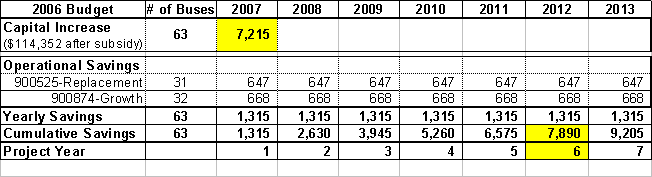
Document 2 demonstrates the predicted capital costs and operational savings where the per-bus life cycle saving has been calculated at $261,025. If the price of fuel increases above the expected average of 4% per annum, life cycle savings will increase accordingly.
A payback period of less than six years is estimated and is feasible for this technology with an 80 percent level of confidence that it will be between four and nine years.
Elements of Risk: The technological change to diesel-electric hybrid has risk elements that are considered LOW and manageable. Two financial risk elements have been defined at Document 3, of which one, the provincial transit bus subsidy program, has been rated as HIGH.
If no provincial subsidy is provided, the payback period will be extended to approximately 16 years. As per the FERS, the City will continue to identify and apply for other applicable provincial or federal subsidy programs
ENVIRONMENTAL IMPLICATIONS
Although long-range transport of air pollutants can contribute approximately 50 percent of the contaminants in Ottawa’s air, much of our air contaminants are generated locally and are within our control. Transportation is a major source of air pollution with burning of diesel fuel being a significant contibutor (as per the National Pollutant Release Inventory). Diesel emissions have been linked with numerous health problems. The health impacts from short exposure range from eye, throat and lung irritation to exacerbated asthma and pneumonia symptoms. Long-term health risks include decreased lung function, arrested lung development and cancer (US EPA, 2002). By implementing hybrid diesel technology for City buses as proposed in this report, a significant component of diesel combustion - particulate matter (PM) - and one of the most important identified carcinogens - polycyclic aromatic hydrocarbons (PAH) - would be significantly reduced to improve our local air quality.
In Ottawa, transportation is responsible for the following criteria air contaminants: 46 percent of particulate matter, 85 percent of the nitrogen oxides and 90 percent of the carbon monoxide. Although the transit buses' portion is less than three percent, it is highly visible and potentially most influential within the community. For 2007 alone, the proposed hybrid technology offers reductions in City bus emissions in particulate matter by 13 percent, NOx by two percent, and carbon monoxide by 66 percent, relative to conventional diesel. The particulate matter emission savings alone is estimated to be $85,777 in health and infrastructure costs. Greenhouse gases will be reduced to an amount equivalent to fuel saving, approximately 17 to 26 percent. For a fleet of 226 hybrid buses, an annual reduction of 6,500 to 10,000 tonnes of greenhouse gases is estimated -- equivalent to removing 850 to 1,350 commuting cars off the road every day.
Results of noise studies of the hybrid technology show that there is essentially no noise difference from conventional diesel buses. The hybrid buses were a litttle quieter during hard acceleration. For the most part, the environmental impact of noise will continue to be similar to conventional buses.
Adoption of hybrid technology into the City’s fleet will provide significant contributions to meeting Ottawa's commitments to maintain and enhance air quality and to reduce greenhouse gas emissions, as stated in the City of Ottawa Air Quality and Climate Change Management Plan approved by Council in January 2005. This will also demonstrate strong environmental leadership to other vehicle fleets within the community.
CONSULTATION
Since the FERS was approved in 2002, public information and consultation for the Hybrid Bus Implementation Program have been conducted at public venues. Informally, Fleet Services has contributed to a number of events celebrating green initiatives where public comments and perspectives on its initiatives have been expressed. Diesel-electric hybrid buses were showcased at events in October 2002 at the City’s Energy Efficiency Fair, the 2004 Car-free Day and most recently at the 2005 Earth Day and Eco-Stewardship Fair events. All indications are that hybrid buses are a welcomed emission reduction technology and tax-dollar worthy approach to improving City of Ottawa air quality.
City advisory committees have been engaged in reviewing the FERS and the hybrid bus project. The Environment Advisory Committee (EAC) supported the 2004 FERS update with a motion to support the updated strategy and its objectives. The EAC, along with the Pedestrian and Transit Advisory Committee (PTAC), have reviewed this report and each passed a motion in support of this report to Committee and Council to purchase diesel-electric hybrid technology.
The PTAC resolved that the Pedestrian and Transit Advisory Committee supports all City efforts to increase the modal shares of walking, cycling, and transit, and the acquisition of cost-effective, low-emission transit vehicles (including hybrid bus and light-rail transit).
The EAC resolved that the Environmental Advisory Committee fully supports the hybrid bus feasibility plan and recommends approval by Transportation Committee and Council.
FINANCIAL IMPLICATIONS
The financial impact of introducing hybrid buses is identified in the Long Range Financial Plan 2 (LRFP 2) for the 2006-2014 capital forecast, referred to capital programs 900525 – Revenue Bus Replacement, 900874 – New Buses, and 902996 - Hybrid Bus Implementation. Due to a revised forecast of the maximum cost of a hybrid bus, project funding exceeds the available envelopes identified in the LFRP 2 for these projects by $4.5 million for the 2006 budget envelope with similar impact for subsequent years: $5.3 million in 2007 and $4.7 million in 2008.
Under the existing Ontario Transit Vehicle Program, two thirds of the incremental cost of hybrid buses is eligible for provincial subsidy. This provincial funding has been announced annually since it was initiated in 2002. This funding, if continued at present level, would amount to $2.7 million, leaving an unfunded residual of $1.8 million in 2006; and in subsequent years, residuals of $2.1 million in 2007 and $1.6 million in 2008.
Other funding that qualifies to offset this residual for transit infrastructure investment will be available from the federal and provincial governments in the form of gas tax allocations and a recently announced new nation-wide allocation from the federal government of $800 million over the next two years. Of this 2005 and 2006 new funding, $40 million is expected for Ottawa, of which $5.5 million could be used to cover all the unfunded residual cost of the planned 226 diesel-electric hybrid bus fleet.
The impact of this project on future operating budgets would be an annual cost saving of about $20,860 per year per hybrid bus compared to a clean diesel bus. This cost saving provides an estimated payback period of less than six years on the initial incremental cost of the hybrid buses; Document 2 displays the payback analysis. These savings include the cost of maintaining additional batteries and the impact of an additional FTE required to implement and support this technology.
The Request For Proposals for this acquisition needs to be released in early December. The Purchasing By-law generally requires that funds can be found in appropriate accounts within Council approved branch estimates to meet the proposed expenditure before commencement of the purchasing process. To enable release of the RFP in early December before approval of the budget, Council will be required to exempt the RFP form the provisions of the City's Purchasing By-Law No. 50.
SUPPORTING DOCUMENTATION
Document 1 – Executive Summary of the NRC Evaluation of two 40-foot Diesel-electric Hybrid Urban Transit Buses, dated May 2005
Document 2 – Life Cycle Cost Analysis
Document 3 – Risk Management
Long Range Financial Plan 2, dated 08 December 2004 (City Web site at www.ottawa.ca/ inside_govt/financial/lrfp2/lrfp_en.shtml)
Air Quality and Climate Change Plan, dated December 02, 2004 (City Web site at www.ottawa.ca/calendar/ottawa/citycouncil/occ/2005/01-12/pec/ACS2004-DEV-POL-0063.htm)
Fleet Emission Reduction Strategy Update, dated May 17, 2004 (City Web site at www.ottawa.ca/calendar/ottawa/citycouncil/trc/2004/06-02/ACS2004-TUP-FLT-0001.htm)
Hybrid Bus Implementation Plan, dated September 08, 2003 (City Web site at www.ottawa.ca/calendar/ottawa/citycouncil/csedc/2003/09-16/ACS2003-CRS-FLT-0004.htm)
DISPOSITION
Based on Council’s direction to date and the interest expressed to improve Ottawa’s air quality and public health, the acquisition of diesel-electric hybrid buses provides environmental and economic benefits that confirm it as the centrepiece of the mid-term component of the City’s Fleet Emission Reduction Strategy. Should Council approve this report, Fleet Services will:
- proceed with phases 2 and 3 of the Hybrid Bus Implementation Plan (902996) by initiating the hybrid bus procurement process and implementing the structural and personnel changes required to introduce the new technology
- submit a project progress information report once every term of Council as part of the Fleet Emission Reduction Strategy updates
- conduct, with the support of Corporate Communications and PGM, a public information campaign for this program
DOCUMENT 1
NRC Evaluation of two 40-foot
Diesel-electric Hybrid Urban Transit Buses
EXECUTIVE SUMMARY
The Hybrid Bus Feasibility study was contracted by the City of Ottawa in the fall of 2004 to the National Research Council’s Centre for Surface and Transportation Technology (CSTT). The study was funded with assistance from the Green Municipal Enabling Fund, a Fund financed by the Government of Canada and administered by the Federation of Canadian Municipalities. CSTT provided an independent third-party evaluation of two commercially available hybrid bus systems, under winter conditions, for service on the Ottawa transit system network, which includes bus rapid transit in addition to congested inter city routes.
CSTT developed comprehensive performance tests and a simulated revenue service trial to assess the operating characteristics of two diesel-electric hybrid drive systems, and to compare these against existing City of Ottawa conventional diesel transit buses. The hybrid systems evaluated consisted of the two primary drive configurations currently marketed in North America, namely the parallel Electric Drive from Allison Transmission (a division of General Motors Corporation) and the series HybriDrive from BAE Systems.
The scope of the study included the life cycle cost of each hybrid technology over the expected 18-year life of the bus, which included the initial capital costs, infrastructure costs, maintenance and operating costs. Data used in this portion of the study originated from City of Ottawa operations (OC Transpo) and fleet maintenance data bases, and from transit operations in New York City and King County (namely Seattle). Further data used in this portion of the study were provided by Allison and BAE Systems about their respective hybrid drive systems.
Emissions tests were not carried out as part of this study primarily because the diesel engines used in the current study did not represent the latest diesel engine technology, which is expected to change again in 2007 to meet more stringent emissions requirements, known to be coming. Additionally, emissions and fuel economy tests, already completed by the Emissions Research and Measurements Division of Environment Canada, are representative of the diesel-electric hybrid buses evaluated in this study and of the relative effect of hybridization on tailpipe emissions. The Environment Canada test employed a heavy-duty chassis dynamometer and incorporated dilution tunnel technology for sampling and measuring vehicle exhaust, and was in accordance with SAE protocol J2711. The results of these tests are available in the public domain and are summarized in this report.
CSTT’s conclusions and recommendations are summarized below. They are very specific to Ottawa drive cycles as they existed at the time of the testing and based on the City of Ottawa’s current fleet, route network, bus allocation strategies and operational and maintenance principles and practices.
- Both diesel-electric hybrid systems meet the performance requirements to operate in the City of Ottawa.
- Both systems will achieve fuel economy improvements estimated at between 17% to 26%, if deployed in high-stop frequency and low-speed routes, such as routes 1, 2, 7, 14, 85 and peak service routes. Comparable percentage reductions in greenhouse gas emissions will be achieved on these same kinds of routes.
- Based on the results of the fuel burn test, CSTT has calculated that carbon dioxide emissions will be reduced from 29 to 44 tonnes per year for every hybrid bus introduced on high stop density and low speed routes in Ottawa.
- Neither of the hybrid systems evaluated in this study provided significant fuel savings on low-stop frequency and high-speed routes, such as test routes #95, 96 or rural express route 232.
- Certain new types of training are expected to be required for key OC Transpo staff directly involved with the operation and maintenance of the new hybrid systems. These include: regenerative braking skills for bus operators so that fuel economy is optimized under the different braking regimes employed by the hybrid systems and electrical system maintenance and safety for technicians working on the high voltage components of the hybrid propulsion system.
- Emissions tests of similar hybrid diesel-electric buses at Environment Canada indicate that significant emission reductions will be realized as a direct result of hybridization of diesel buses, which will be in addition to reductions resulting from improvements in diesel engine technology.
- Route testing showed that the bus industry common Central Business District (CBD) drive-cycle (maximum speed of 32 km/h, 14 stops in 10 minutes) closely approximates inter city, stop-and-go routes in Ottawa.
- Results from Environment Canada’s CBD tests indicated that reductions in fuel consumption and carbon dioxide emissions of up to 30% could be expected with the introduction of hybrid buses on City stop-and-go routes, which is in good agreement with the actual fuel burn testing completed during this study. Similarly, reductions in regulated tailpipe emissions, as a result of hybridization, of up to 90% for carbon monoxide and unburned hydrocarbons, 30% for oxides of nitrogen and 60% for particulate matter would be expected on the slow speed, inter-city routes.
- The hybrid buses were measured to be slightly quieter on the interior during hard accelerations, however, there were no significant differences in exterior noise signature among any of the buses.
- The life cycle cost analysis of the hybrid systems is characterized by a relatively high degree of uncertainty, because of sparse data due to limited operating experience of these systems to date. This is a common limitation in the evaluation of new technologies. The available data show that the life cycle costs of the two hybrid systems will be similar to each other, with the results currently indicating a slight cost advantage for the Allison drive. CSTT notes that the BAE and Allison maintenance data were gathered by two separate transit authorities.
- The results of the life cycle cost analysis indicates that the additional costs associated with the introduction of hybrid buses in Ottawa will be entirely offset, primarily because of improved fuel economy. Other factors such as reduced engine and brake maintenance costs -- resulting from reduced engine loading and regenerative braking – global increases in the price of diesel fuel and potential government subsidies would reduce the life cycle costs even further thereby making the conversion to a hybrid fleet even more cost-effective.
- For the purpose of testing, each of the test buses was loaded to its manufacturer’s printed gross vehicle weight. However, this resulted in all three test bus’ rear axles being overloaded, when compared to current MTO regulations. CSTT developed a simulation which illustrated that the rear axles of all three current generation test buses will be overloaded under many passenger loading conditions. The added weight of hybrid components does not significantly add to this overload.
· If hybrid buses are deployed on high stop density routes, both the Allison and BAE Systems propulsion units will meet the performance requirements stipulated by the City of Ottawa. The Allison hybrid system achieved slightly better performance results based on a series of tests performed on model year 2001 hybrid buses. Additionally, the Allison propulsion system employs a lighter energy storage system, displayed lower fuel consumption (albeit statistically not significant), lower predicted life cycle costs (based on limited historical data from other hybrid users) and does not require an external battery conditioning system. The Allison hybrid drive can presently be installed in 60-foot articulated buses that currently make up about 25% of the Ottawa transit bus fleet. The BAE Systems HybriDrive should be available in a 60 foot bus by 2010. The findings in this report have been formulated based on an assumption that OC Transpo will continue to purchase 40 foot and 60 foot buses beyond 2007. The series of tests used to form the conclusions and recommendations were tailored to the City of Ottawa’s unique routes, fleet and operational requirements at the time of testing. The results and recommendations may, or may not, be relevant to other jurisdictions throughout North America.
DOCUMENT 2
LIFE CYCLE COST ANALYSIS
(Cost per bus)
Capital | Clean diesel | | Hybrid | Increased cost/(savings) | | Life cycle cost for 226 buses |
Bus Costi (in 2006) | $506,500 | | $837,140ii | | | |
Subsidyiii (Ontario) | $(168,664) | | $(384,772) | | | |
| $337,836 | | $452,368 | $114,532 | | $25,884,232 |
| | | | | | |
| | | | | | |
Operations Cost | | | | | | |
18-year life (+1 FTE) | $2,346,681 | | $1,971,124 | ($375,557) | | ($84,875,882) |
| | | | | | |
| | | | | | |
Total Life Cycle Cost | | | | | | |
Capital and Operations | $2,684,517 | | $2,423,492 | ($261,025) | | ($58,991,876) |
Payback Analysis (cost in $000s)
Footnotes:
i basic bus is $506,500 (including PST, tires, inspection and contingency), Hybrid system adds $324,000
ii bus capital cost includes $6,640 per bus for hybrid-related infrastructure costs
iii subsidy is through MTO under the OTVP where the bus is subsidized at 33.3% and any additional capital for alternative emission reduction system is subsidized at 66.7% - subject to annual renewal
DOCUMENT 3
RISK MANAGEMENT
Risk Element | | Mitigating Strategy |
1 - Government of Ontario cancels its subsidization programs | HIGH | In this case, the business case predicts a payback period of 16 years with an 80% level of confidence that it will be between 10 and 18 years. As per the FERS, City will continue to identify and apply for other applicable provincial or federal subsidy programs. |
2 – Predicted life cycle costs are off-the-mark due to the ‘soft’ nature of the data obtained on the hybrid systems | LOW | Inclusive in the 902996 Hybrid Bus Implementation Program is Phase 4 that will serve to validate life cycle cost predictions after two years of in-service data of the first procurement of 68 buses. |