
Budget 2006 – Information on Budget reductions and Service Delivery Improvements/Overtime Savings targets
Report to/Rapport au :
Council / au Conseil
20 February 2006 / le 20 février 2006
Submitted by/Soumis par : Kent Kirkpatrick, City Manager/Directeur des services municipaux
Contact Person/Personne ressource : Leslie Donnelly, Manager, Policy Coordination and Outreach / Gestionnaire de coordination politiques et accès
(613) 580-2424 x28857, Leslie.Donnelly@ottawa.ca
REPORT RECOMMENDATIONS
1) That City Council receive for information the following budgetary updates: the inflation reductions; the promotional materials/postage reductions; the approach to overtime and service delivery improvements; the savings targets; and all compensation reductions except for those identified as "direct service delivery impacts"; and
2) That City Council consider funding on a one-time basis the following "direct service delivery impacts" from the $5 million set aside in a reserve fund during the 2006 Budget for this purpose:
a. The Parkticipate Program ($10,259);
b. The “Busy Kids” program at the Walter Baker Recreation Complex ($12,242);
c. The Baribeau/Iona/Harold wading pools ($27,911);
d. The staff positions at the Glebe and McNabb Community Centres ($127,434);
e. The indoor skate parks at McNabb and Stittsville Arenas ($44,187);
f. The Forester for the urban canopy ($81,646);
g. Shrub maintenance in planters and along roadsides ($55,200); and
h. Transit hours on those routes that do not meet Council-approved performance standards ($206,230).
RECOMMANDATIONS DU RAPPORT
- Que le Conseil municipal reçoive à titre d’information les mises à jour budgétaires suivantes : les réductions de l'inflation, les réductions du budget alloué au matériel promotionnel et aux frais postaux, l'approche relative aux améliorations de la prestation des services et des heures supplémentaires; les objectifs d’économies et toutes les réductions de salaires à l'exception de celles identifiées comme étant des « impacts directs sur la prestation des services »; et
- Que le Conseil municipal étudie la possibilité d’un financement non renouvelable des « impacts directs sur la prestation des services » suivants à partir des 5 millions de dollars mis de côté dans un fonds de réserve lors de l'établissement du budget de 2006 et prévus à cet effet :
- Le programme Parkticipate (10 259$);
- Le programme En mouvement au Complexe récréatif Walter-Baker (12 242$);
- Les pataugeoires Baribeau/Iona/Harold (27 911 $);
- Les postes fonctionnels aux Centres communautaires Glebe et McNabb (127 434 $);
- Les terrains de planches à roulettes intérieurs situés dans les arénas McNabb et Stittsville (44 187 $);
- L’expert-forestier pour le couvert urbain (81 646 $);
- L’entretien des arbustes dans les jardinières et en bordure des routes (55 200 $); et
- Les heures de transport en commun sur ces routes qui ne répondent pas aux normes de rendement approuvées par le Conseil (206 230 $).
EXECUTIVE SUMMARY
Assumptions and Analysis:
On December 20, 2005, City Council approved a 2006 Budget that included a $10 million reduction to the compensation budget, the removal of the $3.9 million provision for general inflation and a $300,000 reduction to promotional materials and postage. They also approved a reduction of $7 million to the capital budget. In addition, City Council increased the savings target from service delivery improvements from $13.9 million to $14.9 million, and added a further reduction target of $3.5 million of City spending on overtime.
At the time these reductions were approved, City staff indicated that the compensation reductions would be the most challenging because cuts to staff represent cuts to service. It was further noted that, given the magnitude of reductions achieved from 2001-2005 (over $107 million) from amalgamation savings, internal service reductions and service delivery improvements, it was not going to be possible to remove $10 million in compensation without affecting front-line services in some way.
City Council determined that City staff was best positioned to determine how and where compensation could be reduced in areas “that will have the least impact on front line City services”. Council further directed that staff report on the compensation reductions and their impact to Council in February.
The specific motion directed staff to reduce compensation costs by examining vacant positions within the City of Ottawa. The assumption was that staff would have the ability to cut a portion of the positions that were vacant in December, provided there would be minimal impact on the delivery of City services. As staff indicated when the motion was presented, the process of analyzing overall vacancies at the City at any point in time is quite complex and a number of factors must be taken into account. Therefore, in order to understand the compensation reductions that have been taken by staff to meet the $10 million reduction requirement, it is important to first understand what a vacancy is and how the City works with vacancies to make sure that the City does not tax more than it needs for compensation. The report provides that information and shows why most but not all of the compensation reductions presented come from vacancies.
Overall, the majority of the compensation reductions will be made with minimal impact to service on the street. For most residents and businesses, the changes will be experienced as longer response times for some services and small reductions in hours for other services. There are a few reductions that involve the elimination of programs that have declining participation, programs that are enhanced levels of service for one part of the city and reductions of hours on transit routes that do not meet City Council’s approved performance standards. Although these reductions will meet Council’s target, staff are aware that those reductions may be of concern to some members of Council. Those few have been highlighted, and could be funded one-time from the $5 million that Council set aside during the 2006 budget to offset the impacts of service reductions.
This report provides not only the information on the compensation reductions, but also on the reductions to inflation, promotional materials and postage, and the capital program. It also outlines the approach the City will be taking to the savings targets from overtime and service delivery improvements.
The inflation reductions will be absorbed within most operations in such a way that they will not affect existing levels of service to the public, and the promotional materials and postage reductions will not necessarily affect the amount of information that goes out to the public, but will likely change ways in which that information is delivered. The Long Range Financial Planning (LRFP) Sub-Committee will review the $7 million reduction to the capital budget in March, after staff finalizes the development of a number of different ways that could be used to achieve this objective.
Although the public should not notice any major changes in the services they currently receive, there is a larger impact that Council and the public need to understand – namely that staff was able to achieve these reductions with minimal impact to the public by eliminating all flexibility within day-to-day operations. This means that staff will only be able to deliver those programs and services that have been budgeted and planned for. There is no longer any capacity to deal with the unexpected and unforeseen or any ability to take advantage of new opportunities. Any new expenditure requests for 2006 will need to be dealt with as an increase to base budgets, be debated and approved by City Council on the understanding that funding would have to come either from further reducing existing programs or provided as one-time funding from reserves and added to 2007 budget pressures.
In addition, these reductions will have a direct impact on the City’s capacity to achieve the full overtime and service delivery improvements targets. Although the overtime review will clearly identify the City’s non-discretionary overtime needs and discretionary overtime spending, it is also anticipated that the magnitude of the compensation reductions will add additional pressure to overtime budgets as departments will have few other options with which to address service delivery pressures that result from normal operating vacancies. This will be factored into the review, but may influence the City’s capacity to meet the 2006 target. As well, a number of the compensation reductions were achieved through operational efficiencies that were already underway and that would have been included as part of the service delivery improvements target. While managers will continue to look through their own operations for opportunities for savings, most of these will be on a smaller scale, as was identified in the Update on the Opportunity Log/2005 Service Delivery Improvements Target and approach to future savings (ACS2005-CRS-OCM-0003) and it is unlikely that any significant additional savings will be able to be achieved outside of the focussed approach of the Branch Process Review Program. As was indicated in the Opportunity Log and budget reports, any savings targets not achieved in a given year will be rolled over into the next.
Finally, it should be noted that the compensation reductions presented place a priority on retaining existing staff. The proposed reductions represent about 127 FTE's, about 30 positions of which have incumbents. Workforce adjustment provisions will be put in place and it is the City’s goal to find employment for all of the affected employees elsewhere in the corporation.
Financial Implications:
These reductions will lead to some adjustments in other line items, but these cannot be quantified at this time. It is expected that most of the adjustments will be minor, and will likely net out (for example, the lost revenues from reducing transit hours on the non-performing routes would be offset by the savings in fuel and supplies). Any workforce adjustment payments that may be required will be funded from reserves.
Should City Council determine that they would like to reinstate any of the compensation reductions through the use of the $5 million reserve fund set aside during the 2006 Budget, that these are one-time funds and that the reinstatements would become additional budget pressures for 2007.
Public Consultation/Input:
These reductions were delegated by City Council to City staff and there were, therefore, no public consultations.
RÉSUMÉ
Hypothèses et analyse :
Le 20 décembre 2005, le Conseil municipal a approuvé un budget pour 2006 qui comporte une réduction de 10 millions de dollars du budget de la rémunération, le retrait de la provision de 3,9 millions de dollars pour l'inflation générale et une réduction de 300 000 dollars du budget alloué au matériel promotionnel et aux frais postaux. Les conseillers ont aussi approuvé une réduction de 7 millions de dollars du budget d’immobilisations. De plus, le Conseil municipal a fait passer l'objectif d'économies de l'amélioration de la prestation des services de 13,9 millions de dollars à 14,9 millions de dollars et a ajouté un objectif de réduction additionnel de 3,5 millions de dollars que la Ville paie en heures supplémentaires.
Lorsque ces réductions ont été approuvées, le personnel de la Ville a indiqué que les réductions de salaires seraient les plus redoutables à gérer parce que couper dans le personnel représente une diminution dans les services. De plus, il a été noté que, compte tenu de l'importance des réductions réalisées entre 2001 et 2005 (plus de 107 millions de dollars) grâce aux économies attribuables à la fusion, aux réductions de service interne et à l'amélioration de la prestation des services, il ne serait plus possible de soustraire 10 millions de dollars en rémunération sans, d'une certaine façon, avoir une incidence sur les services de première ligne.
Le Conseil municipal a déterminé que le personnel de la Ville était bien placé pour déterminer comment et où la rémunération pourrait être réduite dans les secteurs qui « auront le moins de répercussions sur les services de première ligne de la Ville ». De plus, le Conseil a demandé que le rapport du personnel sur les réductions de salaires et leurs répercussions soit remis au Conseil en février.
La motion spécifique requérait que le personnel réduise les coûts de rémunération en examinant les postes vacants au sein de la Ville d'Ottawa. L'hypothèse était que le personnel aurait la capacité de réduire une partie des postes qui étaient vacants en décembre pourvu qu'il y ait un minimum d'impacts sur la prestation des services de la Ville. Comme le personnel l'a indiqué lorsque la motion a été présentée, le processus d'analyse de l'ensemble des postes vacants à la Ville, à un moment donné, est quelque peu compliqué et il faut tenir compte de bon nombre de facteurs. C'est pourquoi, pour comprendre les réductions de salaires qui ont été prises par le personnel afin de satisfaire à l'exigence demandant une réduction de 10 millions de dollars, il est important de comprendre en premier lieu ce qu'est un poste vacant et comment la Ville fait face aux postes vacants afin de s'assurer qu'elle n'impose pas plus que ce qui est nécessaire pour la rémunération. Le rapport fournit ces informations et indique pourquoi la plupart des réductions de salaires présentées proviennent des postes vacants.
Dans l'ensemble, la majorité des réductions de salaires auront un minium d'impact sur les services offerts sur la rue. Pour la plupart des résidents et des entreprises, les changements se feront sentir par des temps de réponse plus longs pour certains services et par de petites réductions dans les heures d'autres services. Il y a quelques réductions qui impliquent l'élimination de programmes qui présentent une baisse de la participation, de programmes qui présentent un niveau de service supérieur pour une partie de la Ville et des réductions du nombre d'heures sur certains circuits de transport en commun qui ne satisfont pas aux normes de rendement approuvées par le Conseil municipal. Bien que ces réductions satisferont l'objectif du Conseil, le personnel est conscient qu’elles peuvent soulever des inquiétudes auprès de certains membres du Conseil. Ces réductions en question ont été soulignées et peuvent recevoir un financement non renouvelable qui proviendra de la contribution de 5 millions de dollars que le Conseil a mis de côté durant le budget de 2006 afin de compenser les impacts sur la prestation de service.
Ce rapport fournit non seulement l'information sur les réductions de salaires, mais aussi sur les réductions de l'inflation, du budget alloué au matériel promotionnel et aux frais postaux et sur le programme d’immobilisations. Il présente aussi l'approche que la Ville adoptera envers les objectifs d'économies relativement à l'amélioration de la prestation des services et des heures supplémentaires.
Les réductions de l'inflation seront absorbées par la plupart des opérations de telle façon qu'elles n'affecteront pas les niveaux de services actuellement offerts à la population. Les réductions du budget alloué au matériel promotionnel et aux frais postaux n'affecteront pas nécessairement la quantité d'information qui est transmise à la population mais changeront les façons dont l’information est acheminée. Le sous-comité de la Planification financière à long terme (PFLT) se penchera sur la réduction de 7 millions de dollars du budget d’immobilisations au mois de mars une fois que le personnel aura finalisé l'élaboration de plusieurs façons qui pourraient être utilisées pour atteindre cet objectif.
Bien que la population ne devrait pas ressentir de changements majeurs dans les services qu'elle reçoit présentement, il y a un impact important que le Conseil et la population doivent comprendre, à savoir que le personnel a été capable d'atteindre ces réductions avec des impacts minimes sur la population en éliminant toutes les flexibilités dans les opérations quotidiennes. Cela signifie que le personnel ne pourra offrir que les programmes et services qui auront été projetés et prévus. La capacité de faire face à l'inattendu et à l'imprévu n’existe plus, ni l’habilité de tirer avantage de nouvelles possibilités. Toutes les nouvelles demandes de dépenses pour 2006 devront être traitées comme étant une augmentation aux budgets de base. Elles devront être débattues et le Conseil municipal devra les approuver sur la compréhension que le financement devra provenir soit d'autres réductions de programmes actuels, soit d'un financement non renouvelable provenant des réserves et devra être ajouté aux pressions budgétaires de 2007.
De plus, ces réductions auront un impact direct sur la capacité de la Ville à atteindre entièrement les objectifs d'amélioration de la prestation des services et des heures supplémentaires. Bien que l'examen des heures supplémentaires identifiera clairement les besoins non discrétionnaires et les dépenses discrétionnaires en heures supplémentaires de la Ville, il est aussi prévu que l'importance des réductions de salaires ajoutera des pressions additionnelles aux budgets des heures supplémentaires puisque les services auront peu d'options avec lesquelles ils pourront répondre aux pressions de la prestation des services qui résultent des postes vacants normaux. Cela sera pris en compte dans l'examen mais pourra influencer la capacité de la Ville à atteindre l'objectif de 2006. De plus, un certain nombre de réductions de salaires ont été réalisées par le biais d'efficacités opérationnelles qui étaient déjà en cours et qui auraient été incluses en tant qu'élément de l'objectif d'amélioration de la prestation des services. Tandis que les gestionnaires continueront d'examiner leurs propres activités pour rechercher des occasions d'épargner, la plupart de ces dernières se feront à plus petite échelle tel qu’il en a été fait mention dans la mise à jour du Registre des occasions dégagées (inscription) et il est peu probable que toute économie additionnelle importante pourra être atteinte en dehors de l'approche du Programme d’examen des processus en vigueur dans les directions sur laquelle l'accent a été mis. Tel que cela a été présenté dans le Registre des occasions dégagées et dans les rapports budgétaires, tous les objectifs d'économies non atteints dans une année donnée seront reportés à l’année suivante.
Finalement, il faut noter que les réductions de salaires présentées mettent une priorité sur la conservation du personnel actuel. Les réductions proposées représentent environ 127 ÉTP parmi lesquels environ 30 sont des postes titulaires. Des dispositions sur le réaménagement de l'effectif seront mises en vigueur et la Ville a pour objectif de trouver de nouveaux postes au sein de la Ville pour tous les employés affectés par ce réaménagement.
Répercussions financières :
Ces réductions mèneront à des rajustements dans d'autres articles, mais ceux-ci ne peuvent être quantifiés à ce moment. Il est prévu que la plupart des rajustements seront mineurs et qu'ils seront probablement déduits (par exemple, la perte de revenus provenant de la réduction des heures du transport en commun sur les circuits non rentables sera compensée par l'économie en carburant et en fournitures). Tous les paiements de rajustement aux effectifs qui seront nécessaires seront financés à partir des réserves.
Il est à noter que, si le Conseil municipal détermine qu'il aimerait rétablir toute réduction de salaire par le biais de l'utilisation du fonds de réserve de 5 millions de dollars mis de côté durant le budget de 2006, il s'agit de fonds non renouvelables et les rétablissements deviendraient des pressions budgétaires additionnelles pour 2007.
Consultation publique / commentaires :
Ces réductions ont été déléguées par le Conseil municipal au personnel de la Ville, et par conséquent, aucune consultation publique n'a été tenue.
BACKGROUND
During the 2006 Budget debate, City Council approved several motions that directed ‘across the board’ cuts to specific line items, rather than targeted reductions to services.
These motions were:
MOTION NO. 47/10
WHEREAS there are 782 vacant FTE positions for a compensation surplus of $18 million;
AND WHEREAS approximately 300 positions are in the process of being staffed, thereby leaving 60% of the vacant positions unfilled;
THEREFORE BE IT RESOLVED that Council apply $10 million of the compensation surplus to offset the 2006 budget shortfall, excluding emergency services.
MOTION NO. 47/11
That the Rules of Procedure be waived to consider and approve the following:
WHEREAS staff will need maximum flexibility to remove $10 million from compensation with the least possible impact on front-line services;
AND WHEREAS not all expenses within the emergency services are directly related to the provision of front-line services;
THEREFORE BE IT RESOLVED that all City departments, with no exemptions, be included in the search for the reductions that will have the least impact on front-line City services.
MOTION NO. 47/82
WHEREAS it is incumbent upon the Corporation of the City of Ottawa, its Elected Officials and its Senior management staff to ensure that the City is managed effectively, efficiently and cost effectively;
THEREFORE BE IT RESOLVED that:
a) the overtime budget in the Operating Budget 2006 be reduced by $3.5 million;
b) the MPE bonus component of the Performance Pay program be suspended for 2006 (approximately $500,000);
c) the 2% inflationary increase be eliminated in 2006 for a cost savings of $3.9 million; and
d) the envelope for promotional materials and postage in the 2006 Operating budget be reduced by $300,000.
MOTION NO. 47/83
BE IT THEREFORE RESOLVED that Council delegate to the LRFP Sub-Committee the authority to review the funding of the Capital program by identifying and substituting $7 million through spending reductions, including review of consulting costs, alternate revenue sources and/or other funding methods.
Because the dollar values associated with these general motions were so significant, and it was clear that there would be some level of service reductions associated with the implementation of these reductions, City Council also approved the following:
MOTION NO. 47/96
WHEREAS City Council is applying a combination of new efficiencies, investments, user fees, service reductions and taxes to balance the 2006 Budget;
AND WHEREAS municipalities throughout Ontario – and across Canada – are struggling to keep up with rising costs associated with inflation, new growth, employee compensation and responsibilities downloaded from other levels of government;
AND WHEREAS as part of the decision-making process City Council directed staff to “apply $10 million of the compensation surplus to offset the 2006 budget shortfall”;
AND WHEREAS this $10 million savings target is in addition to other savings and efficiencies established by City Council;
AND WHEREAS the City Manager advised City Council that, despite concerted mitigation efforts, the achievement of this additional savings target will compromise the delivery of services;
AND WHEREAS City Council is committed to accountability and transparency regarding its financial challenges, including the benefits and consequences of approving particular savings and efficiency targets while balancing the budget;
THEREFORE BE IT RESOLVED that the City Manager provide to City Council an information report on the implementation of the aforementioned savings target no later than the end of February 2006.
This report provides not only the information on the compensation reductions, but also on the reductions to inflation, promotional materials and postage, and the capital program. It also outlines the approach the City will be taking on the savings targets from overtime and service delivery improvements.
DISCUSSION
When City Council approved the preceding 2006 Budget motions for a $10 million reduction to the compensation budget, the removal of the $3.9 million provision for general inflation, a $300,000 reduction to promotional materials and postage, and a reduction of $7 million to the capital budget, Council also increased the savings target from service delivery improvements from $13.9 million to $14.9 million, and added a further reduction target of $3.5 million of City spending on overtime.
At that time, staff indicated that, given the magnitude of reductions achieved from 2001-2005 (over $107 million) from amalgamation savings, internal service reductions and service delivery improvements, it was not going to be possible to achieve all of those reductions without affecting front-line services in some way, although it was equally clear that all reductions would be applied with maintaining existing front-line services as much as possible as the first criteria.
Overall, this report will indicate that the majority of the reductions to compensation, inflation and promotional materials and publications will not involve changes to front-line services at all. For those that do involve reductions to external services, most residents and businesses will experience the changes as longer response times for some services, changes in programming for a few services and reductions in hours for other services.
There are a very few reductions that would involve the elimination of programs that have declining participation, programs that are enhanced levels of service for one part of the city and reductions of hours on transit routes that do not meet City Council’s approved performance standards. Although these reductions are needed to meet Council’s target, staff are aware that those particular reductions may be of concern to some members of Council. Those have been highlighted, and could be funded one-time from the $5 million that Council set aside during the 2006 budget to offset the impacts of service reductions.
It is important to understand that staff was able to achieve the reductions with minimal impact to the public only by eliminating all flexibility within day-to-day operations. This means that staff will in future only be able to deliver those programs and services that have been budgeted and planned for. There is no longer any capacity to deal with the unexpected and unforeseen or any ability to take advantage of new opportunities. New expenditure requests for 2006 will need to be dealt with as an increase to base budgets, be debated and approved by City Council on the understanding that funding would have to come either from further reducing existing programs or provided as one-time funding from reserves and added to 2007 budget pressures.
The following sections will provide an overview of the approach taken to each area of reduction and identify the major impacts that accompany them.
Motion 47/10: $10 million reduction to the compensation envelope
Council Motion No. 47/10 directed staff to reduce $10,000,000 in compensation costs by examining vacant positions within the City of Ottawa. The motion makes specific reference to the fact that there were approximately 782 vacancies in mid-December 2005. About 300 of those positions were in the process of being filled at that time. The assumption was that staff would have the ability to cut some positions on the remainder of the list, provided there would be minimal impact on the delivery of City services.
As staff indicated when the motion was presented, however, the process of analyzing overall vacancies at the City at any point in time is quite complex and a number of factors must be taken into account. Therefore, in order to understand the compensation reductions that have been taken by staff to meet the $10 million reduction requirement, it is important to first understand what a vacancy is and how the City works with vacancies to make sure that the City does not tax more than it needs for compensation.
Understanding Vacancies
As was explained in the City’s Human Resources Plan, Full-Time Equivalents (FTEs) are permanent positions in the City that must be approved by Council. Only Council has the authority to adjust the overall FTE count. City management is responsible for the administration of FTEs and the appropriate classification and union affiliation of positions associated with these FTEs. The position(s) associated with an FTE may be changed or deleted and replaced by other positions provided the overall FTE count does not change. There can be multiple part-time or seasonal positions associated with one FTE, as in the case of part-time recreation staff or seasonal workers in Surface Operations.
The City’s first Human Resources Plan, released in late 2005, shows the breakdown and history of FTE changes since amalgamation in 2001. As of December 31, 2005, the City had 13,128 approved FTEs (including Police), which results in between 15,000 to 17,000 individual employees over the course of the year.
A vacancy refers to the lack of an incumbent in a position associated with an FTE or partial FTE. Vacancies are created for a number of reasons:
· A new position approved by Council has been created in the system but has yet to be staffed;
· The current incumbent in a position leaves the Corporation (an individual retires, resigns or is terminated);
· The current incumbent in a position leaves his/her position and takes a temporary or permanent position in another position at the City of Ottawa;
· The current incumbent in a position goes on Long Term Disability, parental leave, or takes an authorized leave of absence;
Employees are assigned permanently to vacant positions through competition or appointment, and are subsequently termed the incumbent or “owner” of the position. This means that the position becomes his/her substantive position within the organization until the employee wins a competition for a different position, is placed in another position on a permanent basis, or voluntarily or involuntarily terminates employment with the City.
In the course of a typical year, the City experiences a continuous turnover in positions. Setting aside significant seasonal turnover rate, the nominal turnover rate for positions is about 100 per month. In 2005, employees left the City based on the following distribution:
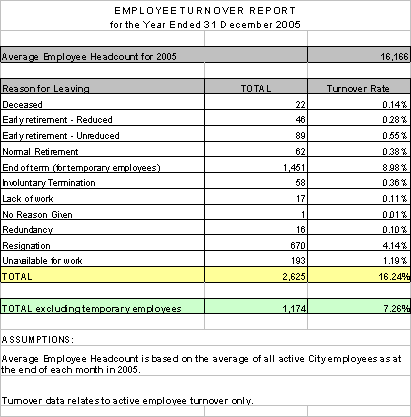
While on a month-by-month basis the number of vacancies at the City changes, the overall FTE count does not change unless Council approves a report that includes a change to the total number of FTEs. The head count – the number of employees on the Payroll – changes significantly from month to month due to the seasonal nature of many positions, and the net of the number of people who leave employment with the City versus those who start their employment with the City in that month. As well, the total number of vacant positions changes each month, as do the types of positions that will be vacant.
In 2005, for example, 2,625 employees left the employment of the City. The headcount in 2005 varied from a low of 15,540 employees in January, to a high of 17,097 employees in July.
A large number of vacancies result from statutory requirements such as parental and maternity leave, extended absence due to long term disability, and approved leaves of absences. In these cases, the position appears as a vacancy within the system, but the position remains the substantive position of its owner. Under normal circumstances, someone is assigned to a temporary position to backfill the vacant position and the temporary backfill is linked to the vacant FTE. The position being backfilled is still listed as vacant because there is a substantive owner of the position. These positions must also be accounted for in any analysis of vacancies.
Furthermore, where many positions make up one FTE, any of these positions could be vacant within the system.
In addition, vacancies are also held to meet departments’ budgeted gapping provision.
Understanding Gapping
As was identified in the previous section, the analysis of vacancies must also take into account the provision for “gapping” that exists in the City’s budget. Gapping is a concept that recognizes that an organization the size of the City will experience employee turnover over the normal course of the year and the process of filling positions leaves “gaps” between the time an incumbent leaves a position and the time a new incumbent enters a position.
Because there is the potential for compensation savings each time there is a gap, and because the City does not want to overtax for compensation, a dollar value for these gaps is included in the budgets for City operations. This recognition is called a “gapping provision”.
Forecasting, assessing and managing gapping provisions is a complicated process due to the number of factors that can influence the amount of gapping that can reasonably be achieved over the course of the fiscal year. Specifically:
- There may be the need for overtime by other staff to cover-off the duties normally performed in the vacated position;
- Managers may need to assign a short term temporary back-fill to the position while a competition is underway;
- Managers may choose to backfill a vacancy with a temporary, lower level position which generates gapping due to the difference in compensation between the two positions;
- Managers may need to keep a position vacant the entire year where the turnover rate is very low in order to achieve their gapping provision;
- Managers can also hold a position vacant and create a temporary position in another area to deal with workload issues elsewhere in their unit;
- There are strict requirements within the collective agreements around posting vacant positions;
- There may be a requirement to conduct an external competition once an internal competition fails to result in a suitable candidate;
- Market conditions that can influence how long it takes to fill certain positions;
- Unusually high numbers of vacancies result in delays in the staffing process;
- There may be little or no turnover in the work group resulting in little or no gapping.
Managers monitor their actual compensation expenditures and compare this to their gapping provision and determine how they will achieve a balanced compensation budget.
Budgeting for gapping means that the overall compensation requirement in the budget is reduced. However, it also requires more work by the manager and careful scrutiny of vacancies in order to ensure that service levels to the public are not impacted, because gapping also removes the normal cushion of flexibility within the compensation budget to deal with the unforeseen. It should be noted that the City has not traditionally assigned gapping targets to its 24/7 operations, as these savings are very difficult to manage and achieve because of the unpredictability of workload and where employees in wage positions routinely move between positions depending on workload requirements.
The 2006 gapping provision at the City is budgeted at $9.1 Million. The total gapping provision in the budget is the equivalent of about 144 FTEs or about 1.4 FTE per each 100 FTEs at the City.
In practice, this means that the total of all of the “gaps” from all the vacant positions over the course of the year would have to add up to an equivalent average of about 144 full time positions throughout the year. Having an average vacancy rate of fewer than 144 FTEs throughout the year will result in a deficit in the compensation budget.
A typical internal competition takes about 56 days, and an external competition increases this to about 100 days. Therefore each vacant position generates up to about two months’ worth of gapping (less any backfill costs, or overtime expenses incurred to cover-off the duties performed by the position). In a best-case scenario, a minimum of 870 positions must go vacant over the course of the year in order to meet the overall corporate gapping provision. In practice the number is much higher.
Since gapping accumulates at different rates throughout the year, it is not appropriate to simply subtract 144 vacant positions from a current list of vacancies in order to ensure that the gapping requirements will be met in 2006. Instead, managers monitor their vacancies against their gapping targets and determine how best to achieve them while taking into consideration the influencing factors listed above.
The December Vacancy Report and the $10 Million Compensation Reduction
In order to meet City Council’s direction, staff examined the vacancies as of January 31, 2006 to determine how many of them were true vacancies – that is, positions with no owner and where there was no temporary backfill or where it is not needed to contribute to gapping requirements.
As of January 31, 2006 there were 746.44 vacant FTE. Of these, 179.56 had a substantive owner and 380.53 were vacant due to reasons such as staffing actions in process or backfilling by temporary employees. A further 73.11 were held vacant for gapping requirements, leaving 113.24 as true vacancies.
Senior management has assessed these positions against the requirements of Motion 47/10 and identified which vacancies could be used to achieve Council’s $10 million compensation reduction with the least possible effect on front-line services.
Summary of $10 Million Reductions to Compensation
As was indicated earlier, the majority of the reductions to compensation do not involve any changes to front-line services. Of the $10 million in cuts, approximately 20% are internal service reductions and 45% are efficiencies.
Approximately 30% are minor reductions to external services. Most residents and businesses will experience these changes as longer response times for some services, changes in programming for a few services and reductions in hours for other services.
There are a very few reductions - about 5% of the total - that would involve the elimination of programs that have declining participation, programs that are enhanced levels of service for one part of the city or reductions of hours on transit routes that do not meet City Council’s approved performance standards. Although these reductions are needed to meet Council’s target and they are not reductions with a city-wide impact, staff are aware that they may be of concern to some members of Council. Those have been highlighted, and could be funded one-time from the $5 million set aside during the 2006 budget to offset service reduction impacts.
Specific highlights of each area are summarized below. Details by department can be found in Appendix 1.
Internal Service Reductions
Most of the internal service reductions involve smaller scale inconveniences and longer turnaround times. These kinds of reductions include longer turnaround times for Print shop copying during the summer months, no cover-off for the Councillors’ reception area during the summer months, longer response times for inquiries and reduced capacity for strategic initiatives in the City Manager’s, Chief Corporate Services Officer’s and Deputy City Managers’ offices, reduced inspection, administration and technical support to some infrastructure services capital projects, an inability to deal with ad hoc requests for performance measures, delays in implementing training programs, and a reduced capacity to deliver electronic records management software to departments.
Some internal reductions, however, will have a more significant internal impact, particularly those reductions to Information Technology Services. There will be delays for new IT projects relating to the Call Centre Agent tool, the 2007 Budget book, and for analytical reporting projects for Building Services, Employment and Financial Assistance and Traffic Planning. As well, there will be slower migrations to new technologies and critical systems will have to be kept in production even when no longer supported by the vendor.
Efficiencies
There are two main types of efficiency reductions. The first are those where staff is managing the existing workload by doing things differently so that fewer resources are needed. While these would normally be included as part of the City’s annual contribution to savings from service delivery improvements, they are being included as part of this exercise so that the reduction to the compensation envelope can be achieved with minimal effects to front-line services.
The efficiencies include those that will be realized due to the Fuel Standardization project, internal organization changes related to the operation of Pretoria Bridge, adjusting resources in Ottawa’s Long Term Care facilities to match the need based on the provincial Case Mix Index, the consolidation of public skating programs and hours and the implementation of unsupervised skating sessions, transferring leadership of the hoarding coalition to community partners, redistributing Ontario Works caseloads, restructuring circulation services and introducing debt collection systems in the Library, and redeploying a number of resources due to process, internal realignment and technology efficiencies in RPAM.
The second is the introduction of gapping provisions to the 24/7 operations that have been previously exempted, specifically for Fire, Paramedics and Transit. As was noted earlier, gapping is particularly challenging to manage in areas where workload demands are unpredictable and staff must be on the street providing service at all times no matter what the circumstances, even if that means overtime must be used. Gapping provisions were not previously assigned in recognition of the special circumstances faced by these operations. After a careful review of the history of gapping in each area, staff has determined the level of gapping that can be assigned to these services without affecting front-line services.
For instance, in the past, vacancies in staffing at Fire have provided the flexibility needed to cover sick leave and overtime at the Fire Department. The reduction in the Fire budget will come from the vacancies’ compensation that previously covered sick leave and overtime. By introducing a gapping provision, the Fire Department will need to closely monitor and manage expenditures for sick leave, overtime, WSIB, etc. to ensure that costs can and will be covered throughout the year.
The Paramedic program also used vacancies to fund their overtime and sick leave costs. As with Fire, the gapping provision will require that the expenditure of sick leave, overtime, and other benefits be carefully monitored and managed throughout the year.
The same is true for Transit Services. In addition, the gapping provision has been increased in RPAM because over 50% of their property management services are outsourced, and increased gapping will provide RPAM with the most flexibility in offsetting the vacancy provision against contracted services, thereby minimizing the use of overtime.
Minor reductions to Front-line Services
Again, although it was clear at the time the reductions to compensation were approved that it was not going to be possible to remove $10 million in compensation without affecting front-line services in some way, City staff worked hard to make sure that any reductions to these services would be minimal. While some individuals may be inconvenienced by these reductions, no services are eliminated and generally services are reduced only along the edges.
The impacts of these reductions include increased wait times for the City’s Call Centre, the Tax Information line and the Client Service Centres and delays in posting Committee and Council Agendas to the website, the decentralization of the Commemorative Naming Program, increased response times for parking enforcement, and slightly increased timelines for development application approvals and delays in responding to inquiries.
In addition, front desk hours will be reduced at all 30 of the City’s recreational facilities by 3 hours per week based on programming and demand, the City’s beaches will open 1 week later, and hours will be reduced at the Cumberland and Gloucester Art Galleries and at Arts Court. The City-run museums will not have a marketing/outreach program and the summer Community Arts program will be redesigned, with the City exploring the feasibility of providing a community arts program via community partnerships. Public health education for elementary schools will be slightly reduced, as will tobacco prevention education for secondary students. There is also a reduction to dental health education for at-risk elementary school children.
As well, there will be slight reductions to the City’s capacity to implement the 2006 Infrastructure Services capital program, reductions to the numbers of inspections of bridges, culverts, transit facilities and retaining walls, a reduced complement to manage growth in parks, sports fields, forestry and urban roads, reduced capacity to undertake certain components of area traffic management studies; transportation demand management; traffic safety investigations; traffic control signal transportation systems management reviews; cycling and pedestrian policy; and some of the crossing guard program will be delayed from May to September. Capacity will also be slightly reduced in the following program areas: water quality testing, sewer use program, surface water quality monitoring, sewer lateral investigations and data entry, meter change-out program, pipe locating, investigation and undertaking small scale water system operational improvements. The reductions include reduced hours for summer and co-op students to supplement full-time staff during peak workload periods.
Service reductions with Direct Service Impact
While staff was able to meet $9.5 million of City Council’s compensation reductions without significant reductions to services to the public, staff could not achieve the full amount without reducing programs that would have a more direct service impact. In selecting the programs that would be reduced to achieve the full $10 million, staff looked for programs that represented an enhanced level of service in one part of the City, programs where there was declining participation, areas where revenues would not be compromised and areas where services exceeded Council-approved standards.
The following are the reductions chosen to achieve the full reductions approved in the 2006 Budget:
- Eliminate the Parkticipate Program ($10,259).
The Parkticipate Program in the former Gloucester and Cumberland is the only program of its kind in the City and represents a higher level of service in one area over others.
- Discontinue the “Busy Kids” program at the Walter Baker Recreation Complex ($12,242).
The program, which serves children with ADD/ADHD, was only offered at 1 site this year instead of 2, and both the fall and winter sessions were cancelled due to lack of registration (the minimum registration required to run the course is 10).
- Close the Baribeau wading pool ($27,911) and convert Iona and Harold Place wading pools.
The average attendance for wading pools across the City was around 7,200 per pool per season. Attendance at Baribeau was 656 in 2005 and 640 in 2004. The City is planning to expedite the conversion of nearby Iona and Harold Place to unsupervised splash pads.
- Eliminate the staff positions at the Glebe and McNabb Community Centres ($127,434).
This represents the harmonization across the City.
- Eliminate the indoor skate parks at McNabb and Stittsville Arenas ($44,187).
This represents a harmonization across the City in terms of access to skate parks. No other indoor parks exist.
- Eliminate the Forester for the urban canopy ($81,646).
This position was created to promote tree cover initiatives on private property in the urban core and to update the Guidelines for Tree Preservation and Planting.
- Reduce shrub maintenance in planters and along roadsides ($55,200).
This would be a partial reduction to the enhanced service approved by City Council in the 2006 Budget.
- Reduce transit hours on those routes that do not meet Council-approved performance standards ($206,230).
Hours would be reduced on 16 routes that have ridership levels that are too low to meet the City’s financial performance standards. The list of routes and hours is listed in Appendix 2.
As was indicated earlier, these reductions are needed to meet Council’s target and staff have outlined why they believe these service reductions should be included. However, staff is aware that these reductions may be of concern to some members of Council and that is why they have been highlighted separately. Should Council wish to reinstate any or all of these, they can be funded one-time from the $5 million that has been set aside for this purpose. Any reinstatements would be added to 2007 Budget pressures.
Workforce Adjustment
Although staff place a priority on selecting compensation reductions that would not affect existing staff, the proposed reductions represent about 127 FTE's, about 30 positions of which have incumbents. Workforce adjustment provisions will be put in place and it is the City’s goal to find employment for all of the affected employees elsewhere in the corporation.
In addition to trying to make sure that everyone affected who wants to stay with the City finds alternate employment with the City, the Workforce Adjustment Program is designed to:
- treat all affected employees fairly, equitably, and with respect while applying consistent processes and procedures across the organization;
- adhere to collective agreements and legislative requirements;
- be timely, fiscally responsible, efficient and effective in managing the impact of involuntary severances; and
- minimize the disruptive impact on the City and its employees.
The City’s Workforce Adjustment Program applies to all full-time and part-time continuous employees in all bargaining units, the management group, as well as union exempt staff. The program does not apply to temporary (full-time or part-time) employees, casual employees, or persons employed through a professional service or consulting contract.
The terms and conditions of employment for management and exempt employees and the collective agreements for unionized staff largely define the process to be followed, including entitlements of employees upon redundancy of their positions. All employees are entitled to receive notice and a severance entitlement in accordance with their terms and conditions of employment and/or collective agreement provisions. In addition, depending on the collective agreement, some unionized employees have rights to vacant positions and priority placement within their bargaining units. Ongoing communication with all parties, including bargaining agents, is a critical component of the program.
Motion 47/82: The $3.9 million elimination of the general inflation provision and $300,000 reduction to the promotional materials and postage budgets
The $3.9 million in inflation reductions were allocated to departments across the board (see Appendix 3). The two Branches that could not absorb their full allocation due to increases in purchased services that they were aware of, namely Traffic and Parking Operations’ street lighting maintenance contract cost increase of $62,000 and increases to Surface Operations’ purchased materials (i.e. salt, grit, topsoil etc.) for $114,000, had that portion of their allocation absorbed elsewhere in the department. While other Branches may also experience significant inflationary increases in purchased services through the year, these are not yet known and the expectation is that all Branches will absorb the full amount of the inflation provision within their operations in such a way that existing levels of service to the public will not be affected.
It is important to understand that although there will be no direct impact to on the street service, these reductions will remove any flexibility that exists in current operations to fund the small scale, unexpected community requests that come in through the year. As these kinds of requests are, by their nature, ad hoc and unplanned, it is not known what those impacts might be.
The $300,000 reductions to promotional materials and postage were also allocated across the board. Not every Branch has the same capacity to absorb their allocation (for example, Employment and Financial Assistance must print and mail Ontario Works cheques and Finance must print and mail tax bills), but the allocation will be met department-wide. This will not necessarily affect the amount of information that goes out to the public, but will likely change ways in which that information is delivered (for example, there may be fewer hard copies of the budget and more CDs, there may be more notices sent electronically rather than by mail and fewer non-statutory ads may be placed.)
Motions 47/83: $7 Million reduction to the Capital Budget
The Long Range Financial Planning (LRFP) Sub-Committee will review the $7 million reduction to the capital budget in March, after staff finalizes the development of a number of different ways that could be used to achieve this objective.
Summary of Impacts of Reductions to Compensation, Inflation and Promotional Material/Postage
While most of the reductions above will not have a major impact to service on the street, they will have a direct impact on the City’s capacity to achieve the full overtime and service delivery improvements targets. Although the overtime review will clearly identify the City’s non-discretionary overtime needs and discretionary overtime spending, it is also anticipated that the magnitude of the compensation reductions will add additional pressure to overtime budgets as departments will have few other options with which to address service delivery pressures that result from normal operating vacancies. This will be factored into the review, but may influence the City’s capacity to meet the 2006 target.
As well, a number of the compensation reductions were achieved through operational efficiencies that were already underway and that would have been included as part of the service delivery improvements target. While managers will continue to look through their own operations for opportunities for savings, most of these will be on a smaller scale, as was identified in the Update to the Opportunity Log report and it is unlikely that any significant additional savings will be able to be achieved outside of the focussed approach of the Branch Process Review Program. As was indicated in the Opportunity Log and budget reports, any savings targets not achieved in a given year will be rolled over into the next.
The following outlines the City’s approach to achieving the savings targets from the reduction of overtime and from service delivery improvements.
Motion 47/82: The $3.5 million reduction target for overtime
The issue of overtime in the City – and how to manage it – is an important one. It is not, however, an easy one. There are a number of factors that influence the City’s overtime environment, including the fact that many of the City’s operations are 24/7 and must remain at specific staffing levels on all shifts (like Fire, Paramedics and Transit), and many significant service drivers (like weather conditions or the failure of necessary infrastructure like watermains or traffic lights) are unpredictable. As well, there are 11 collective agreements that must be observed and there are times when it is more cost-effective to use overtime rather than increasing staffing.
These factors vary from service to service in the City, making an across-the-board cut to overtime impossible. Instead, each service needs to be thoroughly examined in order to know what constitutes discretionary and non-discretionary overtime, what alternative approaches to minimize overtime are available in that service (i.e. adjusting current hours of work, using part-time or temporary staff and improving scheduling) and what capacity exists to reduce overtime.
As well, Branch budgets will be reviewed to determine historically where total overtime expenditures have exceeded the total overtime budget but where the total compensation envelope has not been exceeded in previous years. In these cases, Executive Management Committee will consider and approve adjustments between the line item for overtime and other compensation lines in the budget, provided there is no change to the overall budget amount. This will provide a more realistic financial forecast to be used in the management of overtime in the future.
The City Manager and the Chief Corporate Services Officer will use an independent external consultant to conduct this comprehensive, branch-by-branch review of overtime, and it is anticipated that the results of this review and the capacity that exists within each budget to reduce overtime to achieve the reduction target will be presented to City Council in late spring.
Savings Target: $10.6 Million from Service Delivery Improvements
As part of the development of the 2005 Budget, City Council directed that an efficiency savings target for management to achieve be included as part of every City of Ottawa budget. As was indicated in the Update on the Opportunity Log/2005 Service Delivery Improvements Target and approach to future savings (ACS2005-CRS-OCM-0003), $5 million is the recommended annual target from efficiency savings for budgeting purposes. It was noted that efficiency reviews will yield more savings or less in any single year, so the annual efficiency savings target would be set at a net of $5 million (after the costs of the resources required to conduct the efficiency reviews within the Branch Process Review Program) and include any unachieved balance from the previous year. For 2006, therefore, the target was set at $9 million. In addition, the draft 2006 Budget identified an opportunity to reduce the funding for increased benefit costs that resulted in an additional $5 million to savings from efficiencies that was included in the 2006 Draft Budget, for a total target of $14 million. The final approved target for savings to be achieved from service delivery improvements was $15.6 million. With the $5 million savings from changing how the City funds benefits, the remaining 2006 target is $10.6 million.
In order to make sure that an annual savings target is both attainable and sustainable, City Council approved the Branch Process Review Program (BPRP) report (ACS2005-CMR-OCM-0015) in November 2005. The BPRP is an aggressive program whereby all Branches will undergo a comprehensive, in-depth services review within a six-year cycle. These reviews will be undertaken with the assistance of external, independent resources and will provide City management staff with the approach, methodology, and tools to support the achievement of maximum savings from service delivery improvements.
The City is proceeding with the implementation of the Branch Process Review Program. The two initial pilot projects to validate and customize the review methodology will be conducted in By-Law Services and Real Property Asset Management (RPAM). The RPAM review will cover all of the Branch, and the scope of the By-Law Services review will be established shortly. Project teams will be established in the next several weeks and draft terms of reference for the RPAM and By-Law Services pilot projects will be submitted to CSEDC and HRSS respectively.
The City Manager's Office has issued an RFP for consulting services relating to the application and tool set to be used in the Branch Process Review Program and initial training requirements. Responses to the RFP are currently being evaluated and work on customizing the methodology and tool set will begin shortly.
Following the completion and analysis of the two pilot projects, the multi-year plan will be prepared and brought forward to City Council by the Fall of 2006.
CONSULTATION
These reductions were delegated by City Council to City staff and there were, therefore, no public consultations.
FINANCIAL IMPLICATIONS
These reductions will lead to some adjustments in other line items, but these cannot be quantified at this time. It is expected that most of the adjustments will be minor, and will likely net out (for example, the lost revenues from reducing transit hours on the non-performing routes would be offset by the savings in fuel and supplies). Any workforce adjustment payments that may be required will be funded from reserves.
It should be noted that, should City Council determine that they would like to reinstate any of the compensation reductions through the use of the $5 million reserve fund set aside during the 2006 Budget, that these are one-time funds and that the reinstatements would become additional budget pressures for 2007.
SUPPORTING DOCUMENTATION
Appendix 1 – Departmental highlights for the $10 Million compensation reduction
Appendix 2 – Service reductions with direct service impact – Transit routes and hours
Appendix 3 – Departmental allocation for the elimination of the $3.9 million general inflation
DISPOSITION
$10 million reduction to compensation envelope; $3.9 million elimination of the general inflation provision and $300,000 reduction to the promotional materials and postage.
Depending on and subject to Council approval of the report recommendations and all related final Motions coming out of the February 22 Council meeting, staff will proceed to implement the necessary reductions and program revisions approved by Council.
$3.5 million reduction target for overtime and $10.6 million from service delivery improvements.
Staff will continue to move forward with the initiatives and activities described in the report as a means to respond to the Council Motions with respect to the overtime and service delivery improvement targets.
APPENDIX 2
Possible services to be removed because of low financial performance
Route | Day and time period | Observed ridership | Financial performance (customers lost per net dollar saved) | Hours saved in 2006 |
Route 5 | Saturdays before 09:00 | 167 customers/day | 0.15 | 286 |
Route 6 | Monday to Friday 09:00 to 15:00 | 234 customers/day | 0.16 | 1605 |
Route 18 | Sundays before 09:00 | 85 customers/day | 0.17 | 188 |
Route 127 (St. Laurent to Blair) | Monday to Friday after 19:00 Saturdays after 19:00 Sundays after 19:00 | 54 customers/day Data not available for Sat 21 customers/day | 0.14 Data not available for Sat 0.18 | 456 55 30 |
Route 128 | Saturdays before 09:00 | 30 customers/day | 0.11 | 104 |
Route 129 | Saturdays before 09:00 | 10 customers/day | 0.04 | 65 |
Route 131 | Saturdays before 09:00 | 70 customers/day | 0.13 | 203 |
Route 151 | Saturdays before 09:00 Saturdays after 19:00 Sundays after 19:00 | 37 customers/day 105 customers/day 57 customers/day | 0.14 0.15 0.12 | 110 273 203 |
Route 152 | Sundays after 19:00 | 14 customers/day | 0.07 | 98 |
Route 154 | Saturdays before 09:00 | 13 customers/day | 0.06 | 66 |
Route 156 | Saturdays before 09:00 | 99 customers/day | 0.19 | 197 |
Route 166 | Monday to Friday before 06:30 | 7 customers/day | 0.17 | 70 |
Route 176 | Saturdays before 06:30 | 9 customers/day | 0.18 | 43 |
Route 181 | Monday to Friday, 09:00 to 15:00 | 55 customers/day | 0.18 | 915 |
Route 306 | Monday to Friday before 09:00 | 17 customers/day | 0.19 | 63 |
Notes:
- Service on these routes at these times was removed in June or Sept. 2004, reinstated in June 2005, and would be removed in June 2006.
- Minimum financial performance standard is 0.20 customers lost per net dollar saved.