
OC TRANSPO 2002 SERVICE PERFORMANCE REVIEW
Report to/Rapport au:
Transportation and Transit Committee/
Comité des transports et des services de transport en commun
May 10, 2002/le 10 mai 2002
Submitted by/Soumis par: R.T. Leclair, General Manager/Directrice générale,
Transportation, Utilities and Public Works/Transports, Services et Travaux publics
Contact/Personne-ressource: G. Diamond, Director/Directeur,
Transit Services/Service du transport en commun
842-3636 ext./poste 2271, gordon.diamond@transpo.ottawa.on.ca
|
SUBJECT: OC TRANSPO 2002 SERVICE PERFORMANCE REVIEW
OBJET: ÉVALUATION DU RENDEMENT DES SERVICES D’OC TRANSPO POUR 2002
REPORT RECOMMENDATION
That the Transportation and Transit Committee receive this report for information, noting that major changes are planned on four routes to improve their financial performance, and that the resources made available will be re-allocated to accommodate increasing ridership on other routes in the OC Transpo network.
Route | Day and time | Revenue/cost | Target | Action |
Route 119 | Monday-Friday at JDS shift change times | 15% | 25% | Remove service north of Greenboro Station |
Route 171 | Monday-Friday at JDS shift change times | 20% | 25% | Replace with supplementary service on Route 176 between Fallowfield and JDS |
Route 181 | Monday-Friday peak periods | 15% | 25% | Remove service west of Nortel Carling |
Route 175 | Saturday all day | 10% | 35% | Remove service |
| Sunday all day | 5% | 35% | Remove service |
RECOMMANDATION DU RAPPORT
Que le Comité des transports et des services de transport en commun accepte ce rapport à titre de renseignement, tout en notant les modifications importantes de quatre circuits afin d’améliorer leur rentabilité et affecter les ressources dégagées à l’accroissement du nombre d’usagers d’autres circuits du réseau d’OC Transpo.
Circuit | Jour et heure | Revenu/coût | Cible | Mesure |
Circuit 119 | Du lundi au vendredi, aux heures de changement de quart, à JDS | 15 % | 25 % | Supprimer le service au nord de la station Greenboro |
Circuit 171 | Du lundi au vendredi, aux heures de changement de quart, à JDS | 20 % | 25 % | Remplacer par un service supplémentaire sur le circuit 176 entre Fallowfield et JDS |
Circuit 181 | Du lundi au vendredi, aux heures de pointe | 15 % | 25 % | Supprimer le service à l’ouest de Nortel Carling |
Circuit 175 | Le samedi toute la journée | 10 % | 35 % | Supprimer le service |
| Le dimanche toute la journée | 5 % | 35 % | Supprimer le service |
BACKGROUND
The Service Design Guidelines for OC Transpo service that resulted from the Comprehensive Review of OC Transpo Operations were approved, in May 1999 by the Regional Transit Commission, and are summarised in Exhibit 1. The guidelines are used to ensure that the resources available for on-street service are distributed effectively. They balance basic accessibility with ridership potential, and were developed with full public consultation. The Commission directed staff to apply the Service Design Guidelines as part of the regular scheduling process and to report each year on the service changes resulting from these guidelines.
A detailed financial performance review of each route in the OC Transpo system is carried out each year. The review identifies the routes which are not meeting the minimum financial performance targets during individual time periods and determines ways to improve financial performance, usually by reducing the frequency of service, removing service, or making minor route changes. Resources which are saved from these changes are re-allocated to increase service on routes on which ridership has grown.
This year’s performance review identified approximately 7500 hours of poorly performing service per year, from a total Transit Services budget of 2,250,000 hours per year. This amounts to 0.3% of service. Most of the service continues to operate with satisfactory financial performance. The service reductions will affect 100,000 passenger trips annually, or 0.1% of transit ridership.
DISCUSSION
The annual review of the financial performance of all OC Transpo services for this year has shown that most routes have satisfactory financial performance and meet the Service Design Guidelines. There are, however, some exceptions and those routes with unacceptable financial performance are identified below. Service reductions will be made on these routes in September 2002. Four routes will have significant changes to the current service; either by the removal of service at certain times of the week, or a routing change. These routes are listed with additional details set out below. Maps of the four routes are shown in Exhibit 2.
§ Routes 119 and 171
These routes serve JDS Uniphase work locations in South Nepean and operate from Monday to Friday. The scheduled trip times are set to match JDS shift change times. Recent reductions in employment at JDS Uniphase, corporate restructuring, and changes to the shift times have had an impact on the ridership, which is now low on most trips. JDS Uniphase has consolidated its operations to a central campus located on Leikin Drive in South Nepean and the former headquarters on Cleopatra are no longer in operation. The total employment at JDS Uniphase has decreased from over 6,000 in 2000 to about 2,500 current employees.
Significant improvements in the level of transit services to South Nepean have been implemented over the past few years. These include the opening of a park and ride lot at Fallowfield Station, the extension of Transitway Route 95 along Woodroffe Avenue to the station, and the extension of Route 176 along Merivale Road providing service to the main JDS complex on Leikin Drive.
Route 119 provides service between St. Laurent Station and the JDS complex on Leikin Drive via the Southeast Transitway and Greenboro Station. About 90 passenger-trips are made each day on this route and the current revenue/cost ratio is 15 percent, compared to the guideline of 25 percent for peak period routes that operate outside of the downtown core.
At daytime shift change times, this route duplicates frequent Transitway service on Route 97, and so Route 119 will be cut back to end at Greenboro Station, where customers will be able to connect with Route 97. Early in the morning and late at night, when Route 97 is less frequent, Route 119 will end at Hurdman Station, where customers will be able to connect with the frequent east-west service on Route 95.
With the closure of the former JDS headquarters on Cleopatra, the deviation of Route 119 via Camelot and Cleopatra is no longer required, and will be removed, thus reducing travel time by about two minutes. This route will operate with six trips and continue to provide convenient arrivals and departures for the main work shifts at JDS on Leikin Drive.
Route 171 provides service between Lincoln Fields Station and the JDS complex via the Transitway, West Hunt Club, and Merivale Road carrying approximately 180 passenger-trips each day. The revenue/cost ratio is 20 percent, compared to the guideline of 25 percent for peak period routes that operate outside of the downtown core.
With the closure of the former JDS headquarters on Cleopatra, the deviation via West Hunt Club, Camelot, Cleopatra, and Merivale is no longer required. The Route 171 will be discontinued and replaced by supplementary service on Route 176 between Fallowfield Station and the JDS Complex on Leikin Drive. Customers can connect with frequent service on Transitway Route 95 at Fallowfield.
As employment levels at JDS Uniphase change in the future, Transit Service staff will work with JDS representatives to ensure that the level of service matches the demand.
§ Route 181
This is a weekday peak period route providing connections between Fallowfield Station in South Nepean, Bayshore Station, Nortel, and the Kanata North Business Park, with a bus operating every 30 minutes. The revenue/cost ratio is 15 percent, compared to the minimum standard of 25 percent for peak period routes that operate outside the downtown core. Ridership is very low on the part of the route west of Nortel to Kanata and so this section of the route will be removed. Approximately 70 passenger-trips are made each day on the section of Route 181 west of Nortel and the revenue/cost ratio for this section is approximately 10 percent.
Customers from South Nepean who use this route to travel to Kanata North will be able to make a convenient connection to Routes 99 and 182 at Bayshore Station. The extension to Route 99, that was introduced last September, operates every 10 minutes and provides a fast trip to Kanata from Bayshore via Highway 417. Route 182 operates every 15 minutes, and also provides service to the federal government complex at Shirley’s Bay and to the eastern part of Kanata North.
§ Route 175
This route operates all day, seven days a week and connects Billings Bridge Station, Prince of Wales Drive, Colonnade Road, Country Place, Grenfell Glen, Merivale Gardens, and Baseline Station. Its ridership has historically been very low, and service has not met financial performance targets.
In the last two years other transit service improvements have been made in the area that have attracted customers away from Route 175. These improvements included increased service on Route 176 along the Merivale corridor, the introduction of some Route 176 peak period trips into the Country Place community, and the introduction of all-day service on Route 116 along MacFarlane Road, seven days a week. Overall ridership on route 175 has dropped by about 50 percent as a result of customers choosing alternatives such as routes 116 and 176.
The financial performance on route 175 is well below minimum cost-recovery guidelines all day on Saturdays and Sundays. An attempt was made last year to improve financial performance by reducing costs on weekends by using a van operated by drivers who are in a rehabilitation program. However, even with the reduction in costs, because the ridership has continued to decline, the financial performance remains well below the minimum targets.
On Saturdays, the revenue/cost ratio is 10 percent, compared to the minimum standard of 35 percent. All Saturday service will be removed. Approximately 130 passenger-trips are now made on Route 175 each Saturday. Many of these customers will have other nearby services available on Routes 3, 95, 116, 118, and 176.
Another option examined was to reduce service frequency from hourly to a bus every two hours. This would reduce the cost of operation and would also allow the lower-cost van to be used on all trips. However, past experience in reducing service frequency on Sundays to a bus every two hours suggest that this would only further reduce demand. In 2001, Sunday service was reduced from hourly to every two hours, and ridership declined by about 30 percent. Based on this experience, ridership on Saturdays would be expected to also drop by about 30 percent if frequency were reduced, which would result in estimated revenue/cost ratio of 12 percent, remaining well below the minimum target of 35 percent.
On Sundays, the revenue/cost ratio is 5 percent, compared to the target of 35 percent. As previously mentioned, during 2001, frequency was reduced to from a 60-minute service to 2-hour service using the lower cost van. Even with these changes and because of other routing changes in the area, ridership continued to decline. About 35 passenger-trips are currently being made on Sundays. Therefore, Sunday service will be cancelled.
In addition to the major changes described above, the frequency of service will be reduced, or individual trips will be removed, on several other routes. The details of these smaller changes are provided in Exhibits 3, 4, and 5. These Exhibits show the route number, the type of route, the trips to be removed (with the revenue/cost ratio and the target level), and the number of passenger-trips now made on the trips.
The resources saved by making these service reductions can be re-allocated to routes on which ridership is increasing, to accommodate continued growth by relieving crowding and to stimulate further growth by improving service. The particular routes on which service will be increased will be chosen based on ridership information from the spring of 2002. This ridership information is now being analyzed.
There is a need to identify alternative service delivery methods for low-density areas, to be used in circumstances in which regular service cannot meet the minimum cost-recovery standards. Staff is in the process of assessing opportunities, with the initial objective of implementing a small demonstration project.
CONSULTATION
Individual councillors have been advised of the service reductions on routes in their wards. They have been invited to make any proposals they think could improve the financial performance of the routes.
Staff has also advised JDS Uniphase representatives of the changes affecting their site.
TRANSPORTATION MASTER PLAN
The re-allocation of resources from routes with poor financial performance to routes on which additional capacity is required supports the Transportation Master Plan objective to increase transit ridership.
FINANCIAL IMPLICATIONS
The service changes described in this report will have no effect on the Transit Services budget for 2002. The re-allocation of resources from routes with low ridership to routes with growing ridership will ensure that system-wide ridership and fare revenue can continue to grow.
ATTACHMENTS
Exhibit 1 – Service Design Guidelines
Exhibit 2 – Maps of routes with major service changes
Exhibit 3 – Monday-Friday service changes
Exhibit 4 – Saturday service changes
Exhibit 5 – Sunday service changes
DISPOSITION
The service changes described in this report will begin on Sunday, September 1, 2002.
EXHIBIT 1
Service Design Guidelines
Base Routes Routes 95/97, which serve the Transitway Cross-regional routes operating largely on arterial roads such as routes 2 and 118. | The base route network, consisting of Transitway routes and other cross-regional routes, will provide the following guaranteed minimum service levels: Transitway service: Monday-Friday: 15 minutes 6:00 a.m. to midnight 30 minutes midnight to 2:00 a.m. 5:00 a.m. to 6:00 a.m. Saturday: 15 minutes 6:00 a.m. to midnight 30 minutes midnight to 2:00 a.m. 5:00 a.m. to 6:00 a.m. Sunday: 15 minutes 7:00 a.m. to 11:00 p.m. 30 minutes 11:00 p.m. to 2:00 a.m. 6:00 a.m. to 7:00 a.m. Other base routes: Monday-Friday: 6:30 a.m. to midnight Saturday: 7:00 a.m. to midnight Sunday: 7:30 a.m. to 11:00 p.m. On most base routes a minimum 30 minute service headway will be operated, but, on Sundays, some routes may operate hourly outside of the core hours of 11:00 a.m. to 5:00 p.m. Service will be provided on this network outside of these hours if the minimum revenue/cost target of 25 percent is exceeded. |
Local Routes Other all-day routes which supplement Transitway and other base routes, such as 4 and 156 | Local routes will operate at a minimum headway of 60 minutes in time periods when the following minimum revenue/cost targets are met: 35 percent in core hours 25 percent in off-peak periods These targets represent the percentage of fully allocated operating costs covered by fares. The core hours are: 6:30 a.m. to 6:00 p.m. from Monday to Friday; 10:00 a.m. to 6:00 p.m. on Saturdays; and 11:00 a.m. to 5:00 p.m. on Sundays. |
Peak Period Service Green express and red routes, such as 32, 40, and 192. | For routes that operate only in the peak periods, destined to downtown Ottawa, service will be scheduled so that the average number of passengers at the busiest point on the route, in the busiest 60 minutes, will not exceed 45 (based on that of a standard bus). Peak-period-only routes that operate outside of downtown Ottawa must achieve at least a revenue/cost target of 25 percent. |

EXHIBIT 2 – Maps of routes with major service changes
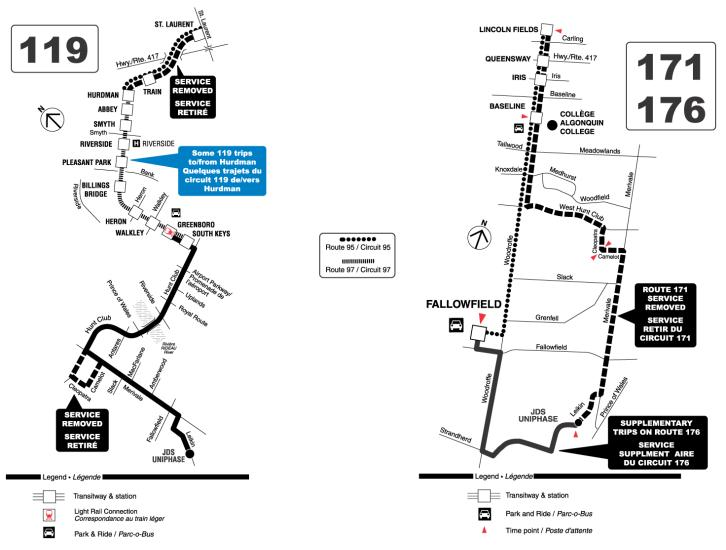
EXHIBIT 2 – Maps of routes with major service changes
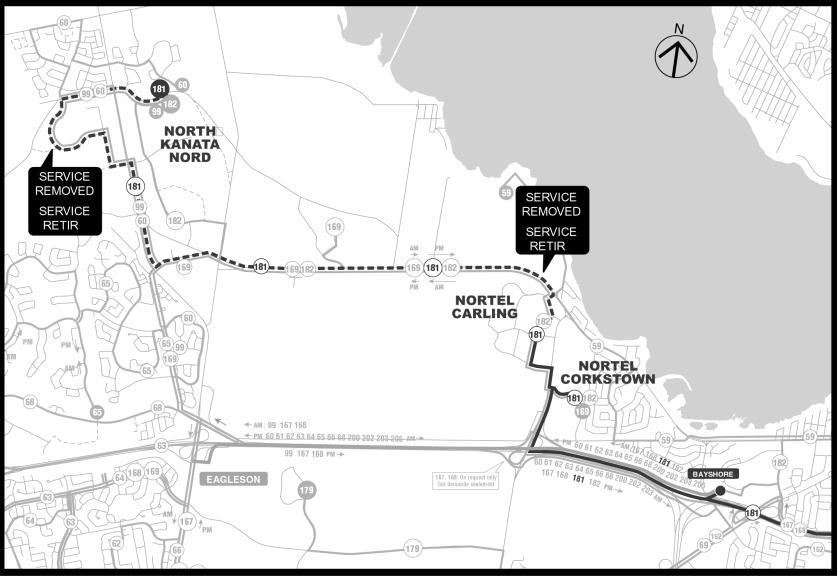
EXHIBIT 2 – Maps of routes with major service changes
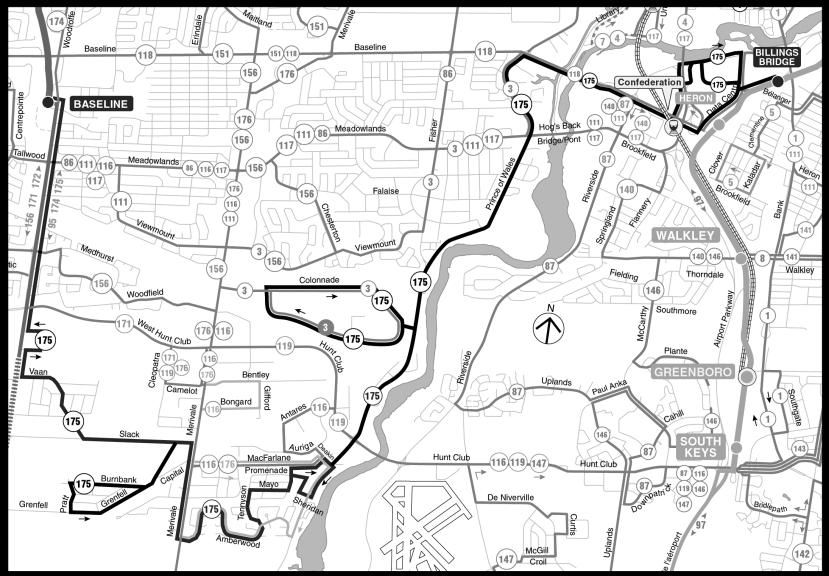
Exhibit 3 – 2002 Service Performance Review – Monday to Friday Service Changes
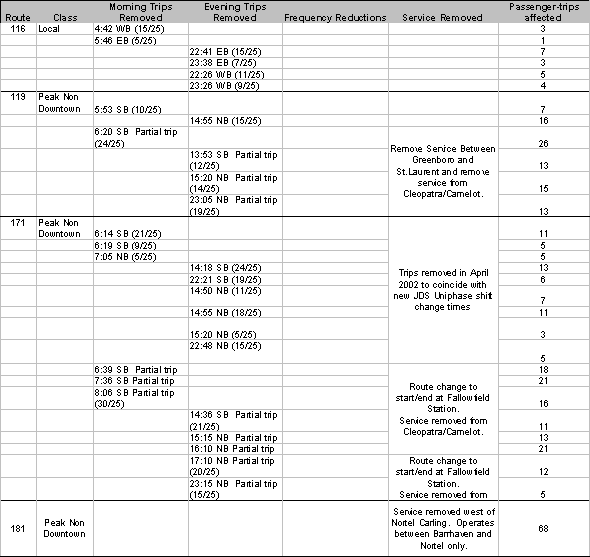
(xx/xx) – Revenue/cost: observed and target
EB – Eastbound
NB – Northbound
SB – Southbound
WB – Westbound
Exhibit 4 – 2002 Service Performance Review – Saturday Service Changes
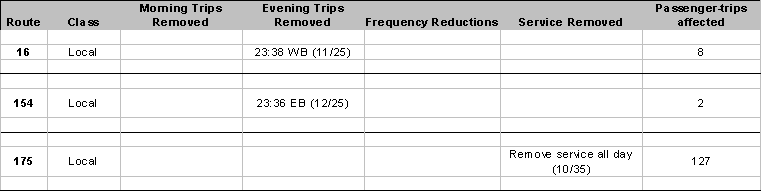
Exhibit 5 – 2002 Service Performance Review – Sunday Service Changes
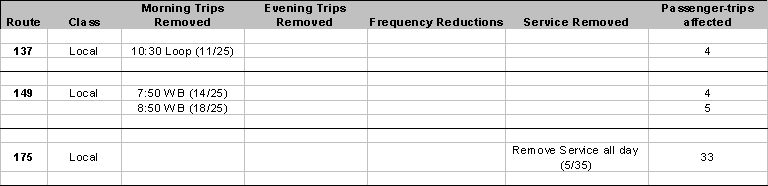
(xx/xx) – Revenue/cost: observed and target
EB – Eastbound
NB – Northbound
SB – Southbound
WB – Westbound