ON-TIME PERFORMANCE (OC TRANSPO)
Report to/Rapport au :
Transportation Committee/
Comité des transports
21 July 2005/le 21 juillet 2005
Submitted by/Soumis par: Pedestrian and Transit Advisory Committee/
Comité consultatif sur les piétons et le transport en commun
Contact Person/Personne ressource: Stephanie Brown Bellefeuille, Advisory Committee Coordinator/Coordonnatrice de comite consultatif
City Clerk’s Branch/Direction du greffe
(613) 580-2424 x 16760, stephanie.brown@ottawa.ca
ACS2005-CCV-PTA-0003 |
SUBJECT: | |
| |
OBJET: |
REPORT RECOMMENDATIONS
That the Transportation Committee recommend Council approve the implementation of an action plan on an urgent basis to resolve the following issues:
a) Immediately implement a policy about on-time performance which specifically states that buses must never leave early from any timepoint (0 minute tolerance for leaving early) and a service standard target of 3-5 minutes late (under normal circumstances) at any point on the route
b) Improved customer service procedures whereby issues are resolved in a timely fashion (refer to KPMG standard of 10 days) and that the issue does not re-occur
c) Improved service monitoring to identify and resolve on-time performance problems in a timely fashion
d) Ongoing review and adjustment of schedules by time of day as required to ensure that schedules are achievable, realistic and efficient. Schedule changes would take place at regular service change intervals
e) Ongoing review and adjustment of timepoints on routes to ensure they are consistent with public timetables and are evenly spaced. Such changes would take place at regular service change intervals
f) Regular (monthly) reporting of results (to Transportation Committee).
RECOMMANDATIONS DU RAPPORT
Que le Comité des transports recommande au Conseil municipal d’approuver la mise en oeuvre de toute urgence d’un plan d’action en vue de résoudre les questions suivantes :
a) adoption immédiate d’une politique relative à la ponctualité qui précise que les autobus ne doivent jamais partir d’avance, quel que soit le point où ils sont rendus dans l’horaire (aucune minute de tolérance pour les départs d’avance) et atteindre un objectif de norme de service visé de 3 à 5 minutes pour les retards (en temps normal), quel que soit le point dans le trajet;
b) amélioration des procédures de service à la clientèle afin que les problèmes soient résolus en temps opportun (se référer à la norme de 10 jours de KPMG) et ne se répètent pas;
c) amélioration du contrôle du service afin de repérer et de résoudre les problèmes de ponctualité rapidement;
d) révision et ajustement continus des horaires selon l’heure au besoin pour que ceux-ci soient réalisables, réalistes et efficaces. Les changements d’horaires auraient lieu à des intervalles réguliers de changement de service;
e) révision et ajustement continus de l’heure des différents arrêts dans les trajets afin de s’assurer qu’elle est conforme à l’heure indiquée sur l’horaire public et que les arrêts sont espacés de façon égale dans le temps. De tels changements auraient lieu à des intervalles réguliers de changement de service;
f) soumission de rapports périodiques (une fois par mois) sur les résultats obtenus (au Comité des transports).
BACKGROUND
At the May 2005 meeting of the Pedestrian and Transit Advisory Committee (PTAC), members addressed the matter of on-time transit service delivery. Reference was made to a February 1999 OC Transpo report and on-the-street examples to illustrate the propensity of early running buses.
At this and previous PTAC meetings, the issue of schedule adherence had been discussed. At these sessions, staff described how schedule adherence was currently being maintained and how the new Global Positioning System (GPS) based SmartBus system, to be implemented in 2005/6, would further improve all aspects of operational performance.
DISCUSSION
At the 21 July meeting, the Pedestrian and Transit Advisory Committee approved the following resolution:
WHEREAS the Pedestrian and Transit Advisory Committee (PTAC) is mandated to provide advice and guidance to City Council through the Transportation Committee; and
WHEREAS on-time performance, reliability and customer service are very important aspects of Transit Service; and
WHEREAS the KPMG comprehensive review of 1998/99 made clear recommendations about on-time performance, reliability and customer service; and
WHEREAS transit service is depended upon by many customers including elderly, children and disabled people; and
WHEREAS serious on-time performance and customer service issues continue to occur on a daily basis;
BE IT RESOLVED that the PTAC recommends to the Transportation Committee the implementation of an action plan on an urgent basis to resolve these issues; such an action plan should include the following elements:
a) Immediately implement a clear and firm policy about on-time performance which specifically states that buses must never leave early from any timepoint (0 minute tolerance for leaving early) and a service standard target of 3-5 minutes late (under normal circumstances) at any point on the route
b) Improved customer service procedures whereby issues are resolved in a timely fashion (refer to KPMG standard of 10 days) and that the issue does not re-occur
c) Improved service monitoring to identify and resolve on-time performance problems in a timely fashion
d) Ongoing review and adjustment of schedules by time of day as required to ensure that schedules are achievable, realistic and efficient. Schedule changes would take place at regular service change intervals
e) Ongoing review and adjustment of timepoints on routes to ensure they are consistent with public timetables and are evenly spaced. Such changes would take place at regular service change intervals
f) Regular (monthly) reporting of results (to Transportation Committee).
CONSULTATION
No public consultation was carried out with regards to this Motion. Staff in Transit Services has provided the following comments:
The PTAC motion has three main elements:
- Better schedule adherence through the implementation of firmer policies and improved scheduling;
- Enhanced timeliness in dealing with customer contacts; and
- Production of operational reports for the Transportation Committee on a monthly basis.
Each of these elements is discussed in Attachment 1. In the case of the first two (recommendations a. to e.), the current situation and future improvements are described. The importance of schedule reliability is recognised by staff and the direction proposed by the PTAC Motion is already being followed. Significant improvements will result from the implementation of SmartBus over the next six to nine months.
With respect to the recommendation about on-time performance, there are minor differences in how the definition of on-time is applied. Operators are instructed to never leave a timepoint ahead of schedule, which corresponds with the PTAC recommendation. However, in measuring on-time performance, early is defined as not leaving timepoints more than one minute ahead of schedule. For reporting purposes, late is defined as leaving timepoints more than three minutes after the published time.
Rather than monthly reporting to Transportation Committee (recommendation f.) it is suggested that, in keeping with Transportation Committee’s role as a policy-making body, schedule adherence performance and customer service turn-round be reported annually as part of an annual performance report.
More information on the monitoring and management of schedule adherence and customer service by Transit Services is provided in Attachment 1.
FINANCIAL IMPLICATIONS
There are no financial implications to this report. Funds for the implementation of the GPS system are covered in the approved budget.
SUPPORTING DOCUMENTATION
Attachment 1 – Further Discussion: On-Time Operations, Responding to Customer Concerns, and Regular Reporting
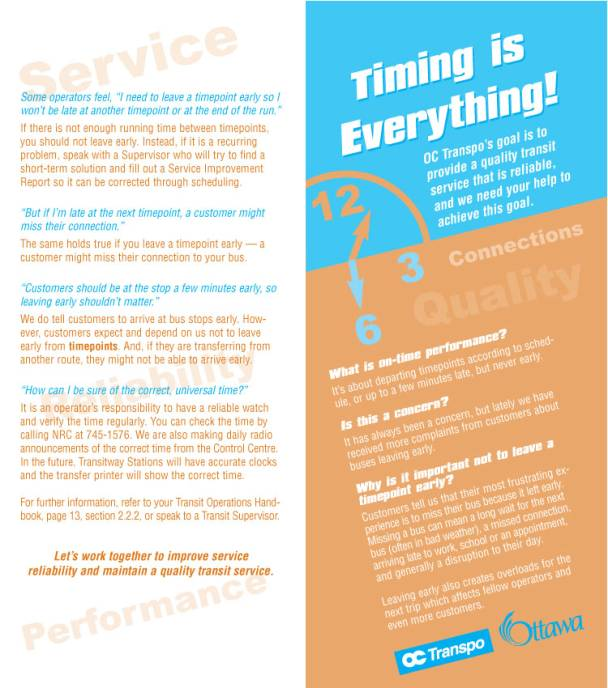
Attachment 2 – Timing is Everything Brochure
DISPOSITION
OC Transpo shall implement the recommendations as approved by Transportation Committee.
ATTACHMENT 1
On-Time Operations
Current Situation
A bus is defined as being ‘on-time’ when it leaves a timepoint if it is:
- Not more than one minute early; and
- No more than three minutes late.
Timepoints
Timepoints are major bus stops along a route, such as Transitway stations and important transfer locations, that are used as pacing points by operators to maintain their schedules. Timepoints are used as the measuring tool for proper schedule adherence as both operators and customers are provided the same information. As a guide to customers, many bus stops, which are not ‘timepoints’ in the network, have posted stop-specific schedules showing only estimated bus arrival/departure times. These times at bus stops are not scheduled nor exact but rather extrapolated based on their relative distance to one another between the scheduled timepoints.
It is not practical to provide these additional times to operators, as the volume of timing information would increase at least tenfold. Currently, operators receive specific timing information in paper form. Providing so much additional information in paper form and expecting operators to be aware of all bus stop times as they are driving is not realistic and could pose a safety risk. Since these bus stop times are not available to operators, they are not part of the performance measurement.
Schedule Adherence
OC Transpo operates an Automated Passenger Counting (APC) system on about 10 percent of the vehicle fleet. These buses are rotated through the scheduled service each day so that a representative sample of service is collected each booking. APC buses are fitted with components that count all passenger activity through each door. In addition, the APC buses record the schedule adherence of the bus at specific timepoints along the routes. The primary use of the data is for planning purposes such as setting service levels and developing appropriate running times.
The most recent APC data covers the January 2005 booking period, which ran from January to April. It shows that buses were on time 72 percent of the time, early 15 percent of the time and late 13 percent of the time.
There are many reasons why buses do not run on time. Staff build schedules taking into account the variability of traffic conditions and vehicular movement flows as much as possible. However, from day-to-day and hour-to-hour, congestion levels can vary considerably and affect traffic flow and schedule adherence. Accidents, detours and bus breakdowns are an operational fact-of-life over which operators have little control. Abnormal weather conditions such as heavy rain, severe snow and ice conditions are contributing factors that can cause the entire network to slow down and run behind schedule. At other times, traffic flows much better than expected and if operators are not watchful, they can find themselves in a position of potentially running ahead of schedule. Operators are instructed never to leave a timepoint ahead of the schedule time.
Schedule Design
Having accurate schedules that reflect realistic travel times has a direct influence on schedule adherence. Schedules are designed to take into account differing travel times by time of day and day of the week. As well, schedules are regularly revised to take into account changes in passenger volumes, traffic congestion and other factors that affect travel times. These changes are identified from Service Improvement Reports received from operators, from comments received from customers, from examining APC system reports and from internal scheduling workshops where individual routes are analysed in detail by a group made up of operators, service controllers and scheduling staff.
Awareness
Over the past three years, an internal on-time performance awareness program has been undertaken to emphasize to all staff the impact on customers of running early. The message of what on-time means has been conveyed through the issuance of bulletins, posters in operator dispatching areas at all garages and by articles in the internal staff newsletter ‘Transpo Express’. All training programs, including those for new recruits and refresher programs for seasoned veterans, emphasize this message. A special ‘question and answer’ brochure dealing with on-time performance issues was produced and distributed to all staff. The brochure appears in Attachment 2.
Monitoring
Transit Operations actively monitors on-time performance through the use of Automatic Vehicle Location information. Transit controllers contact operators via voice radio if schedule adherence problems are observed. Transit supervisors conduct riding checks and spot checks of service performance at key locations through out the service area to ensure that operator on-time performance is maintained. Transit supervisors also investigate and respond to public complaints for schedule adherence, through service monitoring and discussions with the transit operator and transit driver instructors conduct random checks to monitor performance.
In the case of repeated schedule adherence problems, a mobile supervisor is dispatched to observe and, where appropriate, address the operator. Infractions for early running are documented and become part of the overall performance monitoring for bus operators. Accumulation of schedule adherence infractions may lead to disciplinary action.
Planned Improvements
SmartBus – Global Positioning System
The installation of GPS hardware on all buses is underway and will be completed by April 2006. The implementation of GPS software is the cornerstone of the SmartBus project for OC Transpo. It will necessitate changes to how we do business operationally and enable an overall improvement in schedule adherence. The SmartBus system will allow automated vehicle location through state-of-the-art GPS technology of the entire conventional transit and Para Transpo fleet, provide in-vehicle information to operators about their status with respect to schedule adherence, support data communications between transit vehicles and central control, allow the automatic update of the electronic transfer-issuing machines and, in time, support real-time passenger information, vehicle diagnostics and a smartcard fare collection system.
SmartBus technology will provide the operations controller with ongoing and automatic tracking of the fleet and specific bus locations. Bus location information, coupled with our computer-aided dispatch software will enable the controller to maintain and enhance bus system efficiency by performing service restoration activities in a more efficient, effective and accurate manner.
Mobile Data Terminal
Adherence to the schedule will improve, as the onboard Mobile Data Terminal (MDT) will display the actual schedule adherence at each bus stop to the bus operator. This will allow the bus operator to better adjust their driving to reflect the published schedules throughout each trip. Service controllers will also be able to monitor a series of buses on a route and intervene to adjust specific buses to help ensure that the headway is maintained. This is particularly important on high frequency service, for example route 95, where the bunching of buses creates gaps in service resulting in poor schedule adherence and overload conditions requiring the insertion of extra buses to the route.
Accurate Time
A key feature of GPS that will enhance operator adherence to the schedule will be the provision of an accurate, synchronized timepiece on each vehicle. The current practice is for bus operators to provide their own timepiece set to National Research Council time. Inaccuracies, disagreements and complaints are created as a result of variances in individual timepieces of operators and the customers. GPS will provide a single on-bus clock, which will contribute to the potential improvement of on-time performance and the predictability of the service to the public.
Schedule Improvements
GPS will provide consistent, thorough, accurate and more data from all routes during all hours of service, seven days a week. This will enable future schedules to be adjusted to better reflect actual on street travel times. Schedules that more closely mirror on street conditions will automatically have a positive impact on schedule adherence and on-time performance.
In summary, the new SmartBus system, when fully implemented, will provide accurate information that will be used to:
a) Improve service reliability and schedule adherence - electronic real-time information will be used by the bus operator and operations controllers on a minute-by-minute basis;
b) Create more accurate schedules - more data will be available to scheduling staff to develop more representative running times, resulting in better schedules that will improve on time performance.
Responding to Customer Concerns
Current Situation
The customer relations office receives approximately 40,000 requests or comments from customers each year, in the form of telephone calls, e-mail messages, voice messages or letters. These consist of 20,000-25,000 complaints; the remainder of the contacts are compliments, enquiries or suggestions.
Of the complaints, eighty-five percent are answered within seven working days. This means that all available information about the incident or issue has been provided to the customer, and pertinent details have been logged and forwarded to the appropriate staff for their information, or follow-up, or action, as required. No additional contact with the customer is requested or required.
The remaining 15 percent of complaints require additional information or investigation to be able to provide a full reply to the customer. These contacts are logged and referred to appropriate staff for follow-up, usually in the operations or planning groups. These complaints include personnel issues where the staff’s side of the story must be investigated, fare payment errors which require additional contact with the customer to correct, safety issues, and urgent problems related to the location or condition of facilities such as stops, shelters, and stations.
In 1999 the KPMG Comprehensive Review identified an average response time of 14 days, for just 7,000 total annual customer complaints. The abandoned-call rate for the customer relations queue at that time was almost 29 percent - i.e., 29 percent of callers did not reach an operator.
Additional staff in the customer relations group, process automation and efficiencies have resulted in the abandoned-call rate dropping from 60 to 12 percent, and all complaints are now logged, compared to just 60 percent in 1999. Coupled with a 30 percent ridership increase, the number of complaints has increased three-fold since 1999. Many contacts have shifted to e-mail format (7,000 in 2004 compared to 3,100 in 1999). E-mail makes it easier for customers to lodge a complaint, since they do not have to wait for the telephone queue and staff can manage the e‑mail response on their own time throughout the day, which results in a more efficient use of time.
These improvements mean that the office is now exceeding the targets laid out in the Comprehensive Review, by responding to 80 percent of complaints within five to ten days.
The other specific recommendations from the Comprehensive Review have also been implemented within the customer relations office:
· staff have been given access to AVLC data, which permits quick response to many service-delivery complaints
· the internal logging and referral process has been automated
· additional resources have been placed in the group
· a system is in place to ‘flag’ long-outstanding responses
· a monthly review of ‘trends’ is provided to senior management
Future Improvements
The arrival of the GPS SmartBus system will assist staff in further reducing the time it takes to respond to individual customer contacts. Currently, the investigative phase of responding to a service delivery complaint is time-consuming as there is no fully automated schedule database of fleet activity, and most vehicle transactions are not logged in AVLC. Customer relations staff access to the historical records in the new GPS system will facilitate quicker, more accurate and more complete responses to customers.
Regular Reporting
The PTAC motion proposes the regular reporting of operational data to the Transportation Committee. It is suggested that, in keeping with Transportation Committee’s role as a policy-making body, schedule adherence performance and customer service turn-round be reported annually as part of an annual performance report.
ATTACHMENT 2