
OTTAWA SMARTBUS SYSYEM IMPLEMENTATION
Report to/Rapport au:
Transportation Committee/Comité des transports
and Council/et au Conseil
06 October 2004/le 06 octobre 2004
Submitted by/Soumis par: R.T. Leclair,
Deputy City Manager/Directrice municipale adjointe,
Public Works and Services/Services et Travaux publics
Contact/Personne-ressource: G. Diamond, Director/Directeur,
Transit Services/Service du transport en commun
842-3636 ext. 2271, gordon.diamond@transpo.ottawa.on.ca
| | Ref N°: ACS2004-TUP-TRN-0013 |
SUBJECT: OTTAWA SMARTBUS SYSYEM IMPLEMENTATION
OBJET: MISE EN OEUVRE DU SYSTÈME SMARTBUS D'OTTAWA
REPORT RECOMMENDATION
That the Transportation Committee receive this report for information.
RECOMMANDATION DU RAPPORT
Que le Comité des transports prenne connaissance du présent rapport à titre d’information.
BACKGROUND
The plan to proceed with the development of a SmartBus system through a contract with Bell Canada was presented to Corporate Services and Economic Development Committee at its meeting of June 17, 2003. This contract was awarded after an open procurement process.
The Ottawa SmartBus system will provide Automatic Vehicle Location (AVL) capability, using Global Positioning Satellite (GPS) technology, for the entire OC Transpo and Para Transpo fleets. The system will provide in-vehicle information to operators about their status with respect to their schedule adherence, support data communications between transit vehicles and central control, including vehicle diagnostics information, and allow the automatic update of the electronic transfer-issuing machine.
The objectives of the system are to:
· improve transit service reliability and customer convenience;
· reduce operating costs through improved scheduling, more effective service control, and better customer information; and
· reduce maintenance costs through the use of real-time vehicle diagnostics.
The total cost of the project is $5,200,000. A contribution of $1,530,000 has been confirmed by the Provincial Government through the Transit Investment Partnership (TIP) program. The Federal Government is also making a contribution of $250,000 under its Intelligent Transportation Systems (ITS) program. The City’s contribution is $3,162,000 under existing authority from the 2002/2003 capital budget programs
The project was planned in two phases, the first being a pilot test of the technology. This test was successfully completed in the spring of 2004 and clearly demonstrated that the Bell Canada solution met or exceeded all of the functional and technical requirements from the City’s Request for Proposal.
The project is now ready to move to full implementation but, before proceeding, the business case was reviewed to ensure that the project still makes sense in the City’s constrained financial environment. The business case is summarized in Appendix A.
The system will be fully operational by the end of 2005. At that point it will be capable of supporting future systems such as a smart card fare system and a real-time passenger information system to announce the order of arriving buses at high volume stops.
DISCUSSION
Comparative analysis
AVL and GPS technologies are recognised throughout the transportation industry as essential tools for operations and fleet management. They have been embraced by many public transit agencies worldwide, who have demonstrated their value across the organization through increased efficiencies, cost reductions, improved customer service and increased ridership (see examples in Appendix A).
Transit agencies in the United States and Europe have shown the highest rate of AVL/GPS deployment. Currently, there are 46 transit systems in the U.S. with this type of system, and another 32 planning for deployment. In Canada, there are three existing agencies with this type of system (St. John’s Metrobus, Vancouver Translink and Calgary Transit). Many others are actively planning to deploy in 2005 and beyond (Toronto, Go Transit, Mississauga, Montreal).
This project positions Ottawa at the forefront of deploying a fleet-wide AVL/GPS system, or SmartBus, in Canada. In addition, this will be the first Canadian system designed and built using the Intelligent Transportation Systems architecture developed by Transport Canada. Further, we have used industry standards, proven technologies and leveraged the experiences of other transit agencies worldwide to ensure the City’s SmartBus system will provide maximum value for the money.
Implementation Approach
As part of the project:
· Each vehicle will be equipped with a combined Mobile Data Terminal (MDT)/GPS unit, forming the core of the SmartBus system. The order of installation is expected to be by vehicle type to maximize the immediate benefits of the system. The 227 articulated buses and 91 Para Transpo vans will be equipped first, followed by the newer low-floor buses;
· Existing on-board vehicle diagnostic and monitoring systems will be connected to the SmartBus system. This will enable the transfer of vehicle data to a central location for analysis by Fleet Services staff; and
· The Para Transpo Trapeze Scheduling system will be upgraded to use real-time location information to monitor contractor performance and improve the efficiency of the operation.
Benefits
The system will provide important benefits in the operation of the transit system. These benefits have been quantified and developed into a full cost-benefit analysis, a summary of which is in the Financial Implications section.
Service Reliability
Service reliability and predictability remain the key factors in making transit an attractive alternative to automobile travel and maintaining and increasing transit ridership. SmartBus technology will improve service reliability on several fronts.
SmartBus technology will provide the transit service controller with ongoing and automatic tracking of bus location. Accurate bus location information, coupled with computer-aided-dispatch software will enable the service controller to maintain and enhance bus system efficiency by performing service restoration activities more accurately and efficiently. Each day over 200 adjustments to the planned and scheduled service take place due to traffic disruptions, on-street incidents and equipment substitutions for mechanical and other reasons. Equipped with accurate and timely bus position information, the controller can make more efficient use of on-street staff and fleet resources.
Adherence to the schedule will improve, as the MDTs will display actual schedule adherence to the bus operator. This will provide visual feedback to the bus driver with respect to the published schedules throughout each trip. Currently, bus operators use printed dockets which provide schedule information at a subset of bus stops called ‘timing points’ to gauge their progress through each trip. Transit service controllers will also be able to monitor a series of buses on a route and intervene to adjust specific buses to help ensure that even headways are maintained. This is particularly important on high frequency service where the bunching of buses creates gaps in service and overload conditions requiring the addition of buses to the route.
The use of GPS data for scheduling will result in better schedules and improve schedule adherence. Historically, scheduling staff has relied on limited samples of on-street travel time data to make decisions about new schedules. By having access to the volume and quality of data that GPS will provide, better schedules will be written.
In addition, adherence to schedule will be enhanced through the provision of an accurate, synchronized timepiece on each vehicle.
Customer Information
Several types of passenger information and methods of delivery are currently in use. Printed and posted information is widely distributed, and automated information is widely deployed on Internet, video display, and telephone systems.
Implementation of the SmartBus technology will enable real-time bus status information for customers en-route or at a stop, via cell-phone message broadcasts, Interactive Voice Response (IVR) lookups and Internet downloads to PDAs. This information can include actual bus schedule status, which is valuable to all passengers using the transit system, and also vehicle-type status, which is valuable to passengers who require, for instance, a low-floor bus.
Customer demand for these services already exists and is increasing. The implementation of these passenger information improvements depends on a fully deployed GPS/AVL system.
Improved Customer Service
The introduction of MDTs to the transit operator’s workplace will allow the automation of routine communications to Operators from the Operations Centre controllers. This will free Operators to better serve customers and focus on the driving environment. Similarly, the text-based messages will reduce the need for routine voice communication allowing the controller to manage higher priority operational needs, such as breakdowns and accidents. The reduced reliance on voice communications in favour of text messages will free up radio airtime for problem solving while providing concise text messages to operating staff.
Response to Incidents
An important feature that the SmartBus technology will provide to customers and employees is faster response to on-street incidents and emergencies through accurate bus location. Today, every bus is equipped with a silent alarm to be used in emergency situations. The silent alarm activates a high priority call screen and alert in the Operations Centre, and is used between 150-200 times per year throughout the transit fleet. The current alarm notification generates an estimated location based on schedule information, which may be several kilometres away from the actual location of the incident. The GPS and cellular technology will provide a precise location to the controller thereby reducing response time to the incident.
Vehicle Diagnostics
Vehicle diagnostics provide information to the dispatch centre and the maintenance department of the transit agency regarding various vehicle functions and performance characteristics. This information is acquired through sensors connected to systems that include engine, transmission, cooling, fuel, air and electrical. Parameters typically monitored include temperature, pressure levels, speed and position. In addition, operating characteristics such as hard acceleration and braking can be recorded and retrieved. Diagnostic information can be relayed to the dispatch centre and/or the maintenance department in real-time, which allows a vehicle to be taken out of service immediately if the problem is severe, or stored on the vehicle for later retrieval. Real‑time diagnostic information provides early warning of symptoms when readings begin to exceed normal operating ranges. Early detection allows informed operational and maintenance decisions to be made, in a proactive manner, thereby reducing major emergency repairs, minimizing repairs costs and improving vehicle availability.
Approximately 60% of the OC Transpo fleet has existing devices and sensors for monitoring of vehicle performance and gathering diagnostic information. The SmartBus System enables the data to be downloaded from the bus to a central repository on a regular interval.
Para Transpo
The AVL/GPS system will provide Para Transpo with key benefits that will reduce costs and improve the quality of service. The availability of precise vehicle locations to service controllers will improve their effectiveness, allowing available resources to be used to provide more service and increasing service reliability. The system will also reduce emergency response times and increase safety.
Future Considerations
The SmartBus system is needed as the foundation for other key future systems, such as a Smart Card fare system and real-time bus arrival system for high volume bus stops. The business cases for these systems will be presented to Council at a later date and no benefits from them have been included in the current analysis of SmartBus costs and benefits.
CONSULTATION/PUBLIC NOTIFICATION
Not applicable.
TRANSPORTATION MASTER PLAN
The improvements in service reliability and customer service will increase transit ridership and support the direction of the Transportation Master Plan.
FINANCIAL IMPLICATIONS
The budget for this project is $5,200,000 over the two-year term of the contract. Included in this amount are the following capital projects with existing authority, and external funding sources:
· $3,162,000 - Project 900516 Transit Vehicle Information Systems (eligible for SuperBuild funding);
· $50,000 - Project 902952 Transit Computer Systems;
· $275,000 - Project 900362 Para Transpo Integrated Voice Response System;
· $1,527,000 – Province of Ontario, Transit Investment Partnership (SuperBuild);
· $250,000 – Transport Canada, Intelligent Transportation Systems program.
Note: These Federal and Provincial subsidies will be provided on the understanding that the City will fund the balance of the project costs.
The yearly cash flow breakdown is as follows:
Table 1
Delivery Date | Supply and Install Equipment | Project Management | Hardware and Software Integration | Expenditure Totals | City Funds | External Subsidies |
Year 1 | 318 Vehicles (includes 20-vehicle pilot) | | | | | |
Expenditure | $1,500,000 | $100,000 | $250,000 | $1,850,000 | $1,218,000 | $632,000 |
Year 2 | 716 Vehicles | | | | | |
Expenditure | $2,700,000 | $150,000 | $500,000 | $3,350,000 | $2,205,000 | $1,145,000 |
| | | | | | |
Grand Total | $4,200,000 | $250,000 | $750,000 | $5,200,000 | $3,423,000 | $1,777,000 |
Cost/Benefit Analysis
There are broad benefits associated with the SmartBus System, some quantifiable and others more qualitative in nature, such as a decrease in time for emergency responses. In this summary, the expected benefits from Phases 1 and 2 of the project are quantified as far as possible and compared with the system capital and operating costs, over a period of ten years. This is the expected lifecycle of the chosen technology, based on widespread experience within the North American transit industry.
The positive business case does not rely on the future systems (Phase 3) that the system will support, which themselves have very strong business cases, but may require additional funding.
Nor does it depend upon increased ridership that will come from improved reliability and better customer information.
The ten-year cost/benefit analysis is summarized in Table 2 below. Any figures that rely on estimates from external agencies or studies are extremely conservative. For example, the Toronto Transit Commission estimates that service improvements, from its AVL system, will conservatively result in a 0.5% to 1.0% increase in revenues from increased ridership. The City’s analysis uses a far more conservative figure of 0.25% increase in ridership. This approach was used throughout.
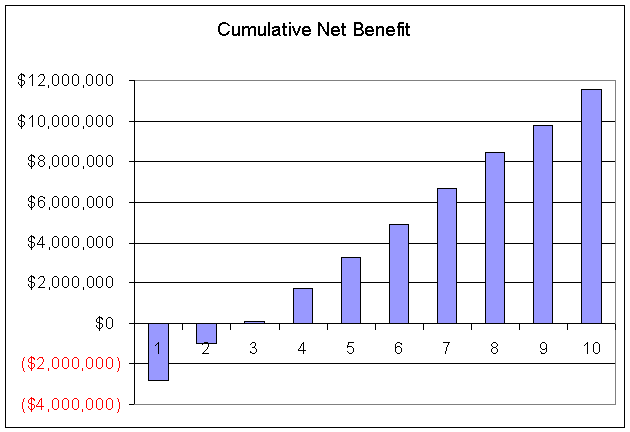
Table 2 demonstrates that the total net present value of Phase 1 and 2 benefits, excluding the vehicle diagnostics and Para Transpo benefits, would exceed costs by $5.9 million over a ten-year period. Including the Vehicle Diagnostics and Para Transpo costs and benefits increases this value to $9.7 million. When Provincial and Federal government subsidies are added, the total net benefit rises to $11.5 million, with payback after the second year following deployment (see Chart 1 below).
Table 2 - SmartBus - 10-Year Financial Summary
10 -Year Financial Summary | |
AVL/MDT - Cost - Capital | (4,243,000) |
AVL/MDT - Cost - Operating | (3,528,000) |
AVL/MDT - Benefit - Capital | 4,351,000 |
AVL/MDT - Benefit - Operating | 9,330,000 |
Subtotal | 5,910,000 |
| |
Para Transpo - Cost - Capital | (684,000) |
Para Transpo - Cost - Operating | (117,000) |
Para Transpo - Benefit - Capital | 0 |
Para Transpo - Benefit - Operating | 2,195,000 |
Subtotal | 1,394,000 |
| |
Vehicle Diagnostics - Cost - Capital | (241,000) |
Vehicle Diagnostics - Cost - Operating | (103,000) |
Vehicle Diagnostics - Benefit - Capital | 0 |
Vehicle Diagnostics - Benefit – Operating | 2,822,000 |
Subtotal | 2,478,000 |
| |
Total Cost - Capital | (5,169,000) |
Total Cost - Operating | (3,748,000) |
Total Benefit - Capital | 4,351,000 |
Total Benefit - Operating | 14,346,000 |
| |
Total Cost/Benefit (NPV) | 9,780,000 |
| |
One-Time Funding | 1,780,000 |
| |
10-Year ROI (NPV) | 11,560.000 |
SmartBus – 10-Year Cumulative Net Benefit
SUPPORTING DOCUMENTATION
Appendix A – Summary of Benefits from Other Systems
DISPOSITION
On disposition of this report, City staff will move on with the full implementation of the GPS/AVL system according to the agreement with Bell Canada.
APPENDIX A
SUMMARY OF BENEFITS FROM OTHER SYSTEMS
Regional Transportation District (RTD) – Denver, Colorado
§ Ridership increased 5.1%
§ Customer complaints decreased 31.8%
§ Hours of service loss due to maintenance decreased 13.2%
§ Hours of service loss due to missed trips decreased 6.1%
Tri-Met transit agency - Portland, Oregon
§ AVL system using a satellite-based global positioning system
§ 9.4% improvement in on-time performance measured at the final destination of the routes under study
§ Variability in headways, or time between bus arrivals at a given stop, decreased by 5% after the implementation of the improvements
§ 3.14% improvement in run time. This improvement in run time allows the transit agency to save operating costs.
Kansas City - Missouri
§ Response times to bus operator calls for assistance have decreased from 7-15 minutes to 3-4 minutes
§ On-time performance has improved from 80% to 90%,
§ Reductions in scheduled running times has generating an estimated operations and maintenance cost savings of $400,000 annually.
Ann Arbor Transit Authority - Ann Arbor, Michigan
§ Average of 8% ridership increase per year
§ Overall drivers’ verdict is favourable
Dallas Area Rapid Transit - Dallas, Texas
§ Para transit and fixed route vehicles
§ Passengers per hour increased from 1.31 to 1.60
§ On time performance increased from 84.5% to 97.2%
§ Complaints per 1000 trips dropped from 27.6 to 1.4
HOP Bus Route - Boulder, Colorado
§ Average service increase of 1500 to 3500 passengers per day
§ Increased efficiency in routing (especially during an accident)
Milwaukee County Transit System - Wisconsin
§ On-time performance improved from 90% to 94% as a result of AVL deployment
§ 28% fewer buses were more than one minute behind schedule
Mass Transit Administration - Baltimore, Maryland
§ AVL increased on-time bus performance by 23%.
Winston-Salem, North Carolina
§ The CAD/AVL Para transit system decreased operating expenses by 8.5% per vehicle mile
§ Decreased the cost to transport a passenger by 2.4% per trip
§ Decrease in passenger wait time of over 50%
VIA Metropolitan Transit, San Antonio, Texas
§ Reduction in voice communication of approximately 80% after the introduction of MDT technologies.
§ Increase the number of passenger trips per vehicle hour due to immediate information regarding vehicle status and location from 1.1 to 2.3.
Spokane Transit (Spokane, Washington)
§ 6,800 registered clients
§ Centralized dispatch – 40% of service contracted
§ First Trapeze Windows/MDC installation
§ On-time performance increased 4%
§ Reduced staffing by ½ FTE
§ Less chaotic dispatch
§ “Where’s my ride” and late cancel calls forwarded to reservations
§ Improved driver/dispatcher communications
§ Better complaint handling through accurate vehicle speed, location information
§ Enabled same-day trips
§ Eliminated paper manifests
St. Cloud MTC (St. Cloud, Minnesota)
§ Para transit service
§ Live since January 2000 with MDT/AVL system
§ Increased service substantially while maintaining 3.7+ passengers/hour level
§ Recovered investment in 2.7 years
§ Improved schedule adherence
§ Efficient real-time routing
§ AVL increases management controls
§ More efficient use of dispatch staff
§ Drastic reduction in radio traffic lets dispatchers focus on optimizing services
§ Eliminated paper manifests
§ Drivers enjoy up-to-date information