
URBAN TRANSIT AREA REVIEW (2005-2)
Report to/Rapport au :
Transportation Committee / Comité des transports
and Council / et au Conseil
02 June 2005 / le 02 juin 2005
Submitted by/Soumis par : Ned Lathrop, Deputy City Manager/Directeur Municipal Adjoint
Planning and Growth Management / Urbanisme et Gestion de la croissance
Richard Hewitt, Acting Deputy City Manager / Directeur municipal adjoint par intérim Public Works and Services / Services et travaux publics
Contact Person/Personne ressource : Dennis Jacobs, Director/Directeur,
Planning, Environment and Infrastructure Policy/Politiques d’urbanisme, d’environnement et d’infrastructure
(613) 580-2424 x25521, dennis.jacobs@ottawa.ca
SUBJECT: | |
|
|
OBJET : |
REPORT RECOMMENDATIONS
That the Transportation Committee recommend Council approve:
1. a. The expansion of the Urban Transit Area to include urban areas adjacent to the existing Urban Transit Area, as shown in Document 1, effective September 2006.
b. Direction to staff to undertake public consultation on transit service improvements in the resulting new parts of the Urban Transit Area, as part of the Transplan 2006 process, with new services and improvements to start in September 2006.
c. Direction to staff to include in the draft 2006 operating budget sufficient part year funds ($500,000) to operate transit services in the resulting new parts of the Urban Transit Area under the same service standards that are used throughout the Urban Transit Area.
d. A phase-in of the operational portion of the Urban Transit Area levy over a four-year period for properties added to the Urban Transit Area, as shown in Document 1, to begin in 2007.
e. Direction to staff to include in the draft 2006 capital budget sufficient funds ($5.05 million) to acquire new buses and new bus shelters to be used to provide new services and service improvements in the new parts of the Urban Transit Area.
f. That the capital portion of the Urban Transit Area levy be applied in full for properties added to the Urban Transit Area, as shown in Document 1, to begin in 2006.
2. The adjustment of the transit levy to allocate twenty-two per cent of park and ride and associated net-capital costs to the remaining Rural Transit Area A and Rural Transit Area B to reflect park and ride usage rates.
RECOMMANDATIONS DU RAPPORT
Que le Comité des transports recommande au Conseil :
1. a. L'expansion du secteur du transport urbain pour inclure les secteurs urbains adjacents au secteur actuel, tel que montré dans le Document 1, à partir de septembre 2006.
b. Demander au personnel d'entreprendre une consultation publique sur les améliorations au service de transport en commun dans les nouvelles parties du secteur du transport urbain, dans le cadre du processus de Transplan 2006, avec le lancement des nouveaux services et la mise en place des améliorations en septembre 2006.
c. Demander au personnel d'inclure dans le projet de budget de fonctionnement 2006 suffisamment de fonds (500 000 $) pour le fonctionnement pendant une partie de l'année des services de transport en commun dans les nouvelles parties du secteur du transport urbain selon les mêmes normes de service que celles employées dans l'ensemble du secteur du transport urbain.
d. Une mise en place par étapes de la partie opérationnelle des redevances prélevées dans le secteur du transport urbain sur une période de quatre ans pour les propriétés ajoutées au secteur du transport urbain, tel que montré dans le Document 1, à partir de 2007.
e. Demander au personnel d'inclure dans le projet de budget d'immobilisations 2006 suffisamment de fonds (5,05 millions de dollars) pour l'achat de nouveaux autobus et abribus pour les nouveaux services et pour l'amélioration des services dans les nouvelles parties du secteur du transport urbain.
f. Appliquer complètement la portion immobilisations des redevances prélevées du secteur du transport urbain pour les propriétés ajoutées au secteur du transport urbain, tel que montré dans le Document 1, à partir de 2006.
2. L'ajustement des redevances prélevées pour qu'elles comptent pour vingt-deux pour cent des coûts des parcs-o-bus et des dépenses nettes en capital connexes pour les secteurs du transport rural A et B afin de refléter le taux d'utilisation des parcs-o-bus.
EXECUTIVE SUMMARY
Assumptions and Analysis:
The City of Ottawa’s Official Plan and the accompanying Ottawa 20/20 Growth Management Plans recognize the citywide benefits of improved transit for both users and non-users alike. Increasing transit ridership reduces the costs of road infrastructure, reduces congestion on the roads and improves air quality. Both Ottawa 20/20 and the City’s Long Range Financial Plan suggest that the net-costs of transit should be spread more evenly across the city so that all residents share both the benefits and costs of transit. These objectives were considered when examining new approaches to funding the net-costs of transit and form the basis of the recommendation to apportion park and ride net-capital costs to both urban and rural ratepayers.
Under the current operational approach, the Urban Transit Area (UTA) is expanded into newly developed areas that are capable of supporting full transit services. In order to achieve the policy direction provided by Ottawa 20/20 and the 30 per cent transit modal split objective of the Transportation Master Plan (TMP), a more proactive methodology for service expansion should be pursued.
A review of the areas adjacent to the UTA indicates several existing developments that have experienced rapid growth and are now capable of supporting full transit services in accordance with the service guidelines used throughout the current UTA. The all-day base route network could be extended into these areas so that most residents would be within 800 metres walking distance of their nearest transit stop and 400 metres during peak periods. However, existing ratepayers will also experience an increase in their annual property tax transit levy to pay for these added services.
In April 2005, five public open houses were held for affected communities adjacent to the UTA to gather comments regarding proposed funding options for the provision of transit service as a result of expanding the UTA. This report summarizes the results of this consultation and recommends expanding the UTA to include some of these areas, as shown in Document 1, as well as phasing-in the operational portion of the transit levy over a four-year period for new properties added to the UTA. In addition, it is recommended to distribute park and ride and associated net-capital costs between the three transit areas based on urban and rural park and ride usage rates.
Financial Implications:
Approximately $1.5 million in additional net annual operating expenditures ($500,000 for part year 2006) and $5.05 million in capital will be required to service the resulting new parts of the UTA. This will increase the net costs of the transit network, and will be shared among all ratepayers within the expanded UTA, as per the existing approach. However, properties added to the UTA will experience a property tax transit levy increase of approximately $380 for a residential property assessed at $247,000. As a result, it is recommended that this increase be phased-in over a four-year period as to avoid abrupt increases in property taxes. The recommendation of distributing park and ride and associated net-capital costs between the three transit areas is based on park and ride usage rates from the City of Ottawa 2003 Park and Ride Survey results. This would result in an increase of approximately $8.72 in the annual transit levy for a residential property assessed at $247,000 in RTA-A and RTA-B and a $2.50 decrease for a similar property in the UTA. This recommendation represents only a shift in the allocation of the levy components, and is therefore revenue neutral for the City as a whole.
Public Consultation/Input:
Consultation for this report included five open houses for residents affected by the proposed UTA expansion, and a presentation to the Pedestrian and Transit Advisory Committee.
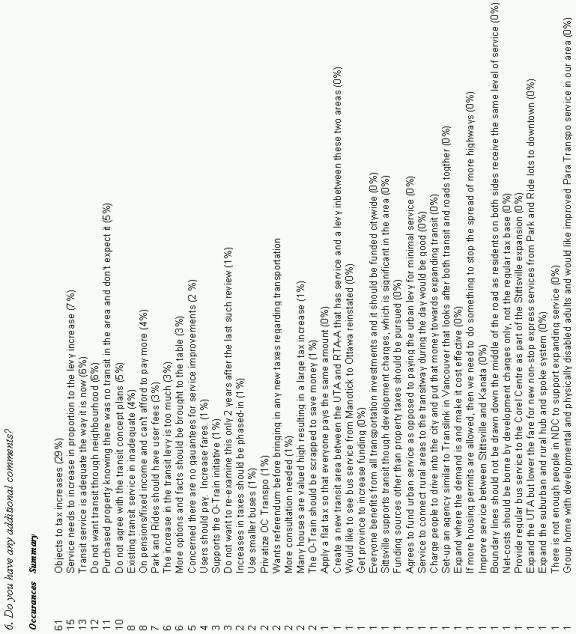
Two hundred and twenty one completed questionnaires were received as part of the consultation survey, as outlined in this report, as well as 116 additional written submissions received through mail, fax, e-mail and through an online questionnaire on the City of Ottawa web site. A summary of the survey results and comments received are included in this report (Document 4).
RÉSUMÉ
Hypothèses et analyse :
Le plan directeur de la Ville d'Ottawa et les plans connexes de gestion de la croissance de la Ville et Ottawa 20/20 reconnaissent les avantages pour l'ensemble de la Ville qu'apporte un meilleur transport en commun, tant pour les utilisateurs que pour les non-utilisateurs. L'augmentation du nombre d'utilisateurs des transports en commun réduit les coûts liés aux infrastructures routières et la congestion routières et augmente la qualité de l'air. Ottawa 20/20 et le Plan financier à long terme de la Ville suggèrent tous deux que les coûts nets du transport en commun devraient être répartis plus également dans l'ensemble de la Ville de façon à ce que tous les résidents puissent partager les avantages et les coûts du transport en commun. Ces objectifs ont été examinés dans la recherche de nouvelles approches pour le financement des coûts nets du transport en commun et ils constituent la base de la recommandation voulant la répartition des coûts nets en immobilisations entre les contribuables des secteurs urbains et ruraux.
Dans le cadre de l'approche organisationnelle actuelle, le secteur du transport urbain (STU) s'étend aux zones nouvellement développées aptes à soutenir des services complets de transport en commun. Afin de respecter l'orientation stratégique d'Ottawa 20/20 et l'objectif de 30 % des déplacements par transport en commun du Plan directeur des transports (PDT), une méthode plus proactive d'expansion des services devrait être adoptée.
Un examen des zones adjacentes au STU montre que plusieurs lotissements résidentiels actuels ont connu une croissance rapide et sont maintenant aptes à soutenir des services complets de transport en commun en accord avec les lignes directrices sur le service utilisées dans l'ensemble du STU actuel. Le réseau de base de jour pourrait être étendu à ces secteurs, afin que la plupart des résidents se trouvent à moins de 800 mètres de l'arrêt le plus près et à moins de 400 mètres pendant les périodes de pointe. Cependant, les contribuables actuels verront également une augmentation de leurs redevances pour le transport en commun dans leur montant annuel de l'impôt foncier en raison de l'ajout de ces nouveaux services.
En avril 2005, cinq séances publiques ont été tenues pour les communautés adjacentes au STU afin d'obtenir des commentaires quant aux options de financement proposées pour la prestation du service de transport en commun liée à l'expansion du STU. Le présent rapport résume les résultats de cette consultation et recommande d'étendre le STU afin d'inclure certains de ces secteurs, tel que montré au Document 1, et de mettre en œuvre par étapes la partie opérationnelle des redevances pour le transport en commun sur une période de quatre ans pour les propriétés ajoutées au STU. de plus, il est recommandé de répartir les coûts des parcs-o-bus et les coûts nets en immobilisations connexes entre les trois secteurs du transport en commun, en fonction des taux d'utilisation des parcs-o-bus urbains et ruraux.
Répercussions financières :
Environ 1,5 million de dollars en dépenses nettes annuelles supplémentaires (500 000 $ pour une partie de 2006) et 5,05 millions de dollars en immobilisations seront requis pour desservir les nouvelles parties du STU. Les coûts nets du réseau de transport en commun augmenteront et ils seront partagés entre tous les contribuables du STU étendu, comme dans le cadre de l'approche actuelle. Cependant, les propriétés ajoutées au STU verront une augmentation des redevances pour le transport en commun dans leur impôt foncier d'environ 380 $ pour une résidence évaluée à 247 000 $. Il est donc recommandé que cette augmentation soit répartie sur quatre ans afin d'éviter une augmentation abrupte de l'impôt foncier. La recommandation voulant la répartition des coûts des parcs-o-bus et des coûts nets en immobilisations connexes entre les trois parties du STU est fondée sur les taux d'utilisation des parcs-o-bus tirés des résultats de l'enquête de 2003 de la Ville d'Ottawa sur les parcs-o-bus. Elle amènerait une augmentation d'environ 8,72 $ des redevances pour le transport en commun pour une résidence évaluée à 247 000 $ dans les STR A et B et une réduction de 2,50 $ pour une propriété similaire dans le STU. Cette recommandation ne représente qu'un changement à la répartition des redevances et ne modifierait donc pas les revenus pour l'ensemble de la Ville.
Consultation publique / commentaires :
Les consultations pour ce rapport comprenaient cinq séances publiques pour les résidents visés par l'expansion proposée du STU et une présentation au Comité consultatif sur les piétons et le transport en commun.
Deux cent vingt-et-un questionnaires remplis ont été reçus dans le cadre du sondage de consultation, tel que décrit dans le présent rapport, et 116 commentaires écrits supplémentaires ont été reçus par courrier, par télécopieur, par courrier électronique et par un questionnaire en ligne dans le site web de la Ville d'Ottawa. Un résumé des résultats du sondage et des commentaires reçus est joint au présent rapport (Document 4).
BACKGROUND
Currently, the UTA defines those areas of the City that receive full transit services and includes those areas that are expected to receive access to full transit services in the short term. Full transit service is defined as being within 800 metres walking distance to a transit stop that is part of the all-day base route network.
The last revision to the UTA boundary was in 2001, at which time the UTA was expanded to reflect the extension and proposed extension of regular transit service to parts of Ottawa designated as Urban Area in the Official Plan. This included areas that were developing and would be served by transit in the short term, in keeping with the City’s historic practice of linking the transit levy to areas capable of supporting full transit service.
In addition to the UTA, in 2002 City Council approved the establishment of Rural Transit Area A (RTA-A) and Rural Transit Area B (RTA-B), following an extensive consultation process. Despite the creation of these new transit areas, ratepayers within the UTA continue to be the primary source for funding the net-costs of transit (99 per cent in 2004), including the transitway, light rail, and park and ride facilities.
During previous budget discussions, Council directed staff to develop an appropriate methodology to expand the UTA and associated levy in the context of Ottawa 20/20 and the Long Range Financial Plan (LRFP). A review of the issue suggested that there are several options to expand the UTA and fund the net-costs of transit that have advantages and disadvantages that should be discussed by the community prior to staff making a specific recommendation. An overview of the UTA and transit levy components, including the advantages and disadvantages of these options were presented to Transportation Committee on March 2, 2005. These options are also very similar to the key recommendations previously outlined in The OC Transpo Comprehensive Review, an extensive report prepared by the KPMG/IBI group and presented to the Transit Services Committee in February 1999.
The Transportation Committee directed staff to undertake the proposed public consultation process and report back to Committee before June 30, 2005 with the results of the consultation and any subsequent recommendations. At the Transportation Committee meeting in March, a motion was referred to staff to amend the net-capital cost options by adding contributions which account for park and ride facilities and other transit infrastructure that benefit rural residents.
DISCUSSION
The public consultation process in April communicated the existing transit funding practices, including an overview of the current transit areas, and the rationale of implementing change based on the policy direction provided by Ottawa 20/20 and the LRFP. The 30 per cent transit modal split objective of the Transportation Master Plan and the benefits of less congestion on the roads, the reduced need and costs of road projects, and the environmental, social, and health benefits of expanding transit services were presented and on display. City staff also presented the following net-operational and net-capital funding options:
Options for Net-Operational Transit Funding: | Options for Net-Capital Transit Funding: |
A. Maintain the existing approach for expanding the UTA B. Expand the UTA to include all developed urban areas C. Replace the UTA with the Urban Area
| A. Maintain the existing approach for funding the net-capital costs B. Fund the net-capital costs from within the Urban Area C. Fund Park and Ride net-capital costs citywide |
Following the discussions of the funding options, staff outlined how transit service would improve in the resulting new areas of an expanded UTA. Several transit service concept plans were presented and on display which illustrated shorter walking distances to bus stops, more frequent service and longer service hours. In addition, the urban transit service guidelines with respect to lower fares for express routes and Para Transpo services were also highlighted.
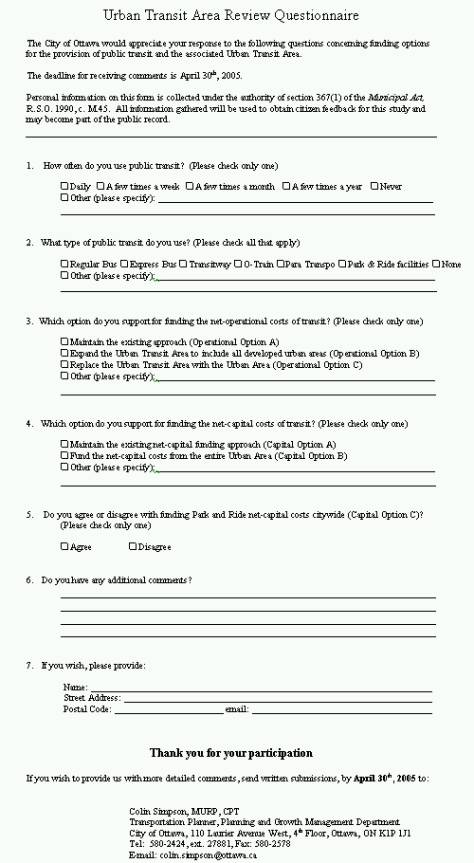
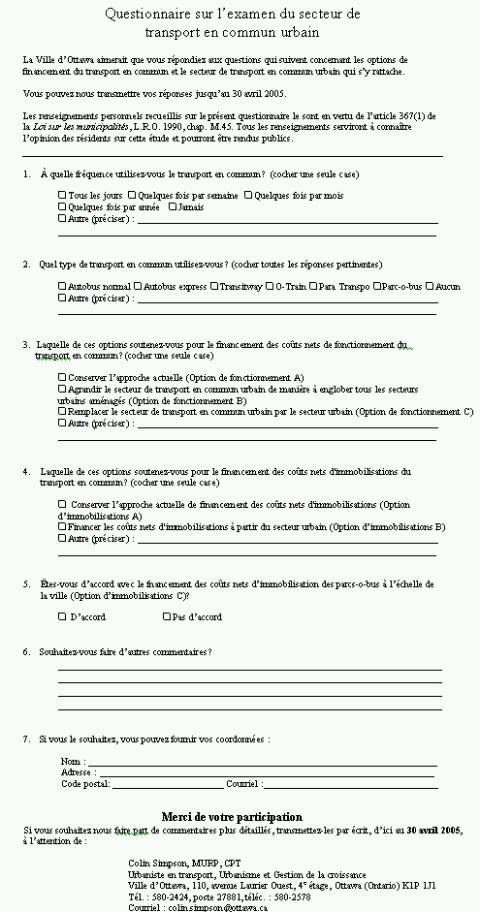
A questionnaire and comment sheet was distributed at each of the open houses and residents were encouraged to express their views and ideas (Document 3). Two hundred and twenty one completed questionnaires were collected through the five open houses as well as 116 additional written submissions from individuals and community associations.
In general, there is an objection to any increase in property taxes with 163 of 221 survey responses in favour of maintaining the existing net-operational approach and 139 of 218 responses in favour of maintaining the current net-capital approach, as shown in Tables 1 and 2. Only 36 of 237 responses indicated daily or weekly transit use (Document 4).
TABLE 1: Which option do you support for funding the net-operational costs of transit?
Option | Total |
163 | |
Expand the Urban Transit Area to include all developed urban areas (Operational Option B) | 30 |
Replace the Urban Transit Area with the Urban Area (Operational Option C) | 16 |
Other | 12 |
Total | 221 |
TABLE 2: Which option do you support for funding the net-capital costs of transit?
Option | Total |
139 | |
Fund the net-capital costs from the entire Urban Area (Capital Option B) | 57 |
Other | 22 |
Total | 218 |
Despite the strong opposition to any increase in property taxes, there was an understanding and appreciation of the indirect benefits of transit and the importance of investing in transit capital infrastructure for building a sustainable urban environment. This may explain why there was a 10 per cent difference between changing the existing net-capital funding approach compared to changing the net-operational funding approach. Also, approximately one-third of respondents supported funding park and ride net-capital costs citywide based on urban and rural park and ride usage rates.
Support for the net-operational option of expanding the UTA to include all developed urban properties or to replace the UTA with the Urban Area was mostly from existing transit and Para Transpo users. However, this support was accompanied by some scepticism, mainly attributed to the recent reductions in transit service brought about by the 2004 budget cutbacks. Although several transit service concept plans were developed and on display, many people were concerned that service expansion would not be guaranteed.
Links between operational costs and direct service was also a major theme throughout the public consultation process. The fact that the UTA levy represents a five-fold increase over the current RTA-A levy generated expectations for five times more transit service. Although the UTA levy is derived by the net-costs of providing transit services at urban standard levels, the amount of service provided relates to the needs of communities. Consequently, the amount of service provided in one area is not related to the cost difference between the levy amounts. However, being part of the UTA allows communities to receive regular, all-day service and eligibility for additional transit services as demand grows in the long term.
Other alternative funding options offered by residents included: increasing transit fares; instituting or increasing fees at park and ride facilities; reducing costs by using smaller buses; applying a flat tax so that all ratepayers pay the same levy amount; increasing provincial and federal government contributions; increasing Development Charges to cover the net-costs of transit; and applying a surcharge to automobile users to fund transit.
RECOMMENDED APPROACH
The recommended approach is to expand the UTA to include all adjacent urban areas and to spread park and ride net-capital costs between the three existing transit areas based on urban and rural park and ride usage rates. A phase-in of the operational portion of the levy for properties added to the UTA is also recommended based on the feedback from the public consultation process.
Operations
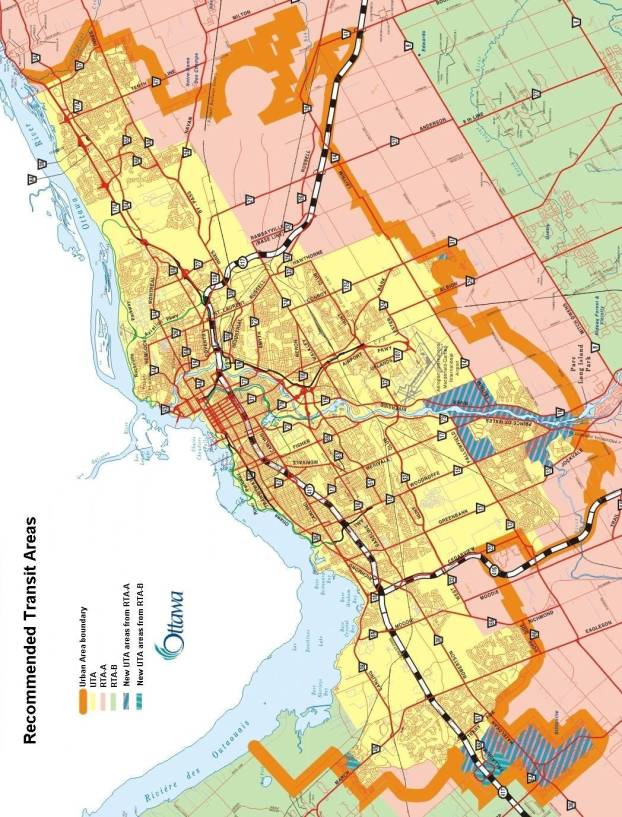
Strong opposition was expressed towards supporting the operational costs of transit in areas that would receive limited or no service. In light of this, only developed urban areas adjacent to the existing UTA that are well connected to other similar urban areas within the UTA are recommended to be added to the existing UTA. In these areas, regular service already exists, or service can be easily extended. Developed areas that are not adjacent or well connected to the UTA are not recommended to be included in the UTA at this time since additional services and improvements would be minimal and may not be cost effective. Document 1 shows the recommended UTA.
Properties added to the UTA would receive transit service according to service guidelines used throughout the current UTA. The established transit service planning policies would result in the extension of the all-day base route network into the new areas, so that most residents would be within 800 metres walking distance (a ten-minute walk for most people) of their nearest bus stop with service seven days a week. The peak-period base route network would also be extended into the new areas, so that most residents would be within 400 metres (a five-minute walk) of their nearest bus stop with service during the peak periods (06:00 to 09:00 and 15:00 to 18:30) from Monday to Friday. The established fare policies would result in the reduction of fares on the direct-to-downtown routes from a rural express fare (currently $98.00 per month) to an express fare (currently $78.00 per month), which would be a reduction of $240 per year for express bus users. Para Transpo fares would also change to the fare system used in the UTA (generally the same as conventional transit) rather than the zone-pricing model currently used in the rural transit areas. All other services would continue at a regular fare (currently $63.00 per month).
In applying the established UTA service standards in the new areas, there is sufficient population to provide new routes and service all week long in Stittsville, to provide a new peak-period service in the Winding Way and Heart's Desire areas of Nepean, and to continue a peak-period service on River Road in Gloucester even after the opening of the light rail line in 2009.
City staff have received some comments regarding the transit service concept plans that were presented at the open houses, and have assured people that a full public consultation would be conducted before any new services would be introduced. Detailed planning of options for the new areas, including consultation with current customers and residents of the areas, would be carried out as part of the Transplan 2006 process.
Capital
The recommended capital approach is to allocate park and ride and associated net-capital costs among all three transit areas based on urban and rural park and ride usage rates. This would link costs to areas that benefit from specific parts of the transit network. The City of Ottawa 2003 Park and Ride Survey results indicate that on average, 19 per cent of park and ride users are City of Ottawa residents from outside the current UTA boundaries. However, 15 per cent of users are from outside the City of Ottawa and it is recommended to spread the costs associated with these non-city residents citywide. As a result, 22 per cent of park and ride net-capital costs would be allocated to RTA-A and RTA-B with the remaining 78 per cent apportioned to the UTA. Sharing the park and ride net-capital costs in proportion to use in the rural areas would add $8.72 to the rural transit levy in RTA-A and RTA-B for a residential property assessed at $247,000 and would constitute a minimal decrease ($2.50) in the UTA levy for a similarly assessed residence.
Although there is merit, in principle, to spreading the net-capital component of the UTA transit levy over the entire Urban Area, the recommended approach provides a similar benefit, as the net-capital costs of the full transit network are apportioned to a broader tax base as to reflect usage of the system. Furthermore, the Urban Area option would result in significant complications to the tax bill in order to re-distribute costs over a comparatively small number of properties, especially if the UTA is expanded as recommended. These complications involve creating additional transit areas and itemizing both the capital and operating portions of the levy separately on property tax bills so that the capital and operating portions can be applied to different transit areas.
CONSULTATION
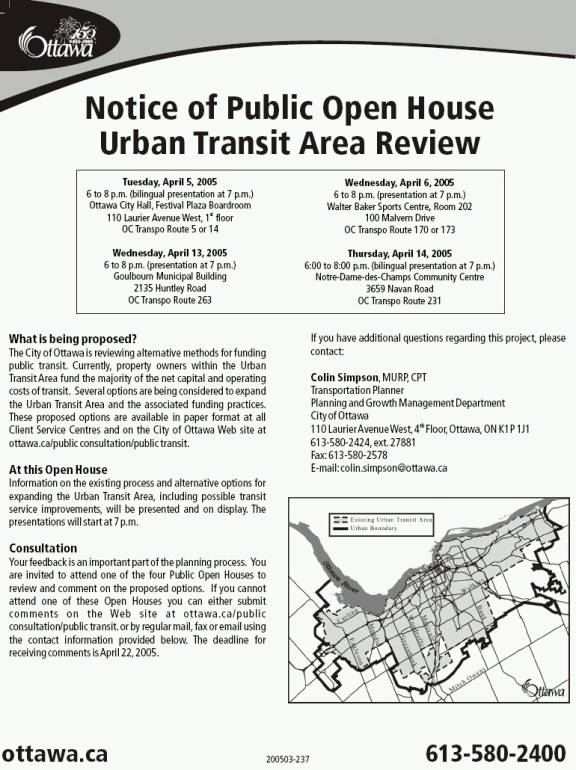
The public consultation process on this issue involved five public open houses that were held at the following locations:
· Ottawa City Hall (Central) – April 5, 2005
· Walter Baker Sports Centre (Barrhaven) – April 6, 2005
· Goulbourn Municipal Building (Stittsville) – April 13, 2005
· Notre-Dame-des-Champs Community Centre – April 14, 2005
· Fred G. Barrett Arena (Leitrim) – April 25, 2005
In addition, a presentation was made to the Pedestrian and Transit Advisory Committee on April 23, 2005.
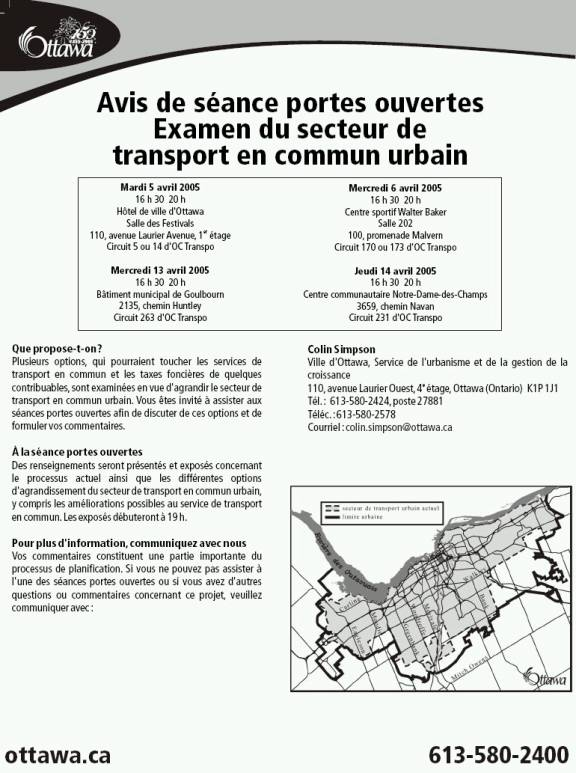
The open houses were advertised in March and April through community newspapers that have circulations adjacent to the UTA and were also advertised in The Citizen and Le Doit on April 1, 2005. Notice was also posted on the City of Ottawa and OC Transpo web sites. All registered community associations were notified and nearly 8,000 bilingual notification flyers were sent to all residents outside the UTA but inside the Urban Area (Document 2). Some councillors also notified their constituents though additional mail-outs and though articles in their community newspapers.
City staff delivered a presentation at each of the open houses, including a bilingual presentation in Notre-Dame-des-Champs, and were available to answer questions. Several maps and visuals were also on display, as well copies of the UTA report that was presented to Transportation Committee March 2, 2005. Participants were encouraged to present their views and ideas, and a bilingual questionnaire was distributed (Document 3).
Residents were also able to provide comments by mail, fax, e-mail and through an online questionnaire on the City of Ottawa web site throughout the month of April. A total of 221 completed questionnaires were received as well as 116 written submissions from individuals and community associations. A summary of the survey results and comments received are included in this report (Document 4).
Subject to the approval of expanding the UTA, another public consultation process is recommended for later this year and in early 2006 to plan and introduce improved transit service in the resulting new parts of the UTA.
FINANCIAL IMPLICATIONS
Subject to approval of Recommendation 1c, additional conventional transit and Para Transpo services will be provided to areas shifting to the Urban Transit Area, beginning in September 2006. The part year 2006 net-operating cost is estimated at $500,000, and will be included in the Draft 2006 Operating Budget. Since the full year net-operational impact is estimated at $1.5 million, an additional $1 million will be required for inclusion in the 2007 Operating Budget.
As per recommendation 1e, the estimated 2006 capital cost is $5.05 million for the purchase of 10 additional buses, and 10 bus shelters to service the expanded UTA. Approval of recommendation 1e does not constitute a pre-commitment of the 2006 Capital Budget, but is subject to City Council approval during the 2006 Budget deliberation. These transit capital costs are eligible for senior level subsidy and gas tax funding and/or gas tax funded debt. Due to the lead time required for procurement of new buses, the 2005 Approved Capital Budget included authority to purchase 31 standard buses for projected service growth in September 2006. This previous approval did not include 10 additional buses for service improvements to the new parts of the UTA. Therefore, the 2006 Draft Capital request for growth in the Transit Fleet will be increased accordingly. In the normal course of business, delivery of the additional bus fleet may not have been completed by September 2006, but following discussions with the supplier it is believed that production and delivery can be accommodated.
The remaining recommendations do not constitute additional costs or revenues to the City, but a recommended shift in transit service areas and resulting tax levies.
Operational Levy
As a result of the feedback from the public consultation process and the concerns regarding a sudden and large increase in the transit levy, it is recommended to phase-in the operational portion of the transit levy for properties added to the UTA. Under this phase-in approach of Recommendation 1d, the adjusted levy for properties added to the UTA would increase annually by 25 per cent of the shared UTA levy requirement, over four years starting January 2007, until the full UTA levy is applied.
Since early September is the best time to implement transit service changes, it is recommended that the existing UTA support the net-operational expansion for the remaining four months in 2006 and to start the levy phase-in process in the new tax year. This approach will result in a short-term operational levy increase for existing UTA ratepayers ($1.01 in 2006 for an average residential property assessed at $247,000), which will be fully offset by the shift in capital support as listed in Tables 3 and 4.
Table 3 shows the estimated operational portion of the transit levy for a residential property assessed at $247,000 based on extrapolated 2005 data.
TABLE 3: Operational Component of the Transit Levy for a Residential Property Assessed at $247,000 1
|
|
|
|
|
|
| New UTA | Remaining | RTA-B | ||
UTA Operational Levy portion | Phased RTA-A into UTA Operational Levy Portion | RTA-A Operational Levy Portion | Operational Levy Portion
| ||
2005 Status Quo Operational Levy | $394.34 | $52.71 | $52.71 | $10.30 | |
Proposed Approach 2006 2 | $395.35 | $52.71 | $52.71 | $10.30 | |
Proposed Approach 2007 3 | $385.92 | $94.93 | $52.71 | $10.30 | |
2008 | $383.86 | $189.87 | $52.71 | $10.30 | |
2009 | $381.80 | $284.80 | $52.71 | $10.30 | |
2010 | $379.74 | $379.74 | $52.71 | $10.30 | |
1 This table represents estimated calculations based on extrapolated 2005 levy and assessment data and is provided as reference only and assumes cost increases required for only the service to the RTA affected areas.
2 Part year operational costs would be assessed in 2006, as service would not be in place until late in the year.
3 Operational costs would be phased in at 25 per cent per year of the full UTA levy amount, beginning in 2007, with the full levy assessed in 2010.
Capital Levy
Subject to approval of Recommendation 1f, the new areas added to the UTA would contribute towards to the UTA net-capital costs beginning in 2006.
Considering the consultation process indicated more of an acceptance to contribute towards capital than operating expenses, and that the increase in the net-capital component of the levy for newly added properties is not as significant as the operational increase, a phase-in of the capital component is not recommended.
Concerning the proposed changes to fund park and ride and associated net-capital costs, Recommendation 2 recommends that 22 per cent of park and ride and associated net-capital costs be spread between RTA-A and RTA-B to reflect park and ride usage rates.
Table 4 shows the estimated capital portion of the transit levy for a residential property assessed at $247,000 based on extrapolated 2005 data.
TABLE 4: Capital Component of the Transit Levy for a Residential Property Assessed at $247,000
|
|
|
|
|
| |
| New UTA | Remaining | RTA-B | |||
UTA Capital Levy portion | RTA-A into UTA Capital Levy Portion | RTA-A Capital Levy Portion | Capital Levy Portion
| |||
2005 Status Quo Capital Levy | $72.49 | $13.63 | $13.63 | $0.00 | ||
Proposed Approach – No Phase in 2006-2010 1 |
| $69.95 | $69.95 | $21.86 | $8.72 | |
1 This table represents estimated calculations based on extrapolated 2005 levy and assessment data and is provided as reference only and assumes capital cost increases for only the service to the RTA affected areas.
Summary of Levy Impacts
This report identifies an increased city cost of $500,000 in 2006. With this additional requirement, and the recommended phase in, and the redistribution of the capital levy among the 3 transit areas, properties within the Urban Transit Area (which represent 89% of all assessment) will experience a 0.32% decrease on the transit portion of the 2006 tax bill. For properties within RTA-A that are to be migrated to the UTA, the net effect of the redistribution in 2006 is an 84% increase on the transit portion of the tax bill, and a 2.8% increase on the total tax bill. For properties within the remaining portion of the RTA-A, the 2006 impact is an increase of 12% on the transit portion of the tax bill, and a 0.4% increase on the total tax bill. For properties within the RTA-B the 2006 increase is 84% on the transit portion of the tax bill, and 0.45% on the total bill.
Table 5 shows the impact of the recommended approach on the transit levy for a residential property assessed at $247,000 based on extrapolated 2005 data.
TABLE 5: Total Estimated Levy for Operating and Capital for a Residential Property Assessed at $247,0001
|
|
|
|
|
|
| New UTA | Remaining | RTA-B | ||
UTA Levy 2 | Phased RTA-A into UTA Levy 3 | RTA-A Levy 4 | Levy 5 | ||
2005 Status Quo Total Levy | $466.83 | $66.34 | $66.34 | $10.30 | |
Proposed Approach 2006 | $465.30 | $122.66 | $74.57 | $19.02 | |
2007 | $455.87 | $164.88 | $74.57 | $19.02 | |
2008 | $453.81 | $259.82 | $74.57 | $19.02 | |
2009 | $451.75 | $354.75 | $74.57 | $19.02 | |
2010 | $449.69 | $449.69 | $74.57 | $19.02 | |
1 This table represents estimated calculations based on extrapolated 2005 levy and assessment data and is provided as reference only and assumes operating cost increases for only the service to the RTA affected areas.
2 The UTA contains 197,489 residential properties.
3 5,613 residential properties currently in RTA-A would have the UTA levy phased-in over four years.
4 11,581 properties would remain in RTA-A.
5 13,358 properties would remain in RTA-B.
SUPPORTING DOCUMENTATION
Document 1 Recommended Transit Areas
Document 2 Public Notices for Open Houses
Document 3 Urban Transit Area Review Questionnaire
Document 4 Urban Transit Area Review Questionnaire and Comment Summary
DISPOSITION
Upon approval of this report, a by-law will be prepared for enactment at a subsequent meeting of Council to replace the part of the Regional Regulatory Code related to the UTA.
RECOMMENDED TRANSIT AREAS Document 1
PUBLIC NOTICES FOR OPEN HOUSES Document 2
URBAN TRANSIT AREA REVIEW QUESTIONNAIRE Document 3
URBAN TRANSIT AREA REVIEW QUESTIONNAIRE AND COMMENT SUMMARY Document 4
1. How often do you use public transit? |
|
|
|
|
|
|
| |||||
|
| Total | % |
|
|
|
|
|
|
| ||
Daily |
| 34 | 14% |
|
|
|
|
|
|
| ||
A few times a week | 2 | 1% |
|
|
|
|
|
|
| |||
A few times a month | 10 | 4% |
|
|
|
|
|
|
| |||
A few times a year | 34 | 14% |
|
|
|
|
|
|
| |||
Never |
| 148 | 63% |
|
|
|
|
|
|
| ||
Other |
| 9 | 4% |
|
|
|
|
|
|
| ||
Total |
| 237 | 100% |
|
|
|
|
|
|
| ||
|
|
|
|
|
|
|
|
|
|
| ||
2. What type of public transit do you use? (Please check all that apply) |
|
|
| |||||||||
|
| Total | % |
|
|
|
|
|
|
| ||
Regular Bus | 41 | 15% |
|
|
|
|
|
|
| |||
Express Bus | 40 | 15% |
|
|
|
|
|
|
| |||
O-Train |
| 8 | 3% |
|
|
|
|
|
|
| ||
Transitway |
| 16 | 6% |
|
|
|
|
|
|
| ||
Para Transpo | 4 | 1% |
|
|
|
|
|
|
| |||
Park & Ride facilities | 15 | 5% |
|
|
|
|
|
|
| |||
None |
| 138 | 51% |
|
|
|
|
|
|
| ||
Other |
| 11 | 4% |
|
|
|
|
|
|
| ||
Total |
| 273 | 100% |
|
|
|
|
|
|
| ||
|
|
|
|
|
|
|
|
|
|
| ||
3. Which option do you support for funding the net-operational costs of transit? |
|
|
|
| ||||||||
|
|
|
|
|
|
|
| Total | % |
|
| |
Maintain the existing approach (Operational Option A) |
|
|
| 163 | 74% |
|
| |||||
Expand the Urban Transit Area to include all developed urban areas (Operational Option B) | 30 | 14% |
|
| ||||||||
Replace the Urban Transit Area with the Urban Area (Operational Option C) |
| 16 | 7% |
|
| |||||||
Other |
|
|
|
|
|
|
| 12 | 5% |
|
| |
Total |
|
|
|
|
|
|
| 221 | 100% |
|
| |
|
|
|
|
|
|
|
|
|
|
|
| |
4. Which option do you support for funding the net-capital costs of transit? |
|
|
|
| ||||||||
|
|
|
|
|
|
|
| Total | % |
|
| |
Maintain the existing net-capital funding approach (Capital Option A) |
| 139 | 64% |
|
| |||||||
Fund the net-capital costs from the entire Urban Area (Capital Option B) |
| 57 | 26% |
|
| |||||||
Other |
|
|
|
|
|
|
| 22 | 10% |
|
| |
Total |
|
|
|
|
|
|
| 218 | 100% |
|
| |
|
|
|
|
|
|
|
|
|
|
| ||
5. Do you agree or disagree with funding Park and Ride net-capital costs citywide? |
|
|
| |||||||||
| Total | % |
|
|
|
|
|
|
|
| ||
Agree | 65 | 30% |
|
|
|
|
|
|
|
| ||
Disagree | 150 | 70% |
|
|
|
|
|
|
|
| ||
Total | 215 | 100% |
|
|
|
|
|
|
|
| ||
|
|
|
|
|
|
|