
Audit of Bus Service Planning and Scheduling
On the 19th of June, the Auditor General released a wide-ranging audit focusing on scheduling and planning at OC Transpo, with a strong condemnation of both Transit Committee and OC Transpo management's practices over the past 20 years.
On the 19th of June, the Auditor General's Office released an audit focusing on OC Transpo's scheduling and planning practices. The audit encompassed a large variety of OC Transpo's malpractices, from scheduling to planning to political interference, and is a strong condemnation of Transit Committee (formerly Transit Commission) and OC Transpo's mishandling of surface transit operations over the last 20 years. The report leaves the impression that "no one is minding the store" at OC Transpo.
The audit can be found on the Auditor General's website at oagottawa.ca. I will provide page numbers to quotes and findings, with commentary and interpretation clearly marked throughout.
Bus Service Performance and Challenges
OC Transpo's challenges with service delivery and ridership are well-documented, both on this site and elsewhere. The auditor's office confirms these challenges - they are with us for the long-haul, and it is reckless of Council to assume that they will not have to take drastic action in the future.
[page 4 of the report] In recent years, OC Transpo has not consistently achieved bus reliability targets as demonstrated in Figure 2 below. Fleet shortages, aging buses, maintenance constraints, staff recruitment challenges, regulatory changes and increases in traffic congestion have placed significant pressure on service reliability.
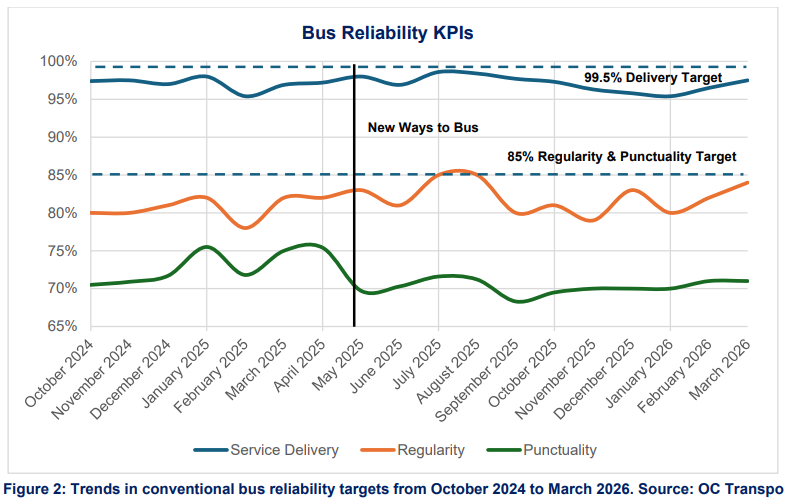
Over half of the current fleet is at or beyond its typical lifespan of 15 years, leading to more frequent breakdowns and longer maintenance requirements. A shortage of licensed mechanics has compounded the maintenance backlog, increasing service cancellations. While the transition to zero‑emission buses (ZEBs) is underway to replace the aging buses, manufacturing delays and operational limitations have slowed the pace of fleet renewal. Additionally, reduced access to dedicated bus lanes, partly due to Stage 2 O‑Train construction, has contributed to trip delays.
In addition to reliability challenges, transit ridership has not returned to pre‑pandemic levels, and travel patterns have changed. In 2025, average ridership reached 72% of 2019 levels (refer to Figure 3).
The poor quality of transit service is not the result of a single factor, and there is no "one easy fix" or even many easy fixes. Any lasting solution will be difficult and must be multi-faceted to properly tackle the challenges the auditor lists.
Given current operational realities, OC Transpo has not been able to reliably deliver its scheduled bus service ... The evolving transit patterns in a post-pandemic landscape, delays in both LRT line openings and delivery of the ZEBs, as well as reduced fleet availability have added complexity to planning and scheduling processes. Management is taking steps to respond to the existing operational constraints.
All this is true, but there is no indication that Council has the desire to tackle what a post-pandemic landscape looks like for funding. Fare revenue has not yet exceeded 2019 levels, but operating costs are up 50%. The old 55% fare recovery model has been dead since the early 2010s.
[the] audit identified several areas where historical decisions have impacted effective bus planning and scheduling processes ... New Ways to Bus was an opportunity to reset the bus network; however, specific foundational pieces were missing; specifically, the establishment of a clear order of priorities given that the network would not be able to address all needs, as well as updated service standards to articulate specific expectations for service levels going forward.
The audit's overall findings are that management, and Transit Committee especially, have lacked a clear vision or even an understanding of what they want from the system; as such, problems go unrectified, cost burdens unsolved, and everything is allowed to drift as the margins are cut for political purposes.
Audit Findings and Recommendations
Long time readers of this site are likely familiar with the following terminology, but it is worth reviewing for clarity.
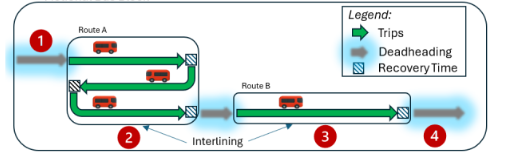
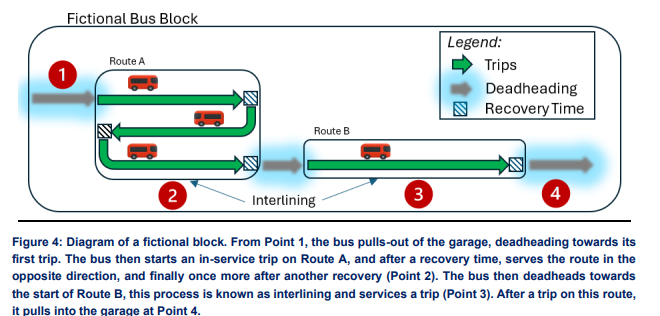
[starts page 10] To better understand a day in the life of an OC Transpo bus, see definitions and Figure 4 below:
Trip: One instance of a route, i.e. a series of stops and rides between locations.
Block: A full day’s work for a bus, made up of several trips (and deadheads) done by the same vehicle.
Deadheading: When a bus travels without passengers, to or from the garage or between trips or routes.
Recovery Time: Extra scheduled time at the end of a trip to absorb delays and keep the bus on time. Also known as a layover.
Interlining: When a bus serves more than one route in a block.
Scheduled run times do not reflect actual travel times and are not consistently adjusted.
This is a finding which is supported by my analysis, but the auditor has tools to measure the entire network, instead of individual routes. The auditor found that nearly 1/3 of trips have runtimes which vary from their schedule by more than 10%. Of these, almost all were underscheduled, not overscheduled.
OC Transpo’s run times were last holistically updated for implementation of New Ways to Bus, based on data collected in 2023. Due to delays in launching New Ways to Bus in April 2025, run times became inaccurate because of evolving traffic patterns throughout the city. In reviewing the results of the fall 2025 service booking, for the weekday routes of 30 minutes or greater in duration, 29% had scheduled run times that varied by 10% or more than actual run times, on average. Of these routes flagged, 86% did not have enough scheduled time and 14% had too much.
If that were the only problem, it would be relatively straightforward to fix ... but it's not the only problem.
Further complexity is added to the run time challenges because of factors such as deadheading, recovery time, and interlining within a block.
These factors are multiplicative (as delays beget delays), and OC Transpo's mass-adoption of every schedule breaking "feature" has been detrimental to the reliability of the network.
For the spring 2026 service booking, 84 (1%) weekday trips have under 5% of in-service recovery time - which is the minimum requirement, as per the collective agreement with the bus operators. Further, 14% of blocks do not have 10% in-service recovery time over the block, which the collective agreement stipulates that OC Transpo should endeavour to provide. Conversely, 33% of blocks have recovery time of over 30% of in-service time. Insufficient recovery time can impact start times of the next trip on the block of work; potentially impacting reliability.
The entire raison d'etre of interlining, according to OC Transpo, is improve efficiency - in other cities this happens by keeping layovers down on low-frequency routes. However, a third of blocks have 18 minutes/hour or more of recovery time averaged across the entire trip.
With an analysis of every route across the network, excess recovery is not only present but prevalent, demonstrating that claims from OC Transpo management about their own practices must be evaluated critically to avoid being lied to. It is not clear if management were simply unaware of these inefficiencies or actively chose to ignore them, but either is an argument for a thorough cleaning at 1500 St. Laurent.
For the spring 2026 service booking, 90% of blocks had interlining. Of those, 48% of blocks interlined three (3) or more routes and 11% of blocks interlined six (6) or more routes ... the more interlining is embedded within a block of work, the greater the risk to on-time performance across routes. For instance, if a bus is running late on one route, that delay can negatively affect downstream trips on other routes. Block-level performance data that may detect impacts of interlining is not regularly analyzed by OC Transpo.
Despite the appalling reliability, nobody at OC Transpo thought to analyze factors that may keep service down.
Before New Ways to Bus, staff said that 40% of blocks ran four or more different routes; now, 48% of trips run three or more routes. It is difficult to compare and the auditor is not following every memo distributed to Council, but these figures are useful to verify claims of reduced interlining from OC Transpo.
During afternoon peak times, routes started late on 19% of trips between August and November 2025. In January 2026, start times were late 37% of the time, with 24% starting over 10 minutes late.
The auditor's language is unclear, but if the January 2026 figure refers to all time periods (not just the PM Peak), then OC Transpo's reliability stats can be conclusively dismissed as bald-faced lies going forwards, as they claimed 17% of trips were late in the same month. The ten minute delay rate being 40% higher than the claimed five minute delay rate is not a statistic that can be written off as methodological discrepency.
For the 25 frequent routes tracked for regularity, five routes (20%) met the 85% target on average from September 2025 to the end of January 2026 weekday service. The remaining 80% did not meet the reliability target.
This is not only an abysmal performance, but also demonstrates that the ability to monitor per-route performance exists even for a non-specialist team. Compare that to OC Transpo's 2023-era claim that these figures were impossible to produce.
Consistent run time gaps have impacted the ability for OC Transpo to deliver consistent and reliable service at target levels, especially during peak periods which has ultimately impacted riders’ trust in the system.
Operational Constraints
Peak weekday service requirements have not been consistently met due to insufficient buses and operators.
[starts page 15] In planning New Ways to Bus, the base scheduled number of buses required to deliver the peak afternoon service was 540 buses. The audit found that fleet availability was not considered a primary constraint in the planning of New Ways to Bus. The redesign did not directly assess whether sufficient resources would be available to operate the redesigned network as management expected there to be sufficient bus resources at the time.
This is a major oversight, but it does have an explanation - New Ways to Bus was repeatedly delayed. Originally scheduled for early 2024, the redesign was punted a whole year while the fleet deteriorated and traffic levels rose.
While the issues currently being experienced with delays receiving and onboarding the ZEBs were unexpected, fleet data from 2023 through March 2026 (see Figure 6) shows there has been an ongoing shortage of bus availability in seasons of higher demand (i.e. spring, fall, winter).
However, despite the constraints above, New Ways to Bus was already infeasible to operate by the time the network was firmed up in late 2023. It should have been evident to OC Transpo from the first presentation of the network in November 2023, and appropriate steps taken to ensure that the fleet would be in the shape needed to operate the new network.
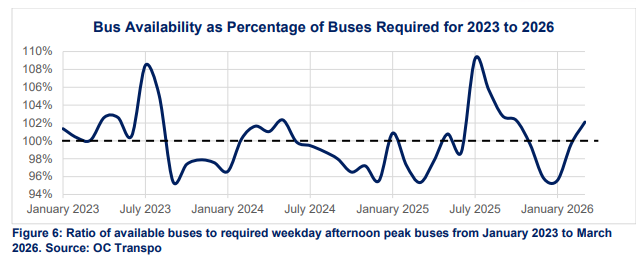
... for January and February 2026, the bus fleet assets were 67% available on average ...
This is a spare ratio of 50%, an extraordinarily high level. Best practice is to operate with 20% to 25% spares.
The fleet is not the only constraint on service ...
There is a current bus operator gap that is not expected to be resolved until January 2027. The most significant shortage, to date, was experienced in January 2026, shown in Figure 7 below ... Using OC Transpo figures, for January 4 to March 1, 2026, 28% of cancellations were due to operator availability.
Despite it falling out of OC Transpo's presentations, operator availability remains a problem. This is a perfectly symmetric match - an operator shortage to match a fleet shortage.
Overall, based on the priorities and targets established, the bus schedule that has been developed cannot be achieved consistently with existing resources.
Opportunities to enhance OC Transpo’s bus fleet plan [for] long‑term decision‑making
Current planning assumes that the incoming 354 ZEBs will replace 354 existing diesel buses (i.e. assumed 1:1 ratio). While we understand that 57% of blocks on weekdays are compatible with ZEBs, there remains a risk that a replacement ratio greater than 1:1 may ultimately be required given the range limitations of ZEBs to operate on a single electric charge. Other transit agencies ... have adopted higher replacement ratios ranging from a 5% to 15% contingency fleet.
This means that 43% of blocks are not compatible with electric buses. Given the deteriorating fleet, OC Transpo may not have enough buses to run the non-ZEB blocks.
This is another way in which OC Transpo's automated scheduling causes problems for scheduling and the fleet.
In review of the fleet plan, we noted there is limited connection to other constraints, such as whether there will be sufficient garage and maintenance capacity to support the planned bus fleet ... OC Transpo does not currently report to Transit Committee its long-term fleet plan, including key assumptions, risks, and contingency requirements.
Rick Leary has repeatedly promised a long-term fleet plan to be delivered in 2027. Its treatment of the replacements for the 40 ft Nova buses will be a sign of its honesty; those buses are being run harder than is typical and will need replacing sooner than usual.
Service Planning
In addition to operating planning, the overall design of the network - routes, frequencies, stops - are also a chaotic jumble with no clear parameters for what service should be offered.
There is no clear definition of what the priorities and trade‑offs should be in the design and delivery of the transit network based on current budget direction ... management acknowledged this challenge in the September 2025 report to Transit Committee.
OC Transpo’s primary documents outlining its transit planning standards are the Transit Service and Fare Policy Manual and the Transit System Management Policies. Although some of the foundational principles remain relevant, both these documents were published in 2005 and are no longer publicly accessible.
For the curious, an archival copy of the latter document is published by myself. I have tried to obtain the former with no success.
Although management noted that the service standards were considered operationally achievable and aligned with the resources and ridership demands in 2005, some service standards are no longer realistic within existing resource constraints ... the existing service standards may not be realistic in the current environment nor be reflective of the current service priorities, contributing to inconsistent service delivery and unmet customer expectations.
While the auditor and management may have opinions, it is impossible to determine whether the service standards are realistic without public disclosure. It is also unclear whether this was made clear to Council when the standards were abandoned in the early 2010s. Weak management could have let them slip without asking for the resources or disclosing this publicly.
While some service improvements were implemented in New Ways to Bus, interviews with management indicate that decisions were mainly driven by budget considerations. The redesign focused on achieving an annual bus operating cost reduction of approximately $10 million, equivalent to a reduction of 70,000 bus service hours annually.
It would be interesting to be a fly on the wall while this was discussed between Council and OC Transpo, or indeed, whether there was any discussion at all.
OC Transpo monitors some service standards such as crowding through review of ridership data to make bus type adjustments during quarterly service changes. However, the ... proportion of residents that live within walking distance to transit services are not regularly tracked. In addition, key evaluation processes such as the Annual Financial Performance Review and the Annual Transplan Consultation Process outlined in the 2005 service standards are no longer occurring.
Based on ridership data I have seen, New Ways to Bus created a mixed bag in ridership, and many new routes are performing with low productivity. However, OC Transpo cannot allocate service if it is not tracked.
As far as I am aware, the financial performance review was last done in 2004, before the 2005 review of management policies; the Transplan consultation process was last properly performed in 2010 with some performative "consultation" amidst the Network Optimization service cuts in 2011.
[page 25] Management indicate that financial reviews were deprioritized because major systemwide service reductions, most recently conducted in 2011, 2016, and 2025, were expected to address any low performing routes. In contrast, other agencies ... undertake annual route-level performance assessments against multiple productivity metrics.
Regular systemwide service reductions and redesigns are not a selling point, they are an obstacle to ridership growth and an admission of failure from Council. If reviews are not conducted, how can the institution learn (not that they are learning) from previous service changes?
I have also heard, third-hand, that Oliver Monahan, the now-departed associate general manager responsible for redesigning the bus network, was not permitted to access ridership figures. The productivity results from New Ways to Bus suggests that this may have been the case for that service change as well.
Existing reporting processes do not present a complete picture of performance against all existing service standards or clearly identify where gaps may exist.
That may reveal that management is not perfect and that Council has not been perfect in its oversight, which is a threat to an institution as hostile to self-awareness as OC Transpo.
In addition, reported performance against standards is often based on system‑wide averages, rather than at the route or service level used by some transit agencies. This can limit transparency of route-specific performance.
Various agencies, including Vancouver's Translink, the Edmonton Transit Service, and Winnipeg Transit, offer public dashboards with information on ridership, service hours, and reliability, the latter two after major network redesigns. Meanwhile, OC Transpo does not even analyze this information privately.
Where performance falls short of established service expectations, such as reliability targets, management has confirmed that no analysis has been conducted to determine the level of funding, resources, or service hours needed to fully meet these service expectations.
This is a symptom of weak staff and management, not Council (for a change). If these discussions are happening, they should be public with various options available for all to see, not just the Mayor and his wrecker band. What's more, Council should not accept "we don't offer a buffet of options" as an answer from staff.
When changes do occur, they are politically motivated and have little-to-nothing to do with ridership goals.
[On New Ways to Bus,] our audit noted that major network redesigns typically include a formal post‑implementation review to assess outcomes and capture lessons learned. Based on our discussions, this type of review has not been conducted and does not appear to be planned for the near term.
OC Transpo claims that it removes low-performing routes through frequent (and harmful) network redesigns. But how can they improve on them when they do not attempt to learn?
Interviews with management and a review of recent service changes indicate that service planning decisions are not always guided by clear planning principles and technical analysis. The introduction of this route added approximately $3.7 million in annual operating costs ... Management confirmed that no analysis was completed prior to introducing the route [Route 105], such as estimated customer benefits, financial performance assessments, and ridership forecasting.
... proposed service changes were to be evaluated to calculate their projected financial performance, with new services introduced only if they met minimum financial performance requirements, delivered measurable customer benefits, and could be supported within the existing budget ... OC Transpo no longer has a public facing mechanism to holistically evaluate, and transparently report on, major service changes ... OC Transpo risks allocating currently constrained operating funds inefficiently.
Route 105 was likely introduced as a response to the backlash to the poor arrangement of Line 4.
I can say that the route has about 2400 weekday riders, putting it 31st in ridership with a productivity of about 40 boardings/hour, which is average. It turned out okay, if not great; but for a cost of $3.7 million, almost 1% of OC Transpo's bus operating budget, results should be better than "average."
This was not the case for many New Ways to Bus changes and there seems to be no attempt to mitigate those cases or assign resources to where it could be more productive.
operational decisions ... with the aim of improving transit reliability or travel times will not proceed until endorsement from the ward Councillor is obtained. For example, our audit learned of an example where OC Transpo proposed rerouting a bus route ... to improve travel time and reliability for customers ... the proposal received broad support from customers and the community. Despite the public consultation ... the project did not proceed as it was not supported by the ward Councillor.
These types of changes (the audit named stop consolidation and straightening routes) are good and should be examined and recommended on a value basis, not on a political meddling basis which rewards well-connected people who are less likely to use transit.
This is a microcosm of the problem with every part of OC Transpo from top to bottom. Council doesn't want to make hard decisions, so they punt to management who fear for their jobs and also delay decisions. No one will sweat the details, and nobody is brave enough to ask for more funding or put the choices in front of Council.
Service has deteriorated, with OC Transpo refusing to commit to any choices which would alleviate its woes, either by modifying its broken scheduling system, removing resources from low-ridership routes, or requesting funding from Council. "Don't rock the boat, nothing changes" could be the motto of 1500 St. Laurent.
Note - the audit did not name a councillor, but the proposed modification was totally Route 7's proposed rerouting from Grove to Sunnyside, which was blocked by Shawn Menard.