
Bus After Midnight, Pt. II: Overnight Service
After the train shuts down, night buses continue to provide service to the city - but with duplication, uncoordinated transfers, and inefficient blocks.
This is the second part of a two part-series on late night and overnight transit. For the first post, which covers late night train-bus connections, can be found here.
The bus network continues to operate after the train ends service for the day. Ottawa is the smallest city north of the Rio Grande with 24/7 transit service, a genuine accomplishment.

OC Transpo began 24/7 service in 2009 with a few trips "filling a gap" on Route 95, providing half hourly service on the city's main transit axe for a low cost. Since then, the network has grown to six overnight routes of varying frequency and not all of them operating seven days a week or 24 hours a day, but still providing a valuable service to riders.
However, as with much of the surface network, its performance is harmed by uncoordinated timetables and poor scheduling. There are overly long layovers, missed connections, and large headway gaps on combined corridors. However, the low-intensity nature of night service means that service is uncomplex, and these problems are solvable at a low cost and with relative ease.
This post will analyze service problems with the overnight network, and suggest potential improvement and expansion opportunities. Some of it is speculative; and funding is always an issue, but the large inefficiencies present potential de-facto funding sources.
With such a barebones service, a small amount of funding and creative thinking can help create a far better night network for a low cost.
The Network Today
Today, the network consists of six routes mostly running on former Transitway corridors. Of the 24/7 routes, N39, N75, and N105 run every half an hour and the N45 every hour. The N57 operates in the few hours after the train closes on weekdays, and sometimes before the train starts again; the N61 runs half hourly but with a puzzling 2-3 hour gap in each direction, the time of which varies by route.

As all the routes fan out along Transitway corridors from downtown, this produces significant duplication; the resources of six routes are used to operate 4.5 corridors with large gaps on one. Routes duplicate each other, while City-designated Priority Equity Neighbourhoods and major destinations like hospitals, dense neighbourhoods, and Carleton University are bypassed entirely.

One remedy is obvious, combining the N57/N61. These routes duplicate each other for virtually the entire length of the N57, and the reduced operating cost can be used to help fill the remaining service gaps on the N61.
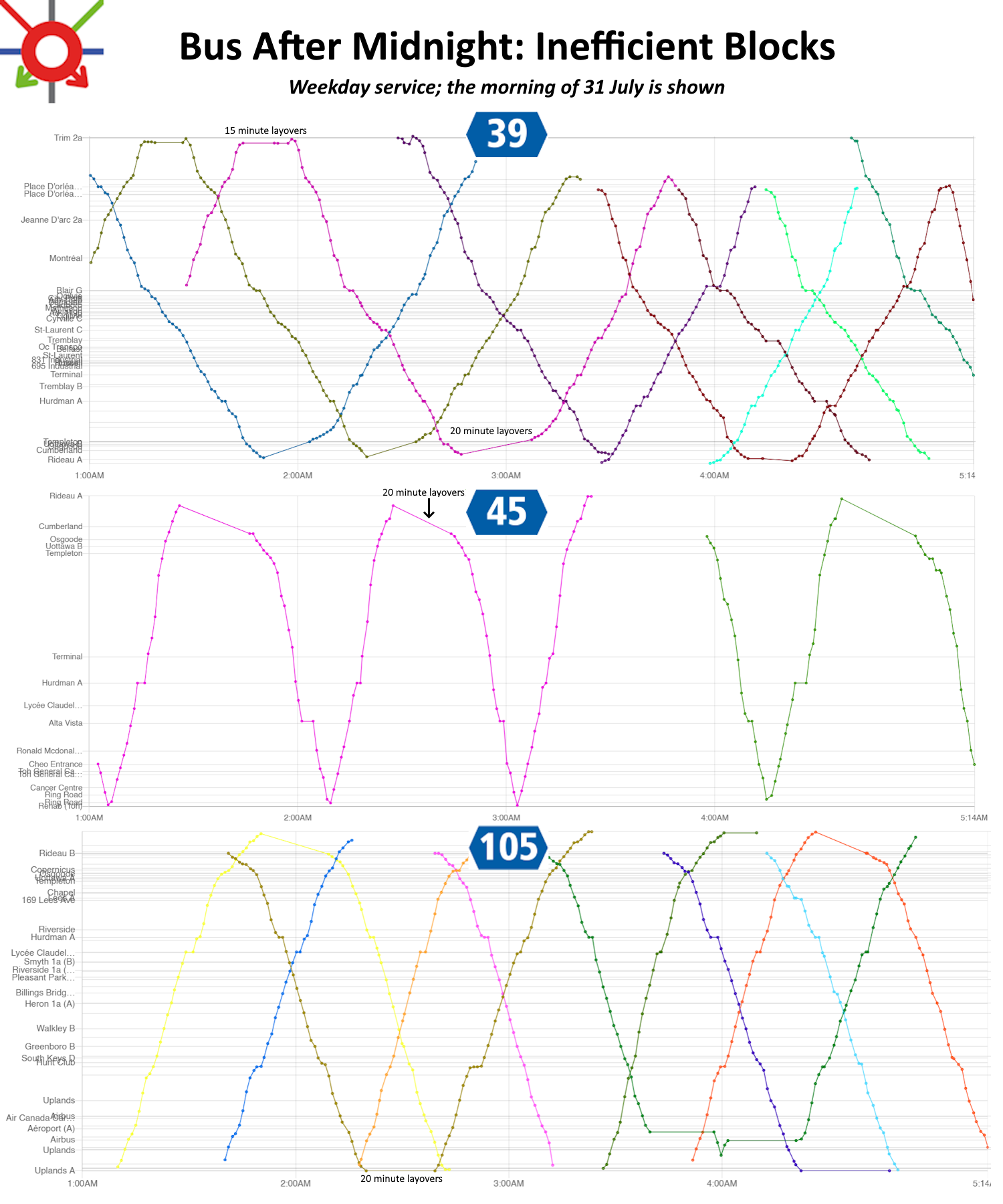
In a great irony, while OC Transpo's daytime network is full of inappropriate interlining, the night network has none, even though it would benefit from the through-running that interlining provides. Resources are, or should be, a continual problem in the overnight network. Ridership is low, and the service justifies itself on equity and dependability, not on productivity. OC Transpo, however, uses its dumb scheduling on the night network, which results in large inefficiencies as buses run ahead of schedule then spend 20 minutes in layover.
I have, in the past, commented on inadequate layovers on the surface network. However, this is for high-volume, high-traffic periods with uncertain runtimes. Night buses should not have 20 minute layovers anywhere, given low traffic and passenger levels.
Like with daytime service, none of the timetables in the night network are coordinated with each other; this impacts the network disproportionately, since the frequency of service is low and driving is fast (no traffic). There are two way this manifests.
First, as noted before, there is significant duplication across the network. While non-ideal from a network design perspective, this means that service should be more frequent in the joint corridor, as buses can be spaced out.
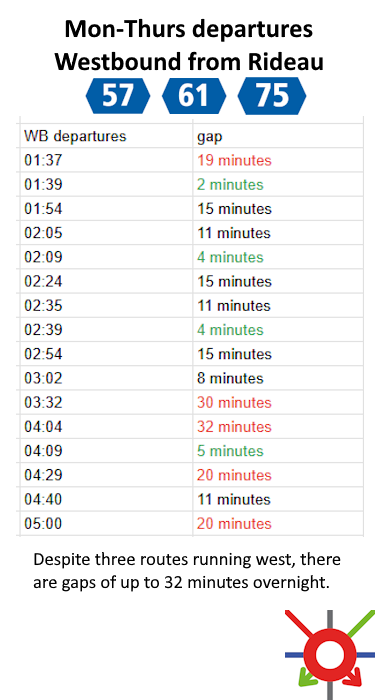
However, that is not what actually happens. Despite three routes running between Lincoln Fields and Rideau, they are not spaced well. Buses arrive and depart as close as zero minutes apart, but there are also gaps of over 30 minutes at other times. The duplication is not being put to good use, and due to uncoordinated schedules, riders face longer waits.
There are also transfers. All night service terminates at Rideau station, requiring a transfer to continue onwards in either direction. This is poor network design, as given the low frequencies and dark conditions, this can be uncomfortable or even unsafe for riders. As such, schedule design should aim to minimize transfers.
However, as seen in Part 1, OC Transpo has trouble coordinating its services to each other. The schedules for different night routes are created separately, apparently with no consideration of how they interact with each other. The problem is especially bad going west to east, but this problem appears in both directions. Weekday transfer wait times can be seen in the two charts below.
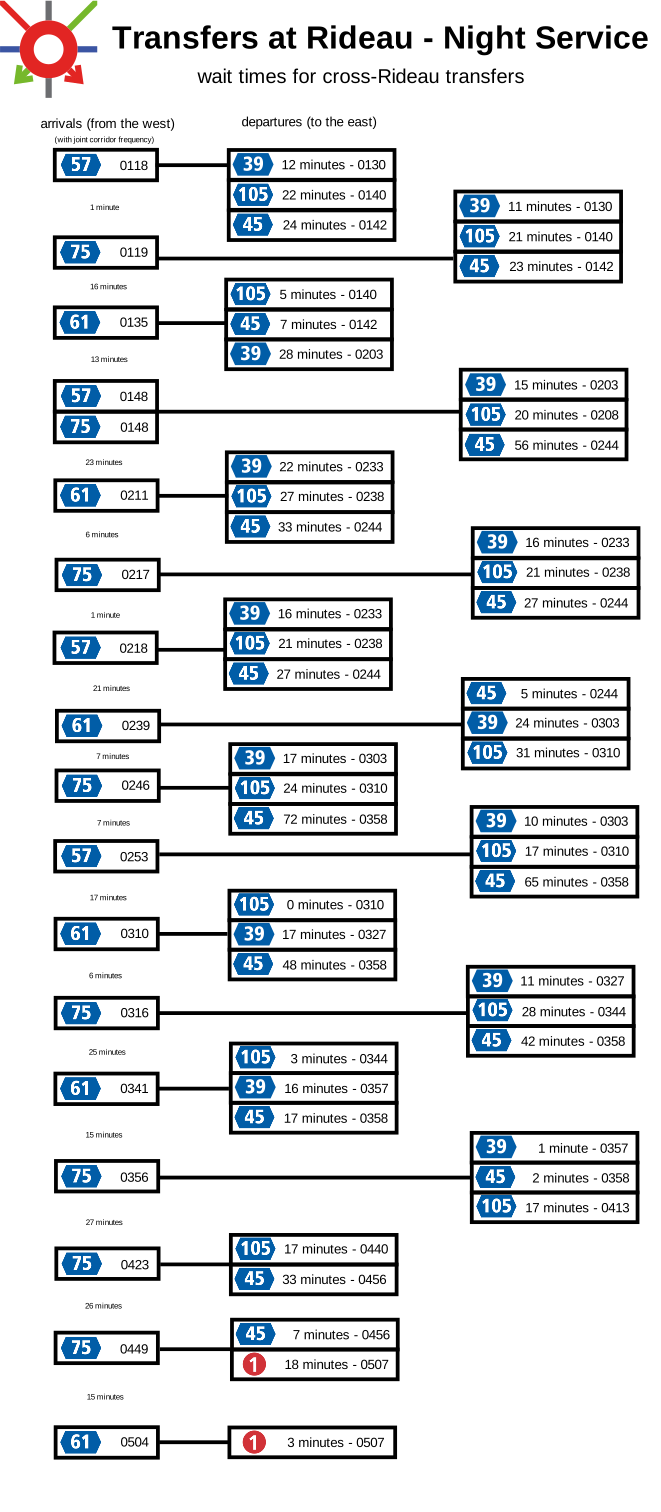
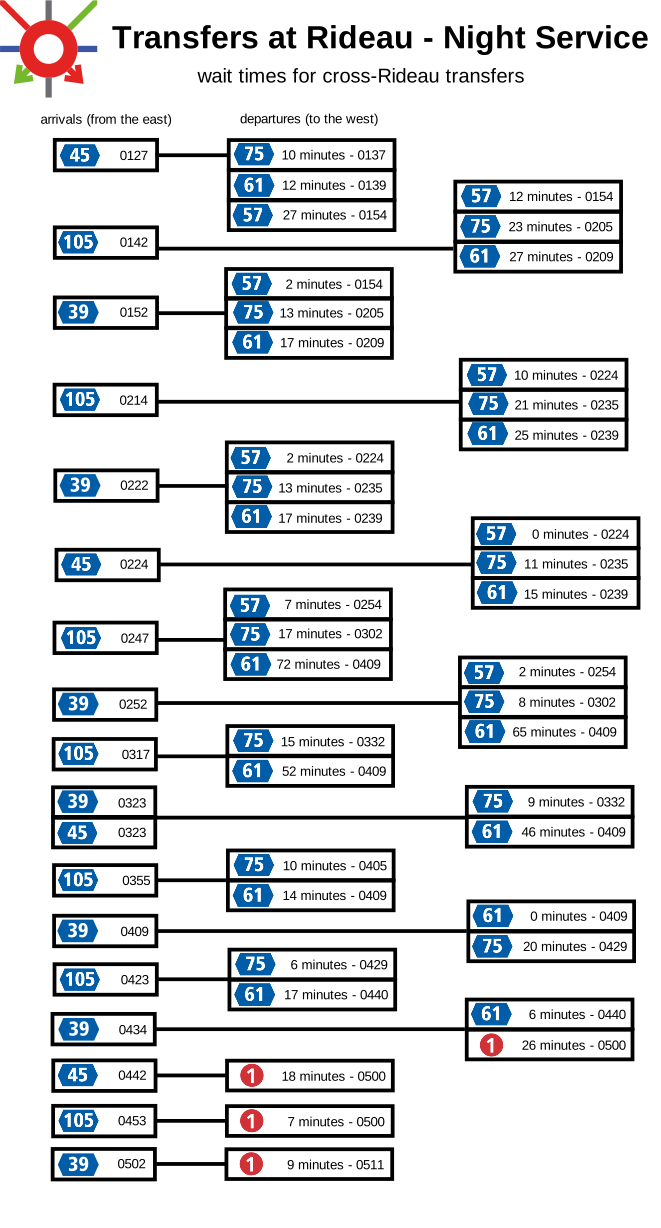
Buses do not coordinate transfers except by accident, and the network breaks at Rideau as a result.
Network Reform, Expansion, and Funding
A reformed network would increase efficiency, fill gaps in the network, and improve the transfer experience for riders. There are two ways the existing network can be modified.
The first is to interline routes, eliminating the transfer at Rideau altogether. In this model, one route would run the old 95 route from Place d'Orleans to Barrhaven Centre and one route would run the old 97 route from Terry Fox to the Airport, each every 30 minutes. The schedule would ensure that buses run every 15 minutes between Lincoln Fields and Hurdman, providing frequent (except for late night Line 1 gaps ...) service on that corridor, 24/7. This would also help reduce the excess layover time currently provided on the night routes, providing resources for improved Kanata-bound service.
The second is to run a pulse out of Rideau. Buses would arrive at roughly the same time every 30 minutes, turn around, and pick up and depart Rideau at roughly the same time. This would provide easier transfers between all destination pairs at the cost of duplicating service on the Rideau-Lincoln Fields corridor, although the N61 could be rerouted down Carling for extra coverage at the Civic Hospital and various development nodes.
In both scenarios, N45 would continue to operate hourly, and given its excess layover time, could be extended to Elmvale, providing 24/7 service to a major transit hub at low cost.
In a network reform scenario, both these proposals would provide better, more consistent overnight service without the need for an extensive funding .
If Council had a sudden and unexpected spark of ambition, a further expansion could improve the utility of the night network, although late night service runs into diminishing returns quickly in a city the size of Ottawa.
There are several destinations that could be plausibly served by such an expanded network and should be prioritized in such a scenario:
- Carleton University
- The Civic, Queensway Carleton, and Montfort hospital campuses
- Urban corridors, notably Bank Street and Montreal Road
- High density, low income neighbourhoods missed by the current network, especially Carlington, Vanier, and Herongate.
The cost would be held down by using routes with wide service spans today, reducing the "hole" that needs to be filled; hourly service would likely suffice for most of them.
Three obvious corridors emerge: Bank Street from Rideau to either Carleton University or Herongate; Montreal Road, which serves Vanier and the Montfort Hospital; and Carling Avenue, which provides coverage to the Civic Hospital, the TOD at Dow's Lake and Westgate, and Carlington. These routes could be interlined for further cost savings.
Of course, night network reform and expansion costs money for a low-ridership part of the day. The former package ("reform") is designed to use existing resources. Targeted interlining would reduce layovers and increase the amount of money available for service. There is considerable inefficiency in the night schedules, and since night service has low traffic and fast road travel, it can lower the layover time with minimal consequences.
Combining the N57 and N61 would also free up resources, as two routes (with their own associated inefficiencies) become one. Since the N57 does not really operate on weekends, there would still be some leftover cost, but two days of night operation is substantially cheaper than seven.
Finally, Friday service on Line 1 continues until two in the morning. Either the buses can be shifted to connect at Blair, Hurdman, and Tunney's on Fridays, or the LRT service (which as a reminder, makes no bus connections except the night network) can be cut back to one o'clock for further savings.
Network expansion (distinct from reform) would be an entirely new cost. Its value must be evaluated on a cost-benefit basis, prioritizing daytime service, which would benefit more riders.
Night Buses and Day Buses
As with the train-bus connections, the night bus network reveals a side of OC Transpo that is a problem both day and night, but is too complex to unravel with the simple tools at hand in the day network.
OC Transpo's operation of night buses is something for our civic leaders to be proud of, but it could be so much more improved for the riders who rely on it, with some humility and willingness to learn from other cities. However, as long as management and Council rely on brute force, first to budget service levels, then to schedule trips, night service will remain poor, burdened by low frequencies and awkward transfers while opportunities for savings and growth go unexamined.
This is the story of all bus service in Ottawa. The night network is merely a great exemplar.
Until next time.