
THIRD PARTY REVENUE OPPORTUNITIES WITHIN THE TRANSIT SERVICE
Report to/Rapport au:
Transportation Committee/Comité des transports
April 11, 2005/le 11 avril 2005
Submitted by/Soumis par: R.G. Hewitt
Acting Deputy City Manager/Directeur municipal adjoint intérimaire,
Public Works and Services/Services et Travaux publics
Contact/Personne-ressource: G. Diamond, Director/Directeur,
Transit Services/Service du transport en commun
842-3636 ext. 2271, gordon.diamond@transpo.ottawa.on.ca
| Ref N°: ACS2005-PWS-TRN-0003 |
SUBJECT: THIRD PARTY REVENUE OPPORTUNITIES WITHIN THE TRANSIT SERVICE
OBJET: OCCASIONS GÉNÉRANT DES RECETTES TIERCES DANS LES SERVICES DE TRANSPORT EN COMMUN
REPORT RECOMMENDATION
That the Transportation Committee receive this report for information.
RECOMMANDATION DU RAPPORT
Que le Comité des transports prenne connaissance du présent rapport à titre d’information.
BACKGROUND
The question of what additional revenue-generating opportunities may be available to the City through the use of transit vehicles or transit facilities was raised during the Universal Program Review in 2003 and during both the 2004 and 2005 Council budget deliberations.
This report provides background on the current revenue-generating activities and also identifies potential opportunities to increase revenues that are currently being pursued by staff.
The specific issue of charging for Park and Ride was raised during Council discussions of the 2005 Budget in March 2005.
A motion proposing the expansion of the monthly parking permit program to all of the City’s Park and Ride facilities to help offset the cost of public transit and also to investigate the impact of increasing parking permit fees to market levels was referred to staff for deliberations within the context of the report on Transit Services and Fare Policies. Accordingly, this report provides information on the potential to generate additional revenue through the introduction of a pay-for-parking program at all Park and Ride lots.
DISCUSSION
Currently, annual revenue of approximately $2.45 million is gained from the various initiatives that are in place, which are summarized in Table 1. There are a number of opportunities to generate additional revenue with transit vehicles and at transit facilities. Many of these revenue-generating initiatives also provide added customer convenience, which makes them doubly attractive. This report summarizes experience to date, identifies areas that are being explored further and discusses the potential for significant increases in these revenues.
Table 2 summarizes potential revenue generating opportunities and Table 3 summarizes the experience of some other large transit properties.
Current Revenue-Generating Practices
Convenience Stores
Concessions were introduced at Transitway stations a decade ago. They were introduced with the joint objectives of enhancing customer services and security, while generating additional revenue for the transit system.
Tomar Investments (Toronto) initially placed ten "Gateway " franchise concessions on the Transitway. Six of these proved not to be commercially viable thus there are four Gateway stores remaining at Orléans, Blair, Hurdman and Lincoln Fields Transitway stations. There are also two Quickie stores at the Baseline and Bayshore Transitway stations.
These six Gateway and Quickie locations provide total annual revenue of $30,000. In the spring of 2005, a Gateway store will be opened at the new Terry Fox Station in Kanata, which is expected to generate an additional $10,000 annually. These amounts are generated through the store leases but there is provision for additional payments should revenues exceed a certain amount: to date this has not occurred. In addition to their own convenience products, the Kanata store will sell OC Transpo photo IDs. This new initiative will make it possible for Kanata residents to obtain photo IDs without the necessity of opening a Sales and Information Centre at Terry Fox Station. This approach represents a cost saving for the City and, if successful, will be considered for future system expansions.
The current contract with Tomar Investments continues until June 2012. The agreement with Quickie at Baseline and Bayshore lasts until January 2006. Both contracts have involved investment by the contractor and, currently Tomar is doing major renovations at its Hurdman and Lincoln Fields locations. The recent RFP for the convenience store at Terry Fox Station drew very limited response.
Requests to start up additional concessions at OC Transpo Transit stations are dealt with on a case-by-case basis, however, it should be noted that some of the earlier concessions failed and the concessions remaining, although viable, are far from being highly profitable.
Automated Teller Machines (ATMs)
Following an open procurement process, ATMs were placed in 2004 at Transitway stations at Orléans, Blair, St. Laurent, Billings Bridge and Lincoln Fields with two more to be added at Hurdman and Terry Fox. These provide an annual revenue stream to the City of about $15,000 per year, which is expected to increase to $25,000 when ten ATMs are in place. The payments represent a share of the transaction fees collected by the ATMs on a per transaction basis. This contract expires in October 2008.
Advertising
The City receives advertising revenues from bus shelters, on-bus advertising and bus bench advertising. The contract for shelter advertising is held by Clear Channel and the contract for on-bus advertising is held by Pattison. Both contracts were awarded in July 2003 following an open RFP process, at a price of roughly half of the previous contracts’ price due to the poor state of the advertising market post 9/11. They run until 2008, with the option to extend a further two years if performance is satisfactory. The bench advertising contract is held by Creative Outdoor Advertising.
Shelters and Transitway Stations
The shelter advertising contract, which generates $660,000 in revenues in the year 2004-2005, increasing to $965,000 in the year 2007-2008, calls for Clear Channel to replace 300 shelters over the five year term with new design shelters and also to maintain all 624 existing advertising shelters. These conditions will save the City approximately $1.8-million in capital costs and $250,000 per year in operating costs. The contract covers all printed advertising in shelters and Transitway stations.
On-bus Advertising
The bus advertising contract generates $1.22 million per year in revenue and covers internal and external printed bus advertising including full ‘bus wraps’. Up to nine (1%) of the bus fleet may be wrapped in ‘contra-vision’ to display an advertising message using the whole bus exterior. However, currently the take-up is only two buses.
Bench Advertising
The Creative Outdoor Advertising bench contract extends until August 2008 and generates $170,000 per year. There are currently 585 advertising benches in place. The contract allows for up to 600.
Advertising on Transit Maps
There are also opportunities to advertise on the transit map, currently negotiated with WestJet. This brings in $10,000 annually.
Newspaper Boxes
There are newspaper boxes on the Transitway and, with the addition of more this year, these will generate more than $100,000 a year. In early March, the City entered into a contract with CanWest to distribute its new free tabloid ‘Dose’ at Transitway stations. Concurrent to this may be the introduction of a free Torstar tabloid called ‘Metro’, in addition to yet another free tabloid to be offered by the Sun publications. It is highly likely that the revenue from newspaper boxes can be doubled in the next year or two.
Charging for Park and Ride
Currently, the only Park and Ride site at which an across-the-board charge is made is Baseline. This is done to try to ensure that spaces in this lot, which is adjacent to Algonquin College’s main campus, are used by regular transit users. A monthly $15.50 permit is required to park at the lot before 11 AM. These are sold to bus pass holders at OC Transpo Sale and Information Offices. The revenue from these permits amounts to $38,000 annually.
Gold Parking Permit
The Gold Parking Permit program, which was introduced in April 2003, operates at the six mature urban Park and Ride lots, allowing customers to voluntarily pay $36 to be guaranteed a parking spot close to the transit platform. The lots at which the program operates are Orléans, Greenboro, Baseline, Fallowfield, and Eagleson East and West. Approximately 150 Gold Permits are sold per month. Total revenues from the Gold Permit Program amount to $52,000 annually. Council approved this program for up to 20% of Park and Ride spaces and so the program could be expanded to 600 spaces were demand to grow to this level.
Other Sources of Revenue
Pass Protection Plan
In 2004, students purchasing an annual bus pass were offered the opportunity to purchase protection against the loss of their pass (once) at a price of $23. Eighty percent of students opted for this protection, resulting in new revenues of $60,000.
Charter Service
OC Transpo responds to the needs of community event organizations and individuals who require chartered bus service, principally during off-peak hours, to avoid compromising regular transit service. Annual revenue of approximately $200,000 is achieved from chartered services, representing a net profit of approximately $50,000. Prices for chartered bus service range from $65 an hour to $100 an hour depending on whether the event is classified as city, festival or private; this stated in order of escalating rate.
Prior to 2004, the City had absorbed a cost of more than $100,000 per year through the provision of free Sno-bus and Tulip Shuttle service. This loss has been effectively eliminated by charging $2.50 for a day pass for the service.
The current strategy to increase revenue from charter services is to set higher prices in accordance with market acceptability, as well as by working more closely with repeat customers and tourism and convention organizers in order to offer more charter services and derivative products (e.g. convention transit passes).
Greyhound Ticket Sales
The partnership between OC Transpo and Greyhound generates $10,000 in ticket sales commissions on an annual basis. This represents 10% of ticket sales. The partnership allows Greyhound to use the Transitway and Transitway stations providing convenient access to inter-city services for OC Transpo customers. OC Transpo Sales and Information offices sell Greyhound tickets.
Sightseeing Bus Operating Fees
The City of Ottawa Act grants to the City of Ottawa as represented by Transit Services (OC Transpo), exclusive franchise for operating a passenger transport service, with some exceptions, within the City of Ottawa. In 2000, the Transit Commission set the operating conditions and fees to grant private operators authority to operate sightseeing services. The operating fees are $2,000 per vehicle operated with a maximum of $10,000 annually. In 2004, sightseeing operations generated $16,000.
Sponsorship of Free Service
There are times at which it is important to encourage transit ridership and also for operational reasons to provide free transit.
Each year staff look for sponsors for free New Year’s Eve service and also free service after 9:00 p.m. on Canada Day. This year, Telus provided $8,000 towards the cost of free New Year’s Eve service after 10:00 p.m.
Potential Revenue-Generating Opportunities
Staff is engaged in pursuing other opportunities to generate revenue. These are summarized in Table 2 and described below.
Advertising
Fare Media
We are actively seeking advertising on transit fare instruments and hope to generate some revenue in this way when the new passes and tickets are printed for the July 1 fare increase.
Billboards at Park and Ride Lots
The billboards at Park and Ride sites are being pursued as a city-wide project by the Corporate Services Department. Transit Services is providing input about the opportunities available in Park and Ride lots, respecting the constraints of the Ministry of Transport of Ontario and the National Capital Commission.
Electronic Advertising
The City entered into an agreement in 2001 with VideoLinks to install advertising screens at Transitway stations. This agreement was to have generated $800,000 per year after the phase-in period. Unfortunately, VideoLinks went out of business and no revenue was gained.
Nevertheless, the technology is slowly evolving and there are now examples of successful electronic advertising programs in the North America transit industry. For example, Toronto has had a clock with scrolling advertising at various subway stations for a number of years. Under an advertising agreement with Viacom, they have recently replaced five of these older clock units with 43” flat screens. One-half of the screen is devoted to advertising, of which TTC gets a percentage of free promotional time, while the other half of the screen shows news, weather, sports etc. contracted from a cable firm. As this is a fairly new application with significant start-up costs, the contract calls for TTC to receive no revenue for the first two years of operation. Starting in the third year, they receive 10% of the advertising revenue, or $375,000 per year, whichever is greater. Another example is Montréal where STCUM receives $100,000 annually from electronic message boards located in their subway cars.
Electronic video advertising is beginning to show promise and is one that staff is pursuing.
Pass Holders
Currently, plastic holders are provided for customers who use bus passes. These keep the photo ID and monthly voucher together and arranged so that they can be easily checked by the bus driver.
It is proposed to stop the practice of purchasing 300,000 plastic wallets, at a cost of $15,000 annually, and take advantage of two revenue-generating sources:
§ Leather wallets will be available for purchase at OC Transpo Sales and Information offices at a cost of $5.00. The City will receive $2.25 from each sale and it is estimated that $18,000 per year could be generated in this way.
§ We will also distribute free pass holders provided by an advertising firm. OC Transpo will be able to use 30% of the space for transit advertising: the remainder will be used for other advertising; fifteen percent of the advertising revenue will be paid to the City. It is expected that this program will generate $25,000 per year.
Pass Protection Plan
A proposal to introduce an annual adult pass for 2006 will be brought forward later this year. If this were approved, a protection plan similar to that for the Student Annual Pass would be offered which would generate in the order of $45,000 per year.
Charging for Park and Ride
Preliminary work done to date has shown that the majority of transit systems across Canada do not charge at Park and Ride lots. A summary of information gathered from other transit properties is shown in Table 4.
It is estimated that the net new operating revenue generated by a mandatory paid parking system at Baseline, Eagleson East, Eagleson West, Fallowfield, Greenboro and Orléans Park and Ride lots would be between $190,000 and $240,000 annually. The capital costs for ticket dispensers, signage, infrastructure, and public information would be about $380,000. These numbers assume a $15.50 monthly permit system with $2/day per space for casual users. They also maintain the $36 Gold Parking Permit arrangement, although it is recognized that the numbers sold would reduce.
This revenue would be gained at a cost of between 55,000 and 90,000 customer-trips annually and therefore, is not recommended.
Pricing for Transit Maps
Transit maps, of which 130,000 are produced each year, have traditionally been free. However, it is proposed to print a $1 price on the 2005/6 maps, which would make it worthwhile for OC Transpo pass and ticket vendors to stock them. Although it is assumed that the majority of maps would continue to be free (in the initial distribution of maps when the new map is available and throughout the year at open houses etc.) this approach is expected to generate $20,000 in new revenue and have the added benefit of attributing a ‘value’ to the map.
Vending Machines
Consideration has been given to installing vending machines at Transitway stations to achieve increased annual revenue of at least $25,000. However, this initiative has been delayed because of concerns related to security as well as the effect vending machines might have on the businesses of current concession operators.
Revenue-Generating Practices Elsewhere
Staff has done a survey of revenue-generating practices at a number of transit companies elsewhere. Results of this survey appear in Table 3. The overall theme running though all transit properties is that, for the most part, they derive non-farebox revenue from similar sources. Interior and exterior bus advertising, transit shelter advertising and bus bench advertising are the biggest sources of revenue. Revenue from convenience store concessions seems to exist at the larger operations and is almost non-existent at smaller properties. Toronto and Montreal each draw $3.0 million from this source, mostly due to having subway systems with large volumes of customers.
SUMMARY
There are many revenue sources associated with operating the transit system. Staff is constantly on the lookout for opportunities to increase revenues without a negative impact on customers and ridership.
Currently, the City is receiving approximately $2.45 million in additional revenue annually and efforts are being made to increase this amount.
It is expected, however, that at least $120,000 of additional new non- farebox revenue can be generated each year starting in 2006.
CONSULTATION/PUBLIC NOTIFICATION
The Pedestrian and Transit Advisory Committee was consulted on the subject of implementing an across-the-board charge in Park and Ride lots. They did not support the proposal because of its impact on transit ridership. Their response is attached as Appendix A.
The issue of billboard advertising in Park and Ride lots has been discussed with Corporate Services staff and is being pursued by that department as a corporate initiative.
TRANSPORTATION MASTER PLAN
The direction to increase revenue sources without having an impact on transit ridership is consistent with the Transportation Master Plan assumptions on improved cost-recovery.
FINANCIAL IMPLICATIONS
This report summarizes the revenues currently generated and those initiatives being pursued within Transit Services. Any additional revenue generated will be reflected in the annual operating budget of the department.
SUPPORTING DOCUMENTATION
Table 1 Existing Revenue Generating Possibilities
Table 2 Proposed Revenue Generating Possibilities
Table 3 Methods of Non Fare Box Revenue Generation – Other Properties
Table 4 Park and Ride Charges at Other Transit Properties
Appendix A Letter from Pedestrian and Transit Advisory Committee Opposed to Proposal to Apply Across-the-Board Charges at Park and Ride Lots
DISPOSITION
Staff will continue to develop revenue-generating opportunities with the objective of maximizing revenues without reducing ridership.
TABLE 1 EXISTING REVENUE-GENERATING INITIATIVES | |||
Opportunity | Current Status | Annual Revenue Generated | Comments |
Convenience Stores | $40,000 | ||
Automatic Teller Machines | Five ATMs at Transitway stations: two more to be added at Hurdman and Terry Fox. | $15,000 | RFP based on 10 ATMs in place for $25,000 per year. Important to place where security is strong. |
Advertising in Shelters and Transitway Stations | Contract with Clear Channel. | $660,000 | Contract in place until July 2008.Determined by RFP. Shelter advertising contract includes print advertising rights at Transitway stations. Saves $1.8 million in capital and $250,000 per year. |
Advertising on Buses | Contract in place with Pattison. | $1.22 million | Contract in place until June 2008. Determined by RFP. |
Advertising on Benches | Contract with Creative Outdoor Advertising. | $170,000 | Contract in place until August 2008. Determined by RFP. |
Advertising on Transit Maps | WestJet | $10,000 | 130,000 maps distributed. Offer made following search by Staff for sponsor. |
Newspaper Boxes | 300 in place. | $100,000+ | |
Permit Parking at Baseline | $15.50 charge applies to all Baseline spaces before 11:00 a.m. | $38,000 | Used to control use of park and ride lot by Algonquin College students. Council approval obtained. |
Gold Permits | Introduced in April 2004 at six Park and Ride lots. | $52,000 | Revenue could increase by a factor of four as take-up increases. Council approval obtained. |
Annual Student Pass Protection | Introduced in 2004, 80% acceptance. Sold at $23 per plan, one replacement. | $60,000 | Achieved revenue of $60,000. Responsibility shift to customers. Optional customer service initiative. |
Charter Services | In off-peak and summer months only. | $50,000 | Festival services provided at cost. Commercial charters provided at market rate. |
Sightseeing Services | Operating fees - $2,000 per vehicle operated to a maximum of $10,000 annually. | $16,000 (2004) | Operating Fees set by the Transit Service Committee in 2000. Authority granted in cooperation with Traffic and Parking. |
Greyhound Pass Sales | Tickets sold at Sales and Information Centres. | $10,000 | Remuneration for sales of Greyhound bus tickets. |
Sponsorship of Free Service (Canada Day, New Year’s Eve) | Telus sponsored free New Year’s Eve service after 10 p.m. in 2004. | $8,000 | Opportunities for Canada Day and New Year’s Eve. Offer made following search by Staff for sponsor. |
Total | | $2.449 million | |
TABLE 2 PROPOSED REVENUE-GENERATING POSSIBILITIES | |||
Opportunity | Current Status | Annual Revenue Generated | Comments |
Advertising on Fare Instruments | None | $12,000 | Looking at possible advertisements on passes, transfers, etc. Sponsors determined following search by staff. |
Billboards | To be investigated by Corporate Services. | TBD | Focus would be on Park and Ride lots. To be determined by RFP. |
Electronic Advertising | None currently in place. | TBD | Previous unsuccessful experience with Videolinks. Proponent misread the market for this type of advertising. Abandoned the project. Revenues of $800,000 per year were ‘guaranteed’ in original contract. However, technology has evolved and there are indications in the marketplace that this form of advertising is becoming viable as a business. To be determined by RFP. |
Pilot Distribution of OC Transpo Pass Booklets | Currently, OC Transpo spends $15,000 on 300,000 plastic holders – photo IDs and passes. Bookman Group to produce 400,000 booklets centering plastic holders. | $25,000 | Booklets supplied free to pass holders. Free supply quarterly by Bookman Group. 10 of 30 page booklet to City/OC Transpo. 15% revenue from ads goes to OC Transpo. This will also save $15,000 of current expenditures. Unsolicited proposal accepted, but to be followed by RFP. |
Pilot Sale of Leather Wallet Holders | City contracted Spectrum Adv. to pilot sale of wallets at Sales and Information Centres. All risk assumed by Spectrum. | $18,000 | 10,000 wallets for sale at $5.00 each. City to receive $2.25 each. Revenue based on 8,000 sold. Unsolicited proposal accepted, but to be followed by RFP. |
Adult Annual Pass Protection | Planned for 2005 introduction. Anticipate 50% acceptance on 4,000 annual pass sales. | $45,000 | Based on success of standard protection plan. Annual Adult Pass planned for December 2005. |
Across-the-Board Charges at Park and Ride Lots | Being investigated: would have $15.50 permits and $2 daily parking available. | $190,000-$240,000 | Capital costs of $380,000. Ridership loss of 55,000 to 90,000. Not recommended. |
Sale of Transit Maps | Transit maps are free. | $20,000 | |
Vending Machines | $25,000 | Security concerns. Competes for space with Newspaper Boxes. To be determined by RFP. | |
TABLE 3
METHODS OF NON FARE BOX REVENUE GENERATION – OTHER PROPERTIES
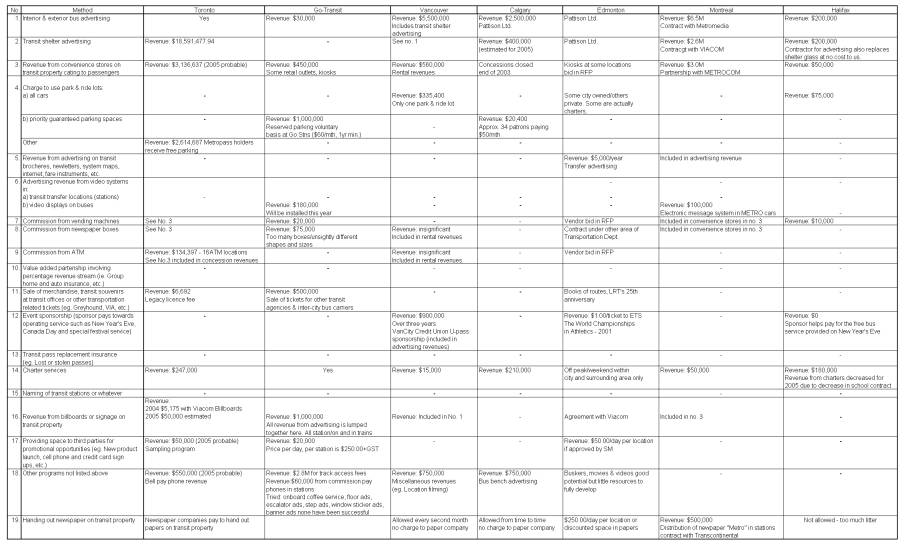
TABLE 4
PARK AND RIDE CHARGES AT OTHER TRANSIT PROPERTIES
Location | Description and Pricing Scheme |
Toronto | There are 23 locations providing over 12,000 spaces. Use of lots is free for Metropass holders. On average, the lots are operating at 97% of capacity. There are plans for the expansion of the park and ride system within the next 5 to 10 years. The fee for cash-paying customers is $2 to $6 per day depending on lot location. In terms of operations, there is no parking attendant at the lots. Few of the lots are equipped with gates at the entrance. This has been causing problems when the lot reaches capacity, as the users pay at the gate to enter, and then realize that there is no spot available. There is no signage available to show whether the lot is full. In other lots there are pay and display machines installed. There are also complaints about customers parking illegally in some lots. The Municipal Parking Authority is responsible for ticketing violators. In March 2001, a survey of park and ride users was carried out to determine the home origin of drivers using selected TTC lots. About 60% of users live outside the City of Toronto. This figure is higher (up to 86%) for lots located at the outskirts of the City. |
Greater | There are a total of 41,800 parking spaces and the overall utilization rate is 89%. Permit holders occupy 20 to 25% of the spaces in lots, and the remainder is free parking. Parking permits guarantee a parking space for the permit holder at a cost of $60 per month and permit holders are required to sign a one-year contract. GO transit security personnel enforce parking regulations. At some lots parking spills over to adjacent streets. Currently there is a waiting list to obtain a permit at four park & ride lots. GO Transit is studying the introduction of mandatory daily paid parking. |
Vancouver | There are 21 locations providing approximately 5,000 spaces. All lots except one are free. The charge lot is heavily used due to its location near a Skytrain station. In return for paying a fee of $1 per day, security patrol has been provided. There are sporadic incidences of customers parking illegally in this and few other lots. The Municipal Parking Authority is responsible for ticketing violators. There is no significant capacity problem at other lots. All the lots operate on a first-come first-served basis. If any lot is full, extra demand spills over to adjacent streets and/or nearby shopping centers (if any). Lots located in remote areas are under capacity. |
Calgary | There are 30 locations providing approximately 11,000 spaces. All lots have free parking, and at one lot a pilot project has been initiated where a monthly permit is available for $50 per month. The permit provides the user with a reserved spot located close to a light rail station, and revenue generated from permit sales is used to improve maintenance and security. There is capacity problem at LRT stations, which account for about 80% of total spaces at park and ride lots. The remaining 20% are bus-only lots and are not fully utilized. There is 1-2 hour parking restriction at adjacent streets. There are incidences of users parking illegally on circulation areas and other unmarked spaces. However, the City does not take a pro-active role in ticketing the violators and mainly responds to complaints from citizens by sending ticketing officers to the site. The City also receives complaints about lack of capacity at LRT stations. To alleviate the problem there will be an additional 800 spaces developed in 2005 by expanding the South, North West, and North East LRT lots, respectively. |
Edmonton | There are 4 locations providing approximately 2,800 spaces. All lots are provided free of charge except during special events, where a $2 charge is applied. Two of the lots located near the LRT are at full capacity. The capacity at one of the lots was recently significantly increased that eliminated the overflow parking problem. The other lot is located near a low-density residential area. When the lot is full, extra demand spills over to adjacent streets in that area where there is no restriction on on-street parking. There have been occasional incidences of customers parking illegally in the lots. Edmonton Transit has the responsibility for ticketing violators. The capacity problem is less severe at other lots, however if they get full, customers have to find a parking place nearby or in the shopping centers. Some shopping centers issue tickets to patrons who use their space as a park and ride lot. |
Gatineau | Currently 12 parking lots provide a total of over 1,400 spaces. A permit is required at two parking lots, and there is no charge to attain a permit or park at any park & ride lot. ‘Bait cars’ are used to deter car theft and a surveillance camera is located at an Alymer park & ride lot. Five of the lots are often full, and at some lots parking overflows on to adjacent streets. There are plans to develop six additional Park & Ride lots with an additional 1,800 parking spaces, when the Rapibus project is implemented. |
Winnipeg | Currently 9 parking lots provide a total of 240 spaces. A permit is required at some parking lots, and there is no charge to obtain a permit or park at any park & ride lot. Parking spaces are available on a first come first serve basis. Park & ride lots are typically located at a grocery store or church parking lot, and the transit provider enters into an agreement with the private property owner to allow the use of their parking lot. Two lots are reaching full capacity. There are plans to partner with other property owners and provide up to 420 new spaces located at five new park & ride lots. |
APPENDIX A

M E M O / N O T E D E S E R V I C E |
|

To / Destinataire | Joel Koffman, Program ManagerScheduling and AnalysisTUPW | File/N° de fichier: 08 19 04 |
From / Expéditeur | Donna Mulvihill, Coordinator Pedestrian and Transit Advisory Committee | |
Subject / Objet | Pay Parking at Park and Ride Lots | Date: September 8, 2004 |
At a meeting of Pedestrian and Transit Advisory Committee members on 19 August 2004 the regular update provided by the OC Transpo representative on this organization's activities, performance and upcoming service changes included a request for members' views on whether the city should try to obtain extra revenue from Park and Ride locations by charging for at least all parking at all lots during the morning hours. Possible rates were mentioned. Discussion ensued and Committee members were unanimously not in favour of any extension of current charging practices at this time for the following reasons.
- Loss of ridership would occur.
- More vehicles would enter the already congested inner core of the city during peak hours leading to longer journey times and added air pollution.
- Transit riders who will soon have to react to early morning and evening service cuts in suburban and urban feeder routes as a result of Budget 2004 decisions by driving to Park and Ride lots to access transit-way routes will AGAIN be targeted.
- Many will perceive such a move as a " cash grab ". Fare increases related to cost of living indices are the more ethical means of raising extra revenue from riders.
- The foregoing reasons run counter to the transit and other transportation goals in the City's Transportation Master Plan and Official Plan.
Therefore, it is strongly suggested that extra revenue generation from parking charges at Park and Ride locations not be sought during the next 12 to 15 months.
Original Signed by:
Donna Mulvihill, Coordinator