
TRANSIT SERVICE IN VILLAGES AND RURAL AREAS - STATUS REPORT AND SHORT-TERM RECOMMENDATIONS
Report to/Rapport au:
Transportation and Transit Committee/
Comité de transport & des services de transport en commun
and Council/et au Conseil
December 20, 2002/le 20 décembre 2002
Submitted by/Soumis par: R.T. Leclair, General Manager/Directrice générale,
Transportation, Utilities and Public Works/Transport, services et travaux publics
Contact/Personne-ressource: G. Diamond, Director/Directeur,
Transit Services/Service du transport en commun
842-3636 ext. 2271, gordon.diamond@transpo.ottawa.on.ca
| Ref N°: ACS2002-TUP-TRN-0015 |
SUBJECT: TRANSIT SERVICE IN VILLAGES AND RURAL AREAS - STATUS REPORT AND SHORT-TERM RECOMMENDATIONS
OBJET : SERVICE DE TRANSPORT EN COMMUN DANS LES VILLAGES ET LES SECTEURS RURAUX – RAPPORT D’ÉTAPE ET RECOMMANDATIONS À COURT TERME
REPORT RECOMMENDATION(S)
That the Transportation and Transit Committee recommend Council approve:
1. The cancellation of Route 730 (Orléans to Notre-Dame-des-Champs and Navan) because of low ridership;
2. The cancellation of the 8:30 p.m. trip on Route 720 (Orléans to Cumberland Village) because of very low ridership; and
3. The implementation as soon as possible of changes to the routes and schedules of Routes 163 (Stittsville), 283 (Richmond), and 720 (Cumberland Village).
RECOMMANDATIONS DU RAPPORT
Que le Comité des transports et des services de transport en commun recommande au Conseil d’approuver :
1. L’annulation du circuit 730 (d’Orléans à Notre-Dame-des-Champs et Navan) en raison du faible taux d’achalandage;
2. L’annulation du service de 8 h 30 sur le circuit 720 (d’Orléans au village de Cumberland) en raison du très faible taux d’achalandage;
3. La mise en oeuvre le plus tôt possible de modifications aux circuits et aux horaires des circuits suivants : 163 (Stittsville), 283 (Richmond) et 720 (village de Cumberland).
BACKGROUND
Following a widespread public consultation program and extensive discussion at two joint Committee meetings of Transportation and Transit Committee and Agricultural and Rural Affairs Committee on March 20, 2002, and April 3, 2002, and at its meeting on April 10, 2002, Council approved the provision of transit services in villages and rural areas of Ottawa to begin in September 2002.
Council approved the establishment two new areas where service would be provided outside the Urban Transit Area: Rural Transit Area A, where residents would have access to regular transit services and Para Transpo service, and Rural Transit Area B where only Para Transpo service would be available. The boundaries of Rural Transit Area A were modified at a Council meeting on April 24, 2002, to exclude Greely, West Carleton, and northern Kanata. The approved Rural Transit Area A and Rural Transit Area B are shown in Exhibit 1. Based on the estimated costs and revenues for the period from September to December 2002, a transit levy on a $150,000 property of approximately $14.31 in Rural Transit Area A and $2.16 in Rural Transit Area B was approved.
Fares were set on the assumption that fares would cover 50 percent of the costs of regular transit service and 20 percent of the costs of Para Transpo services. The fares for regular service are summarized in Exhibit 8.
The approved plan was based on the assumption that, while the bulk of the new services would be supplied directly by OC Transpo, the local bus service in Stittsville and the rural connector services would be acquired through a tender process. Cooperation with private intercity bus companies to enhance the services they now provide to residents outside the City and in Rural Transit Area Zone B was also a part of the approved plan.
Council directed staff to provide a status report concerning ridership, operating experience, costs and recommending any immediate changes needed in mid-December 2002. This report responds to that direction. Staff were also directed to present a second status report, in April 2003, concerning ridership on each service, park and ride lot usage, operating experience, costs and providing the results of an attitude survey of a random sample of rural residents. This report was to be presented before final tax rates were set for 2003 and could include recommendations for changes to services, transit area boundaries, and/or funding strategies.
DISCUSSION
Regular Transit Service
Implementation
Following the decision by Council, staff worked with Councillors and residents of the villages and rural areas to plan the details of the routes and schedules for the new services. The routes as implemented in September 2002 are shown in Exhibits 3 to 7.
In total, 81 hours of service per weekday are provided on the six rural express routes, four local services connecting to Transitway stations inside the Urban Transit Area, a local service in Stittsville, four connector routes and the extension of Transitway route 97 to Stittsville. This is summarized in Exhibit 9.
Eleven of the new services (Routes 97, 183, 186, 196, 199, 231, 232, 262, 263, 283, and 296) are operated by City employees. Fourteen new transit operators were hired to cover this requirement.
A small part of the new service was offered to private contractors through an open tender process. The contracted services, which amounts to 19 percent of the overall service hours, operate mainly in the rural areas, and are not designed to carry passengers for trips starting and finishing inside the Urban Transit Area.
Eight new park and ride locations were established, where village and rural residents can drive their cars and then board buses for travel toward the central part of Ottawa. The park and ride locations at Leitrim, Manotick, Navan, Notre-Dame-des-Champs, and Stittsville (Carp Road) are within City-owned parking lots, generally at arenas and community centres. The location at Carlsbad Springs is within the parking lot of GreyHawk Golf Course, the location at Richmond is within the parking lot of the Richmond Promenade shopping plaza, and the location at Vars is at a carpool lot owned by the Township of Russell. Staff entered into agreements with the owners of these lots for their use by transit customers.
The scheduled bus requirements for City-provided services are nine on a weekday, which means that eleven buses are needed in the fleet. Seven new articulated buses were added to an order that was already underway. These buses are used on busy routes in the urban area, and have made eleven 40-foot buses available to operate the rural services. The new buses were delivered and put into service in November 2002. As an interim measure, between September and November 2002, seven older articulated buses, which would normally have been retired, were kept in service.
One new small bus will be leased for one year, to replace one of the 40-foot buses in the fleet, and will be used to provide the new local services from Richmond and from Manotick. This bus is expected to arrive in early 2003. As an interim measure, between September 2002 and the arrival of the small bus, a 40-foot bus has been used to provide these services.
To ensure continuous communication between buses on the new rural services and the OC Transpo Control Centre, and to maintain the City’s safety and security standards, an expansion of the transit radio system was required to cover the new areas served.
Staff reached agreements with thirteen merchants in the villages and rural areas to act as vendors for transit tickets and passes, and as a distribution point for information on the new services. Vendors are in place in Carlsbad Springs, Cumberland Village, Kars, Manotick, Navan, North Gower, Notre-Dame-des-Champs, Richmond, Stittsville, and Vars.
Promotional and information material was prepared and distributed to advise prospective customers of the new services in the villages and rural areas. The services were advertised on OC Transpo buses, on radio, and in newspapers. A new transit system map was developed, which showed the new services and listed also the private intercity bus companies that provide commuter service into Ottawa. Detailed pocket timetables were made available for all of the new services. Information is also available on the OC Transpo web pages and through the transit telephone information office. A major part of the promotional program centred on free fares, which were offered on the rural services during the month of September.
Operating Experience
Ridership
A summary of ridership counts taken on each of the new services is presented in Exhibit 2. During the month of September, free fares were offered and the higher initial ridership reflects this. Overall, ridership on most of the rural express services that run directly to downtown at peak periods has grown quickly, and has met or exceeded expectations. Ridership on the all-day local services is growing more slowly, and is below the expected level. Ridership on the contracted connector services is below the expected level.
Feedback from Customers
Customers of the new services have made many helpful suggestions and comments. Between September 1 and November 30, the OC Transpo Customer Relations office received 200 written or verbal communications about service in the villages and rural areas. In addition to these comments, some customers have contacted Councillors’ offices or have made suggestions directly to transit staff. The comments have been overwhelmingly supportive of the services, and many have made suggestions for further expansion and improvement. All of the comments and suggestions from customers are evaluated, and those that can be acted-on immediately are. The next report to the Committee will include any resulting recommendations for changes to the services. Some of the most commonly received suggestions for future improvements have been:
- Customers on Route 231 from Navan and Notre-Dame-des-Champs have asked that an earlier trip be provided;
- Customers on Route 232 from Vars have asked that the route be faster and more direct to downtown, without the section through Carlsbad Springs;
- Customers in Stittsville have asked that Route 97 serve more of the residential areas of the village; and
- Customers on Route 296 from Manotick have suggested that the fare on that route should be lower, to recognize its shorter distance.
Minor Service Changes Already Made
There have been a few operational concerns with the new services. Some matters that have been addressed are:
· The schedule for Route 783 between Munster Hamlet and Richmond did not allow sufficient time for the bus to make the trip, and so changes were made before the service started in September 2002;
· The routing of Routes 183, 283, and 783 within the parking lot of the Richmond Promenade shopping plaza has been changed slightly; and
· The routing of Route 232 via Anderson Road in the morning peak period has been compared to a possible alternative routing via Highway 417, and the present route has been found to be more reliable;
- The trip times of Routes 283 and 783 in the morning peak period were changed by a few minutes in December 2002, to allow for improved connections and a shorter waiting time at Richmond;
- The time of the second trip on Route 296 from Manotick in the morning peak period was changed by a few minutes in December 2002, to allow for an earlier arrival time downtown; this also affected the time of the morning trip on Route 796 from North Gower and Kars, which connects with the second trip on Route 296 in Manotick; and
- The park and ride location at Notre-Dame-des-Champs was changed from the parking lot of the Église Notre-Dame-des-Champs to a City-owned lot at the Notre-Dame-des-Champs Community Centre, by mutual agreement, to reduce maintenance costs.
Short-Term Recommendations
It takes time to build ridership on new transit services, and in this context, three months is not long. However, it is clear from the information we have so far that some action should be taken in the short-term.
It is recommended that Route 730 be cancelled. This route operates from Place d’Orléans Station to Notre-Dame-des-Champs and Navan in the afternoon and evening. The route was established to serve as a way for people to travel home from Orléans from after-school events and work, and for people who had used Route 231 in the morning to travel home later in the evening. So far, ridership on this service has been very low, with fewer than four customers on each trip on most days and no more than eight customers on any trip since the service began. If the cancellation is approved, the last day of service on Route 730 would be Friday, February 14.
It is recommended that the evening trip on Route 720 be cancelled, and that the afternoon trip be shortened to begin at Place d’Orléans Station instead of at Innes and Tenth Line. Like Route 730, the evening trip was introduced for people travelling home later after school, and ridership has been very low, with fewer than three customers on most days and no more than seven customers on any day since the service began. By contrast, the morning and afternoon trips on this route have been used by 15 to 20 customers on most days, and should be retained. The last day of the discontinued trip would be Friday, February 14.
Staff are working with the Councillors and with community groups to identify changes that would improve ridership on three routes:
- Ridership on Route 163, the local service in Stittsville, has been well below the expected levels. Staff will explore ideas to change the route or the schedule to better meet residents’ local travel needs. Any changes would be introduced as soon as possible in February or March.
- Ridership on the third afternoon trip on Route 283, from downtown to Richmond, has been very low. Staff are examining an option to change the times of all three trips in the afternoon to allow for ridership growth to be accommodated earlier in the afternoon peak period. These changes would be introduced on Monday, April 21, 2003 with the next service change.
- If the recommended changes for Routes 720 and 730 are approved, it would be possible to make some adjustments to the time of the afternoon trip on Route 720, from Place d’Orléans Station to Cumberland Village. Staff would survey the customers on the afternoon trip to determine whether a change would be more of a benefit than an inconvenience to the customers. Any change would be introduced as soon as possible in February or March.
Recommendations for the overall service, based on additional ridership information and the results of the overall monitoring program, will be included in the April 2003 report.
Para Transpo Services
Implementation
Prior to September 2002, Para Transpo was available in some areas outside the Urban Transit Area. In September 2002, the service was made available across the entire rural part of the City of Ottawa. Rural Para Transpo service, like the service inside the Urban Transit Area, is provided by both Para Transpo contractors, FirstBus and Westway Taxis, with 87 percent of the trips provided by FirstBus Canada.
Operating Experience
Ridership
Ridership on the new Para Transpo service in the villages and rural areas has been lower than was expected, but because the average trip length has been greater than expected, the costs and fare revenue are close to the expected level. There have not been as many short trips within Stittsville, Richmond, and Manotick as had been expected. Through September, October, and November, 1,032 trips had been made on Para Transpo to, from, or within the villages and rural area, with an average trip length of 23 km. This compares to 467 trips in the same period in 2001. Two-thirds of the 1,032 trips were made by Para Transpo customers using wheelchairs, compared with 32 percent in the UTA.
Feedback from Customers
The majority of Para Transpo customers have been pleased with the new service. For customers who were receiving Para Transpo service outside the Urban Transit Area prior to September 2002, their fares have been reduced. For those who lived in an area where service was not available, they now have access to accessible transportation.
Short-Term Recommendations
There are no short-term changes recommended for Para Transpo rural service. Trip patterns, customer satisfaction and financial performance will continue to be monitored with the results included in the next report which will be presented to Transportation and Transit Committee in April or May 2003. Any recommendations for changes to Para Transpo's rural service will be made at that time.
Other Issues
Monitoring Program
In addition to ongoing ridership counts, surveys have been conducted to gather the views of customers on the new services and the views of residents of the villages and rural areas. These include an attitude survey of a random sample of 900 rural residents, which was carried out in November 2002. The next report to the Committee will include a summary of the findings of the surveys, and any resulting recommendations for changes.
Cooperation with Intercity Bus Companies
Seven intercity bus companies provide commuter service to Ottawa, from towns to the east, south, and west. The OC Transpo system map and web pages now provide basic descriptions and contact information for these companies, so that customers can easily get in touch to find out more about the companies’ services.
Staff are working on agreements with these companies to integrate their fares with those of OC Transpo, to encourage new ridership to areas in Ottawa that these companies do not serve directly. The intercity bus companies have found that ridership on their services has increased based on the improved information, and are expecting further increases made possible by the fare integration and possible Transitway access.
Cooperation with Neighbouring Municipalities
Staff have been providing information to the City of Clarence-Rockland, as that municipality considers how best to provide an attractive transit service between Rockland and Ottawa. Staff have also provided information to other municipalities working to improve transportation to Ottawa, including the Township of North Grenville, the Town of Smiths Falls, the Township of Russell, and the other member municipalities of the Canada’s Capital Municipal Gateway Association.
ENVIRONMENTAL IMPLICATIONS
The new transit services in the villages and rural areas of Ottawa have led to increased use of transit for local and long-distance travel. This has led to reduced use of automobiles, and thus to reduced emissions. Transit services such as these will, in the longer-term, also lead to reduced requirements for land to be used for road construction.
RURAL IMPLICATIONS
The services described in this report provide new or improved public transportation in the villages and rural areas of Ottawa. The nature of the service that is provided in each area varies according to the population of the villages and rural areas and the travel needs of the people who live there. The largest villages now have direct OC Transpo service to downtown during peak periods and local service at other times, and several smaller villages have new connector bus service. The villages and rural areas, which are more distant from downtown, have access to commuter service provided by private intercity bus companies and to park and ride lots in the larger villages and in the urban area. Para Transpo service has been extended to all parts of the City.
The new services have also provided a benefit for the urban parts of the City. Increased use of public transportation has resulted in reduced use of individual automobiles for some trips, thus reducing air pollution and traffic congestion. The addition of new transit customers from the villages and rural areas will, over the longer-term, allow for transit services in the urban part of the City to be improved, to everyone’s benefit.
RECOMMENDATIONS
Based on experience to date, it is possible to make some limited recommendations for short-term changes to regular transit routes.
These are:
· To cancel service on connector Route 730 from Place d’Orléans to Notre-Dame-des-Champs and Navan;
· To cancel the 8:15 p.m. trip on Route 720 from Orleans to Cumberland Village; and,
· To implement without delay any changes in routing or schedule timing on routes 163, 283, and 720 identified through the work currently underway with community groups.
Customers would be properly notified about these changes. For route 720 and 730 it would be possible to cancel service as early as Friday, February 14, if Council approval were obtained by the end of January 2003.
No changes are recommended at this time for rural Para Transpo services.
A further report, containing a review of the ridership and financial performance of the new services and recommendations for the future of the services, will be presented to the Transportation and Transit Committee in April or May 2003, in time for Council’s decisions to be reflected in the 2003 tax rates. The report will allow Council to make decisions on the future of transit service in the villages and rural areas, for September 2003 and beyond.
CONSULTATION
Extensive public consultation was carried out in the development of the plan for rural transit services approved by Council in April 2002.
Following the approval of the new services, staff met with groups of interested residents and transit customers, as organized through Councillors’ offices, to plan the details of the routes and schedules of the new services. Staff wrote to residents and landowners near the bus stops on the new services, to advise them of the new bus stops and to ask for their comments.
Surveys of transit customers and residents have been carried out and staff continue to collect comments and suggestions from transit customers and others. The results of the surveys and customer feedback will be incorporated into future recommendations.
TRANSPORTATION MASTER PLAN
The City’s Transportation Master Plan establishes a principle that travellers will be encouraged to use transit in preference to individual automobiles. The plan calls for park and ride lots and rural bus services to promote transit use by rural residents.
The new services in the villages and rural areas of Ottawa support the aims of the Transportation Master Plan, by providing new transit service connecting the largest villages and the parts of the surrounding rural areas directly with the central part of the City. Customers who travel on these services now have a choice that they did not have previously, and are no longer required to use automobiles for their travel.
FINANCIAL IMPLICATIONS
The results in this report are from the first two to three months of the one-year pilot project to provide improved transit service in the villages and rural areas of Ottawa. The next report to the Committee, expected in April or May 2003, will include a detailed review of ridership and financial performance, and recommendations on whether the services should continue and whether any changes should be made for the second year of the services, starting in September 2003.
During 2002, there will be a shortfall of approximately $80,000 between the cost of the new rural services and the fare revenue and taxes approved to pay for the new service. This will be included in the 2003 tax calculations that will be presented to Committee in April or May 2003, when recommendations for services for September 2003 and beyond will be provided.
In summary for 2002:
| Costs | Revenues |
Operating costs for conventional service | $616,000 | |
Fare revenue from conventional service | $182,000 | |
Costs for Para Transpo service | $71,000 | |
Fare revenue from Para Transpo service | $14,000 | |
Tax revenue collected | | $412,000 |
TOTAL | $687,000 | $608,000 |
It should be remembered that the 2002 tax rates were set based on rapidly changing views of how the boundaries would be defined and, therefore, how service would be provided. In addition, it was anticipated that the cost of free fares in September 2002 would take more than a few months to recoup. The impact of these is estimated to be:
Shortfall in revenues collected because of the free fare paid in September | $60,000 |
The difference between the total amount collected through the tax assessment after boundaries were defined in detail and the approximations assumed during Council deliberations | $20,000 |
In 2003 the preliminary view, based on current costs and projections, is that for the full year operating and capital costs would be $1.92 million for conventional service and $353,000 for Para Transpo. These costs would be offset by $957,000 in fare revenues. There would also be a cost of $478,000 to finance the vehicles and other capital items for the year, which is less than had been expected because the Province of Ontario is covering one-third of the cost. This would mean $1.8 million would be required from taxes, and for the full year the costs would be $64.54 in Rural Transit Area A and $6.51 in Rural Transit Area B. However, a full report will be brought to Committee in April or May 2003, with any recommendations for changes to service to take effect in September 2003. This report will contain a full analysis of the taxation implications and will be available before final tax rates are set for 2003.
ATTACHMENTS
Exhibit 1 – Map of Rural Transit Areas A and B
Exhibit 2 – List of Routes and Ridership Summary
Exhibit 3 – Map of Routes – Stittsville and Richmond
Exhibit 4 – Map of Routes – Manotick
Exhibit 5 – Map of Routes – South Gloucester
Exhibit 6 – Map of Routes – Vars
Exhibit 7 – Map of Routes – Navan and Cumberland
Exhibit 8 – Fares for Rural Express, Transitway, and Local Services
Exhibit 9 – Financial Situation in 2002
DISPOSITION
Following the approval of this report, staff will continue to work on evaluating the ridership and financial performance of the new services, analyzing the results of the attitude survey, cooperating with intercity bus companies and neighbouring municipalities, and developing recommendations based on these tasks. The recommended service changes would be introduced as early as possible in February and March.
Exhibit 1
Map of Rural Transit Areas A and B
Exhibit 2
List of Routes and Ridership Summary
Route | Type | Villages | Projected ridership per day | September ridership per day (free fares) | October ridership per day | November ridership per day |
97 | Transitway | Stittsville | 300 Mo-Fr 300 Sa | 193 Mo-Fr Saturday ridership figures not yet available | ||
163 | Local | Stittsville | 200 | 33 | 29 | 31 |
183 | Local | Richmond | 100 Mo-Fr 100 Sa | 27 Mo-Fr 34 Sa | 19 Mo-Fr 8 Sa | 19 Mo-Fr 12 Sa |
186 | Local | Manotick (Monday-Saturday) North Gower, Kars (Friday-only) | 100 Mo-Fr 100 Sa | 43 Mo-Th 53 Fr 23 Sa | 36 Mo-Th 59 Fr 15 Sa | 37 Mo-Th 62 Fr 11 Sa |
196 | Local | Manotick | 100 Mo-Fr 100 Sa | 52 Mo-Fr 57 Sa | 43 Mo-Fr 33 Sa | 41 Mo-Fr 34 Sa |
199 | Local | Gloucester South | 100 Mo-Fr 100 Sa | 91 Mo-Fr 71 Sa | 63 Mo-Fr 47 Sa | 67 Mo-Fr 37 Sa |
231 | Rural express | Navan, Notre-Dame-des-Champs | 100 | 131 | 104 | 104 |
232 | Rural express | Vars, Carlsbad Springs | 40 | 65 | 58 | 54 |
262 | Rural express | Stittsville | 180 | 205 | 136 | 167 |
263 | Rural express | Stittsville | 180 | 206 | 160 | 169 |
283 | Rural express | Richmond | 150 | 190 | 167 | 182 |
296 | Rural express | Manotick | 100 | 88 | 64 | 68 |
720 | Connector | Cumberland | 40 | 38 | 27 | 26 |
730 | Connector | Notre-Dame-des-Champs, Navan | 20 | 2 | 2 | 2 |
783 | Connector | Munster Hamlet | 40 | 34 | 23 | 22 |
796 | Connector | North Gower, Kars | 20 | 15 | 15 | 14 |
Exhibit 3
Map of Routes – Stittsville and Richmond
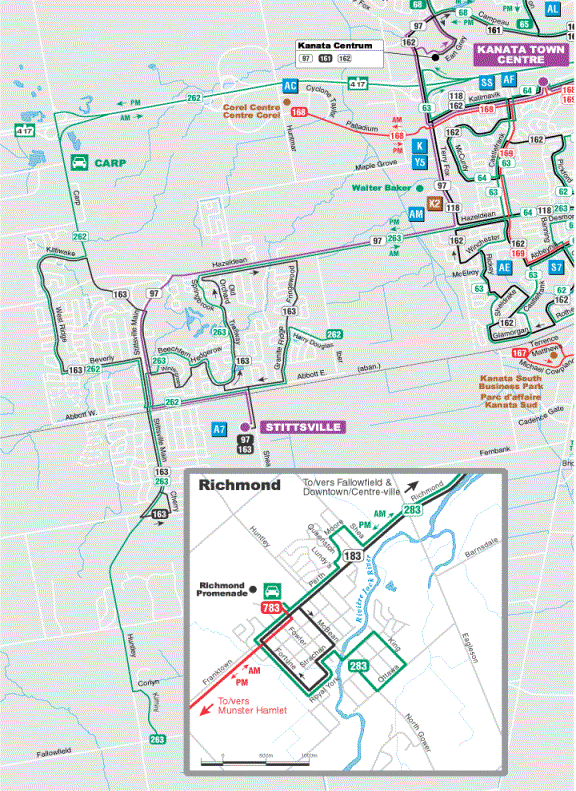
Exhibit 4
Map of Routes - Manotick
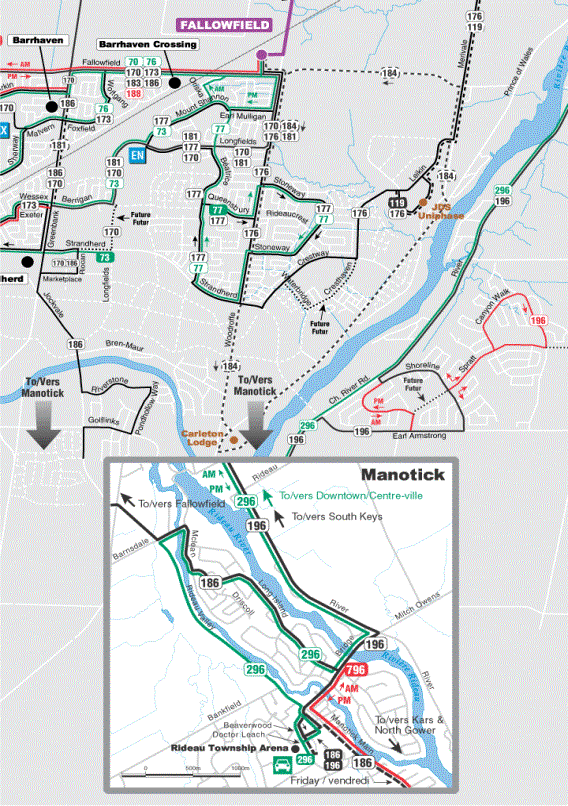
Exhibit 5
Map of Routes – South Gloucester
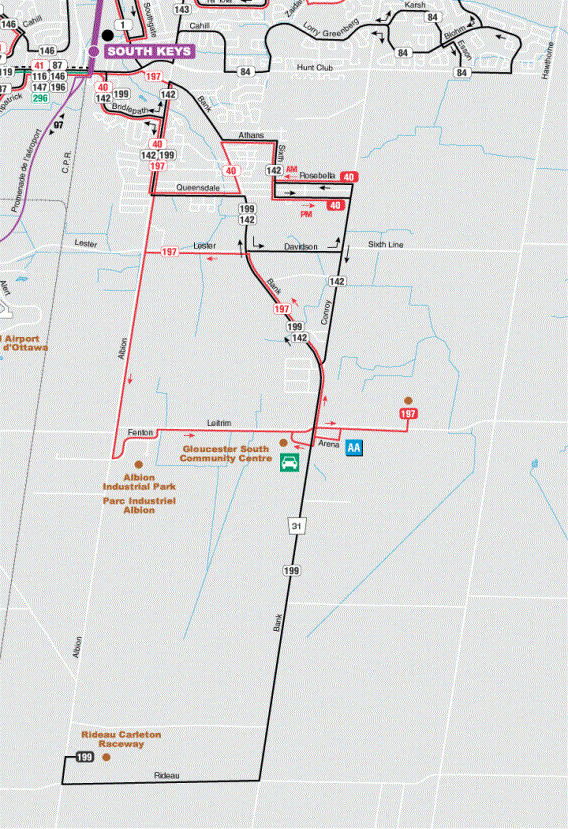
Exhibit 6
Map of Routes - Vars
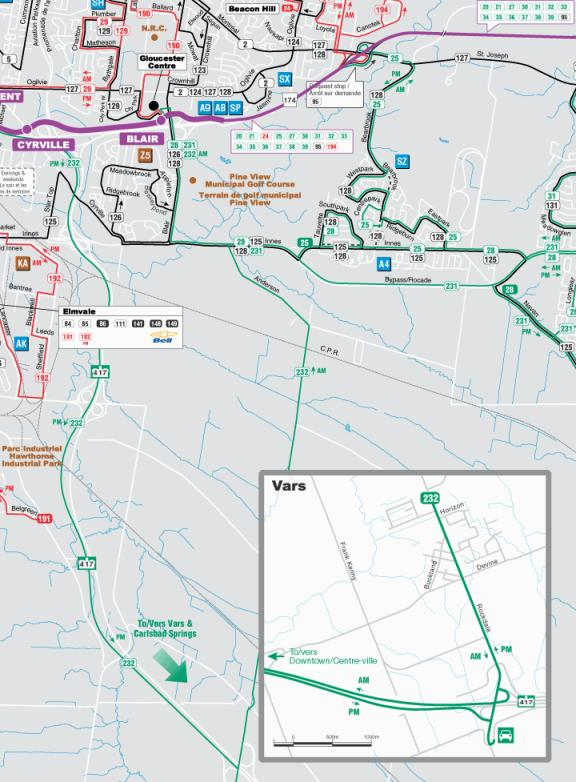
Exhibit 7
Map of Routes – Navan and Cumberland
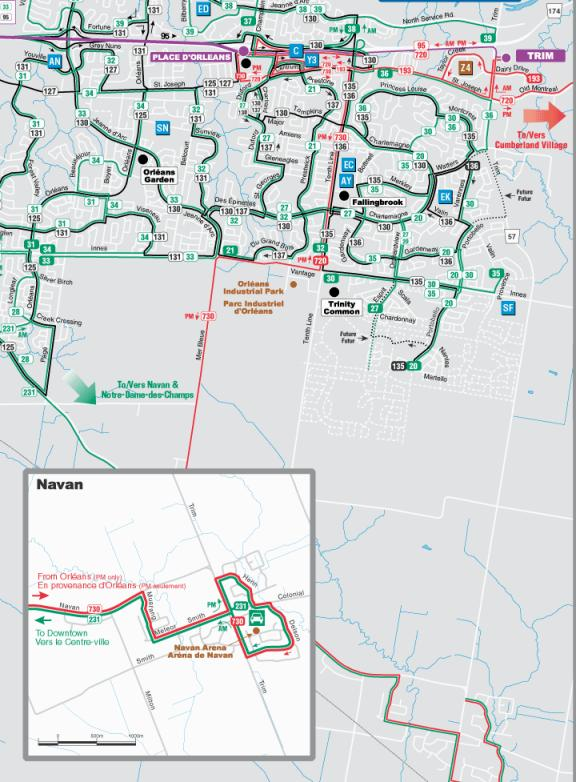
Exhibit 8
Fares for Rural Express, Transitway, and Local Services
FARE TYPE | AMOUNT | COST PER TRIP |
Fares for rural express services | ||
Adult/student/senior cash fare | $4.75 | $4.75 |
Adult/student/senior ticket fare | 4 tickets | $3.40 |
Adult monthly pass for rural express services | $108.50 pass | $2.71 |
Ecopass subscription for rural express services | $44.92 per pay period ($97.33 per month) | $2.43 |
Students’ monthly pass for rural express services | $92.75 pass | $2.32 |
Children’s cash fare – Valid on all services | $1.25 | $1.25 |
Children’s ticket fare – Valid on all services | 1 ticket | $0.85 |
Seniors’ monthly pass – Valid on all services | $25.50 | – |
| ||
Fares for local or Transitway service – Regular OC Transpo fares | ||
Adult/student/senior cash fare | $2.50 | $2.50 |
Adult/student/senior ticket fare | 2 tickets | $1.70 |
Adult regular monthly pass | $60.50 | $1.51 |
Students’ regular monthly pass | $49.75 | $1.24 |
Children’s cash fare – Valid on all services | $1.25 | $1.25 |
Children’s ticket fare – Valid on all services | 1 ticket | $0.85 |
Seniors’ monthly pass – Valid on all services | $25.50 | – |
DayPass – Not valid on rural express service; valid on all other services; valid as a family pass on Sundays and holidays | $5.00 | – |
| ||
Special local fares (Stittsville local service and connector routes to/from locations in the UTA) | ||
Cash fare – Adults, students, seniors, and children | $1.25 | $1.25 |
Ticket fare – Adults, students, seniors, and children | 1 ticket | $0.85 |
Passes for rural express services are also valid | – | – |
Notes: Upgrades also available from regular and urban express passes and from O-Train tickets. The costs per trip are based on 40 trips per month. The Ecopass cost per pay is based on 26 pay periods per year. The special local fares for local and connector services would not allow transfers to other OC Transpo services.
Exhibit 9
Financial Situation in 2002
| | AMOUNT IN 2002 |
OPERATING COSTS | | |
Conventional service operated by OC Transpo | 80.5 hours/weekday 33.4 hours/Saturday | $536,425 |
Conventional service operated by contractors | 18.7 hours/weekday | $79,977 |
Para Transpo service operated by contractors | | $70,570 |
Total | | $686,972 |
| | |
RIDERSHIP AND FARE REVENUE | | |
Conventional service | 1275 trips/weekday in 2002 360 trips/Saturday in 2002 1770 trips/weekday in 2003 700 trips/Saturday in 2003 | $182,054 |
Para Transpo service | 268 trips in September 413 trips in October 351 trips in November | $13,478 |
Total | | $195,531 |
| | |
TAX REVENUE | | |
Rural Transit Area A | | $373,919 |
Rural Transit Area B | | $38,283 |
Total | | $412,203 |
| | |
COMPARISON OF COSTS AND REVENUE | | |
Total costs (operating, one-time, and capital) | | $686,972 |
Total revenue (fares and taxes) | | $607,734 |
Difference | | $79,238 |