
Route 48 service snapshot - 13 April-10 May
Route 48 is a local route in Alta Vista, and one of the busiest local routes in the network. An analysis of its schedule reveals inadequate runtimes, erratic travel times, and bunching.
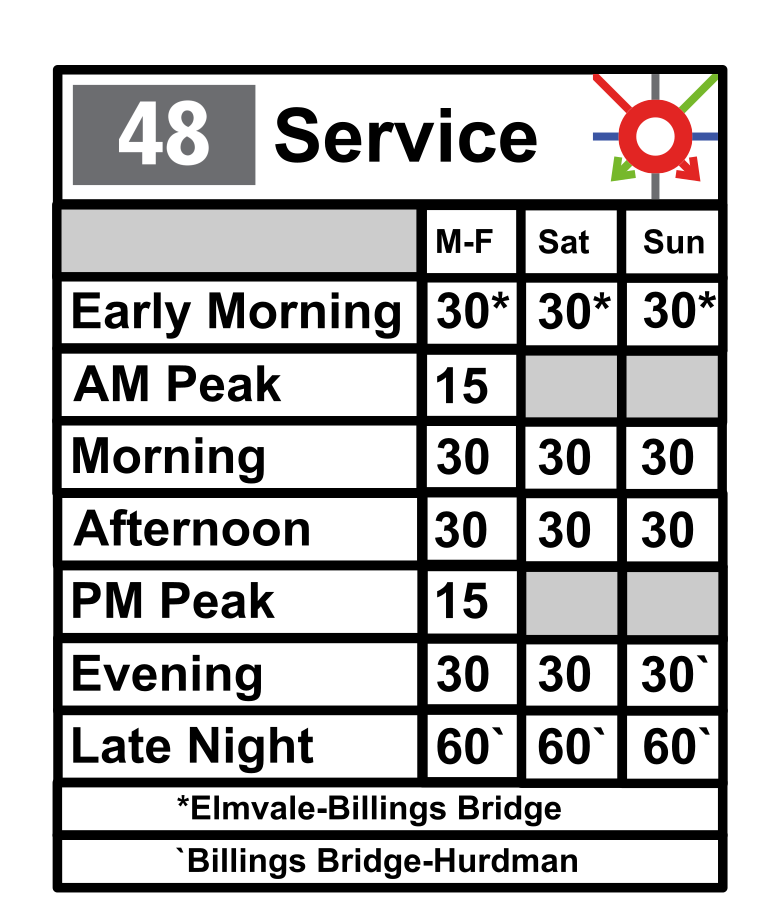
Route 48 is an Alta Vista local route, running from Hurdman Station on Coronation Avenue and Russell Road to Elmvale, then south to Southvale, west on Walkley, and northwest on Kilborn Avenue to Billings Bridge. From there, it runs down Bank and Sunnyside to Carleton University and a Line 2 connection. This is the busiest post-New Ways to Bus local route, with around 3600 weekday riders.
Despite this, the route faces several challenges. Cancellations are high and peak period bunching is as severe as on frequent routes, leaving large gaps in service. Northbound service also lacks scheduled runtime. This all comes together to create a bus route that is unreliable on weekdays, especially during peak periods.
Cancellations
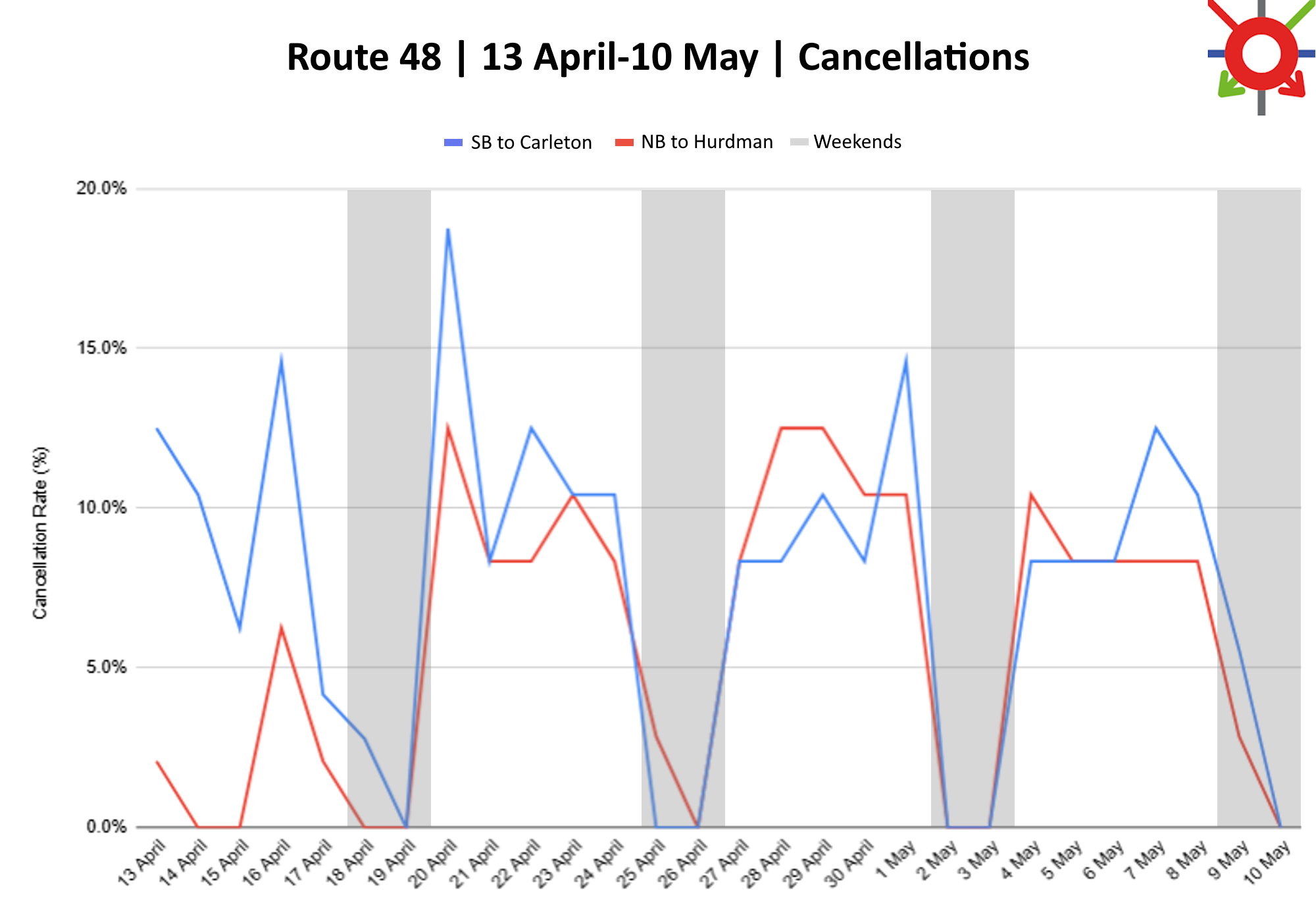
Over the snapshot period, Hurdman-bound service saw a cancellation rate of 6.3%, while Carleton-bound cancellations reached 8.3%. These combine for a cancellation rate of 7.3%.
These are calculated from pre-January schedules, and count temporarily cancelled trips in the statistics. As OC Transpo has not published a list of cancelled trips, they function like random cancellations to the rider on the street, and are therefore counted as such.
Travel Time
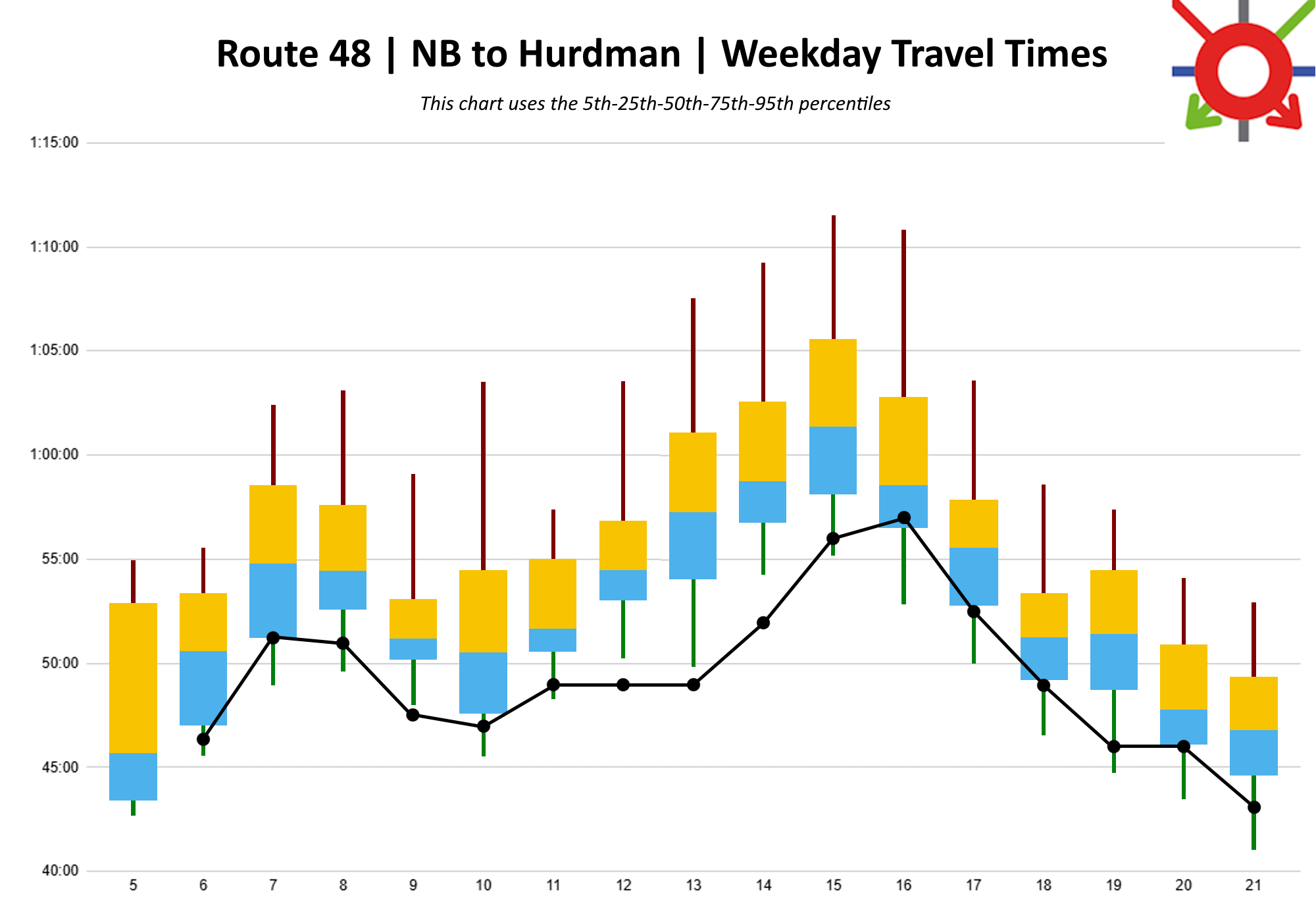
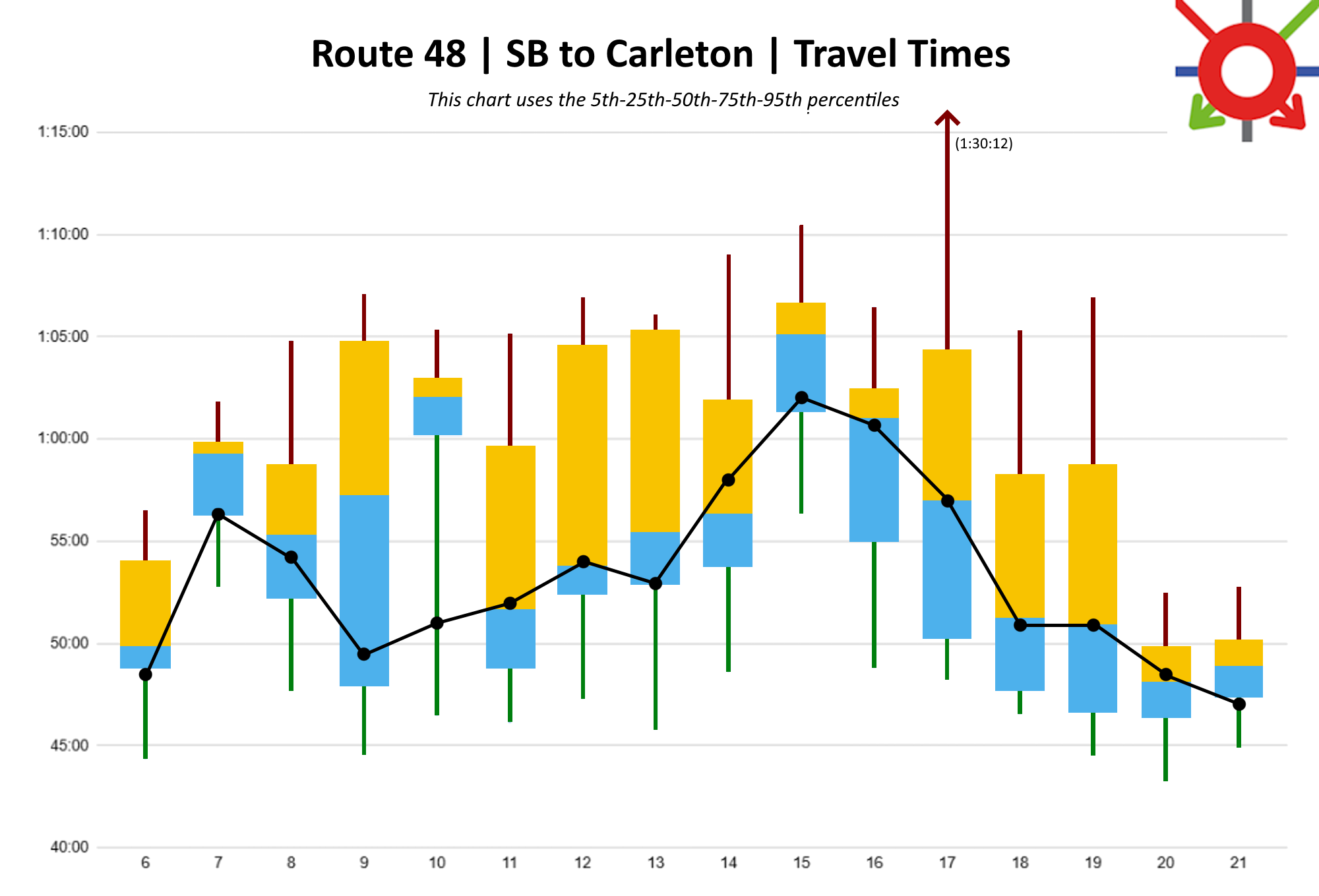
The Hurdman-bound service runs with significant underscheduling across most of the day, meaning their schedules do not reflect the real amount of time it takes to traverse the route. The problem is severe, and schedules run below the 5th percentile of runtimes in the midday. Only in the peak hours and late evening do the scheduled runtimes surpass the 25th percentile of real runtimes northbound.
Travel times are also highly variable, especially in the afternoon and PM Peak. The top half of runtimes may reach 10+ minutes for a route scheduled at 50-55 minutes, which is very high (and does not even count the bottom half of runtimes).
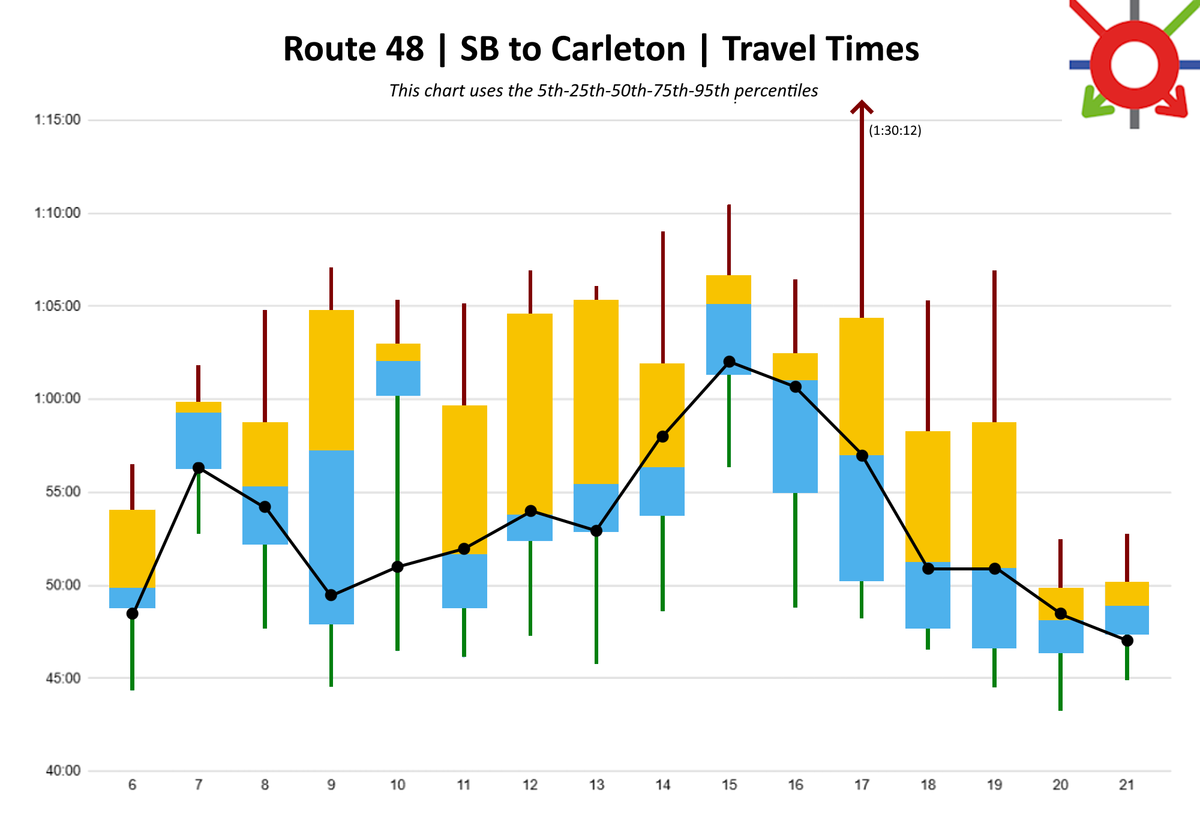
As variable as that is, the Carleton-bound service is even more erratic, and what's more, does not follow a clear pattern. Schedules seem to reflect the real runtimes, but the range of runtimes is very wide across the entire day, and apart from a PM Peak bump, they seem to be almost randomly scattered across the day.
I have only one (weak) theory to explain this odd data. I recorded a high weekday cancellation rate (over 10%, as weekends brought the average down), and there were significant delays and bunching from an underscheduled northbound service. Buses behind the gap would have had a higher travel time. However, this does not explain the variability across the whole day, nor why this pattern is not observed on other routes.
On Time Performance
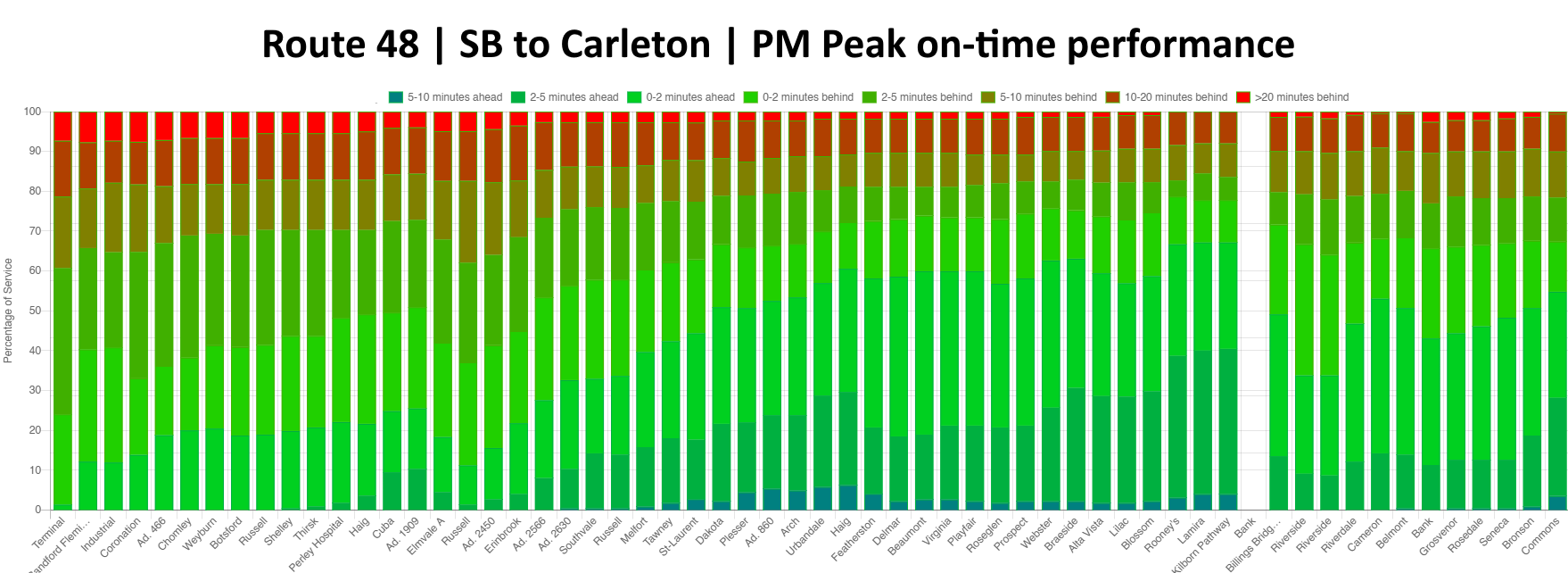
The two directions of the route, like many others, show distinct patterns of punctuality. Southbound service is, as mentioned above, not underscheduled. Late northbound trips cause delays right out of the gate, but this delay shrinks across the route, confirming at least that the southbound service has adequate runtime.
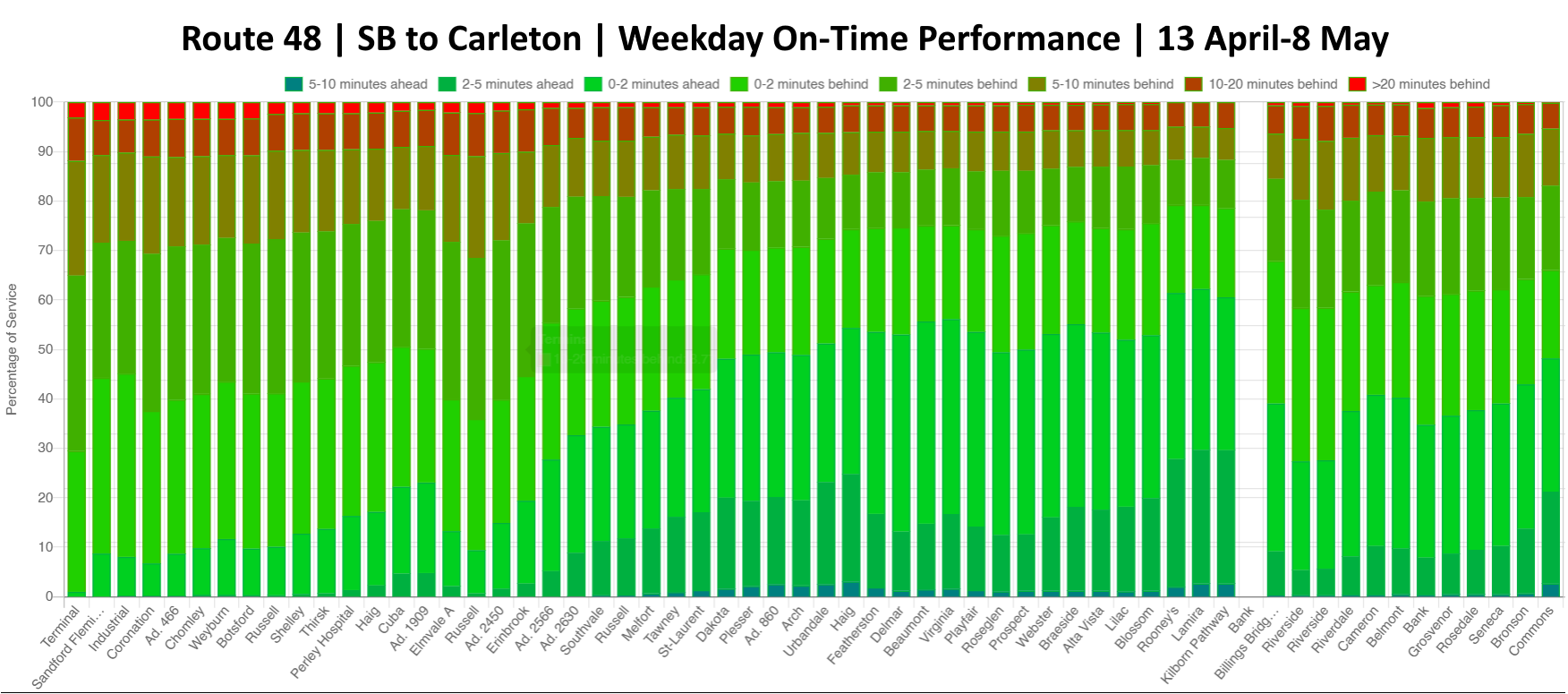
Northbound service is less erratic, but despite most trips departing Carleton on-time, the majority of trips fall five minutes behind schedule by Billings Bridge, only 3.5 km away. On-time performance climbs back up but only to about 65%, contributing to the poor performance of southbound service right out of Hurdman station.
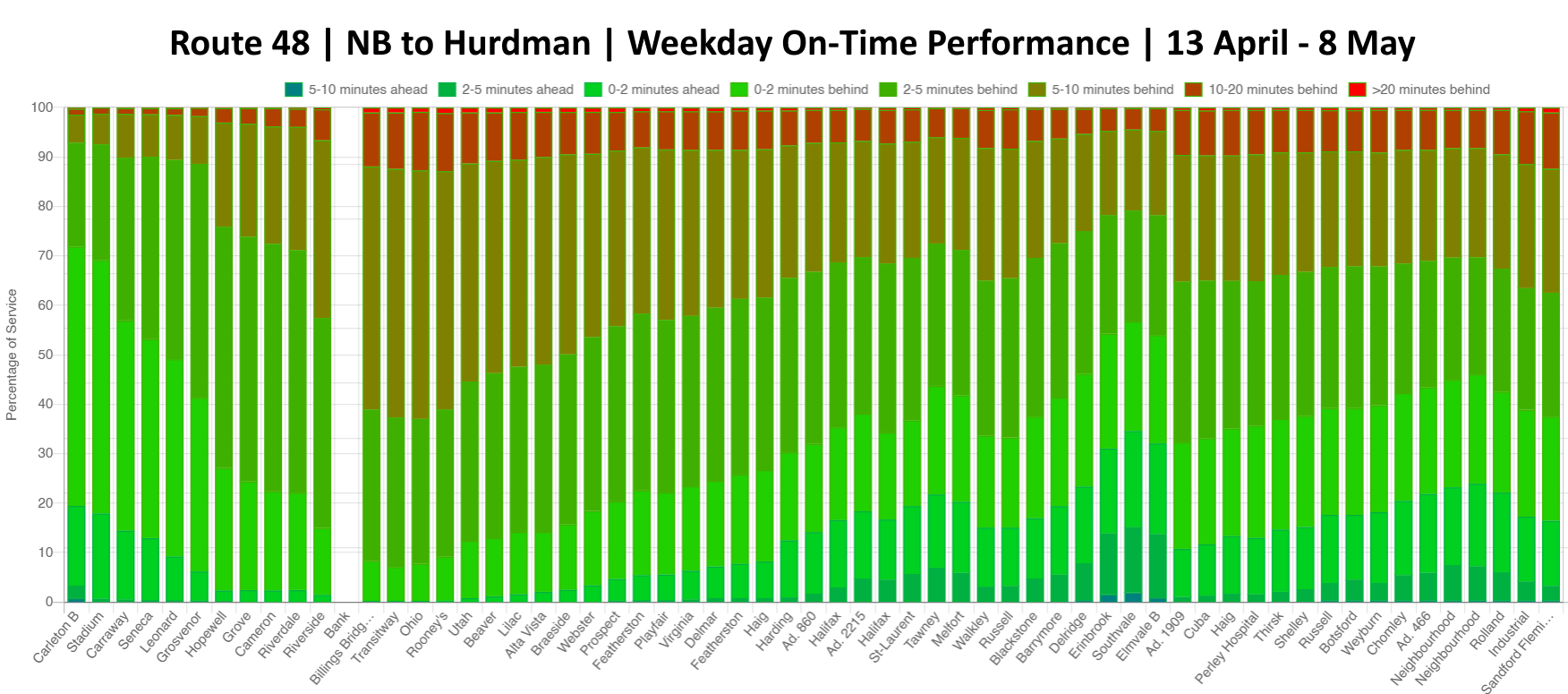
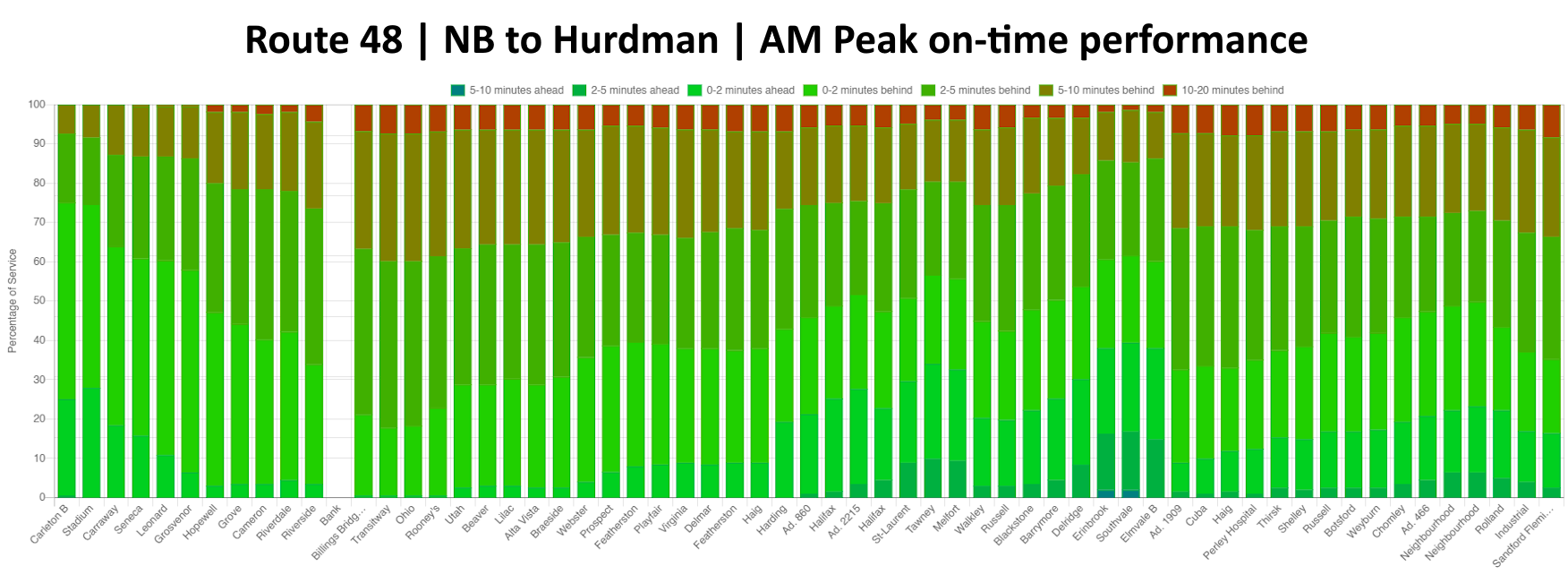
These problems are repeated across the entire day at varying levels of severity. The AM Peak is better behaved than the rest of the day in both directions. Midday service is underscheduled in the northbound direction, while southbound service shows a 40% rate of late departures from Hurdman station. In the PM Peak, northbound service actually is slightly less underscheduled due to a more generous schedule, but many southbound trips are late (likely a consequence of interlining) and on-time performance is poor, while buses bunch together.
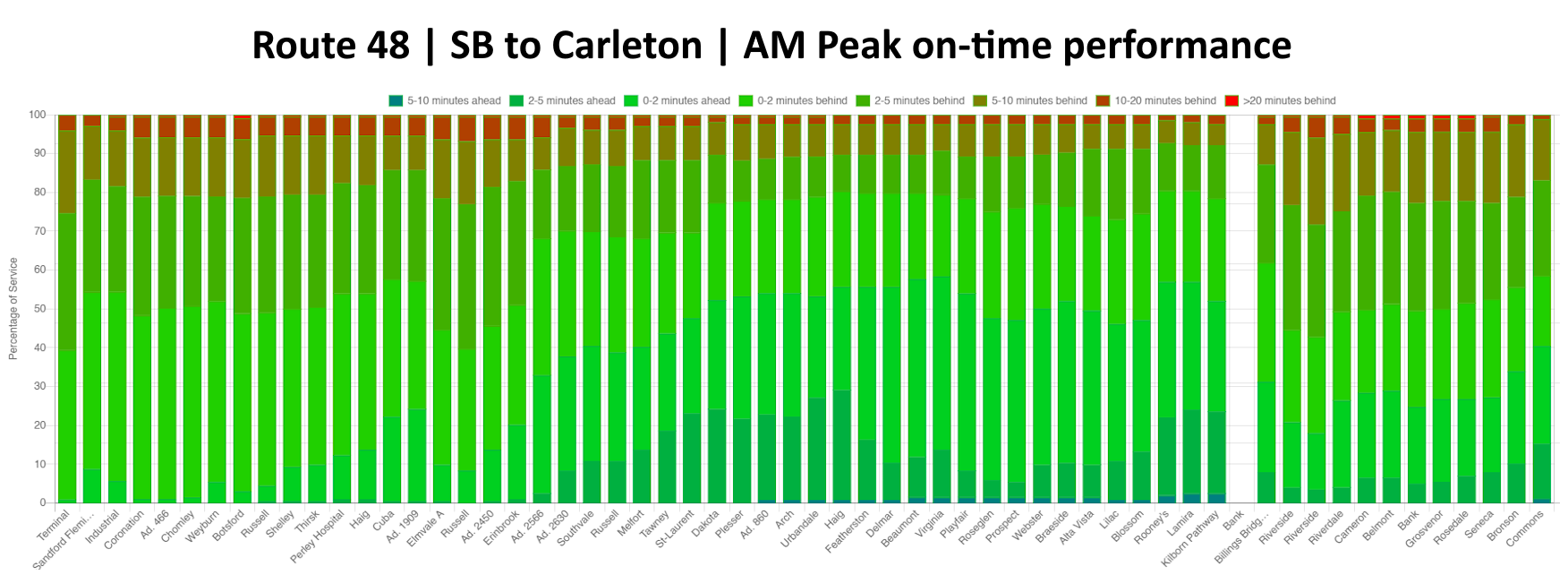
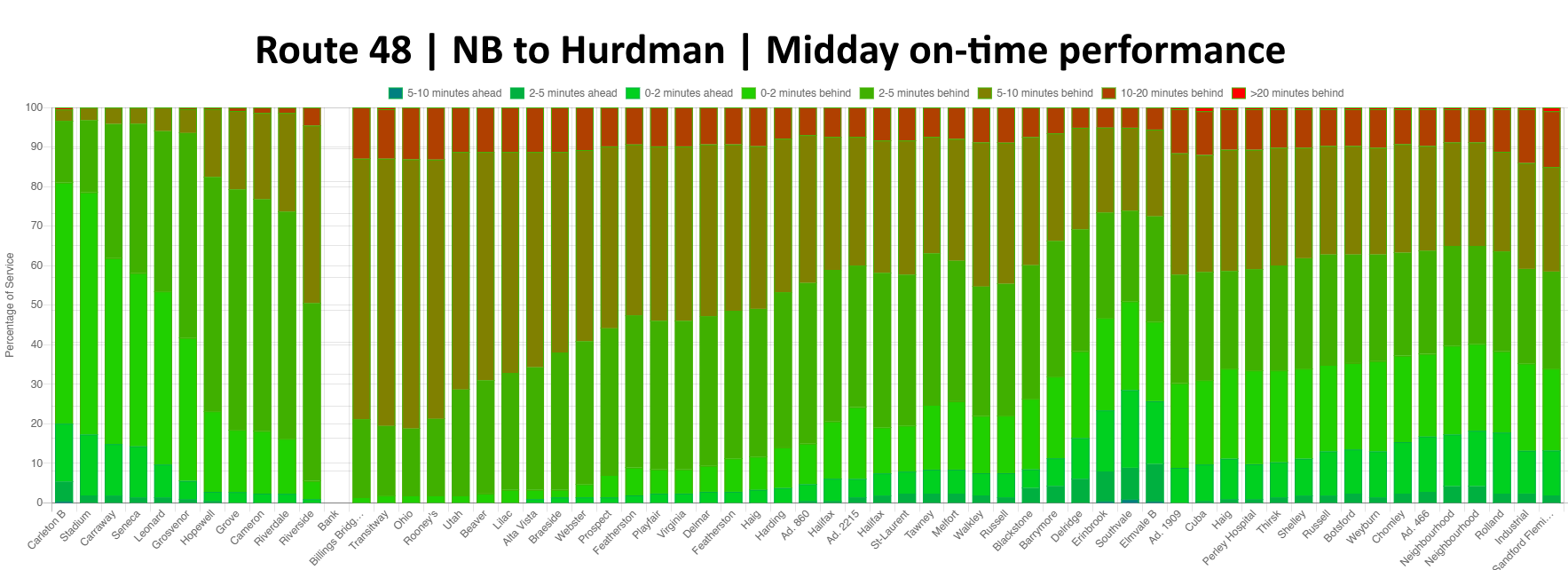
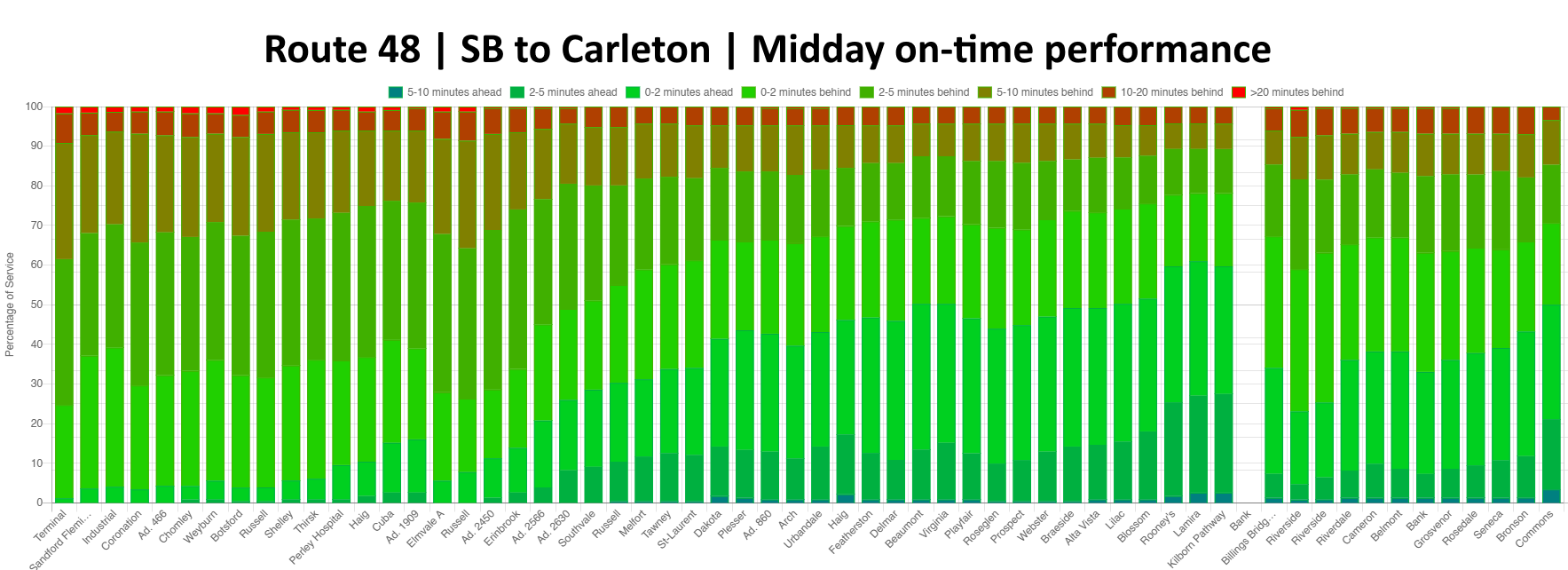
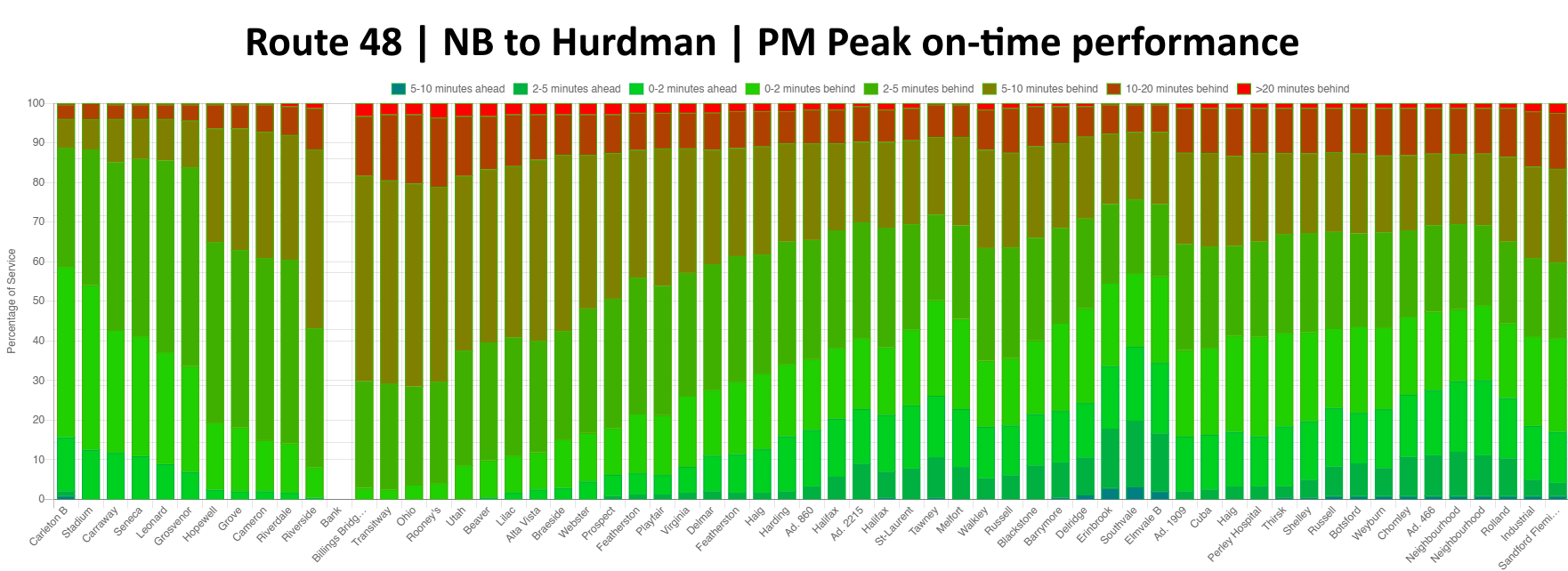
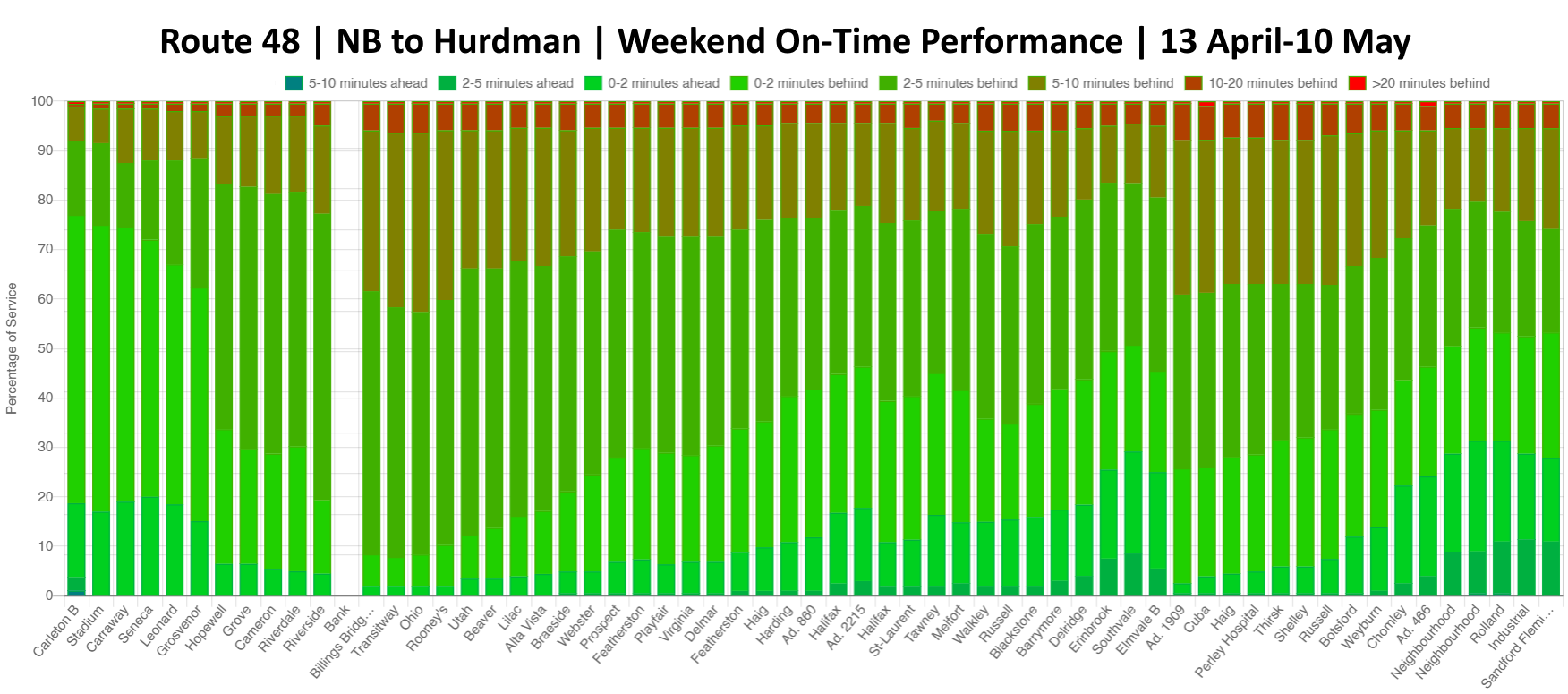
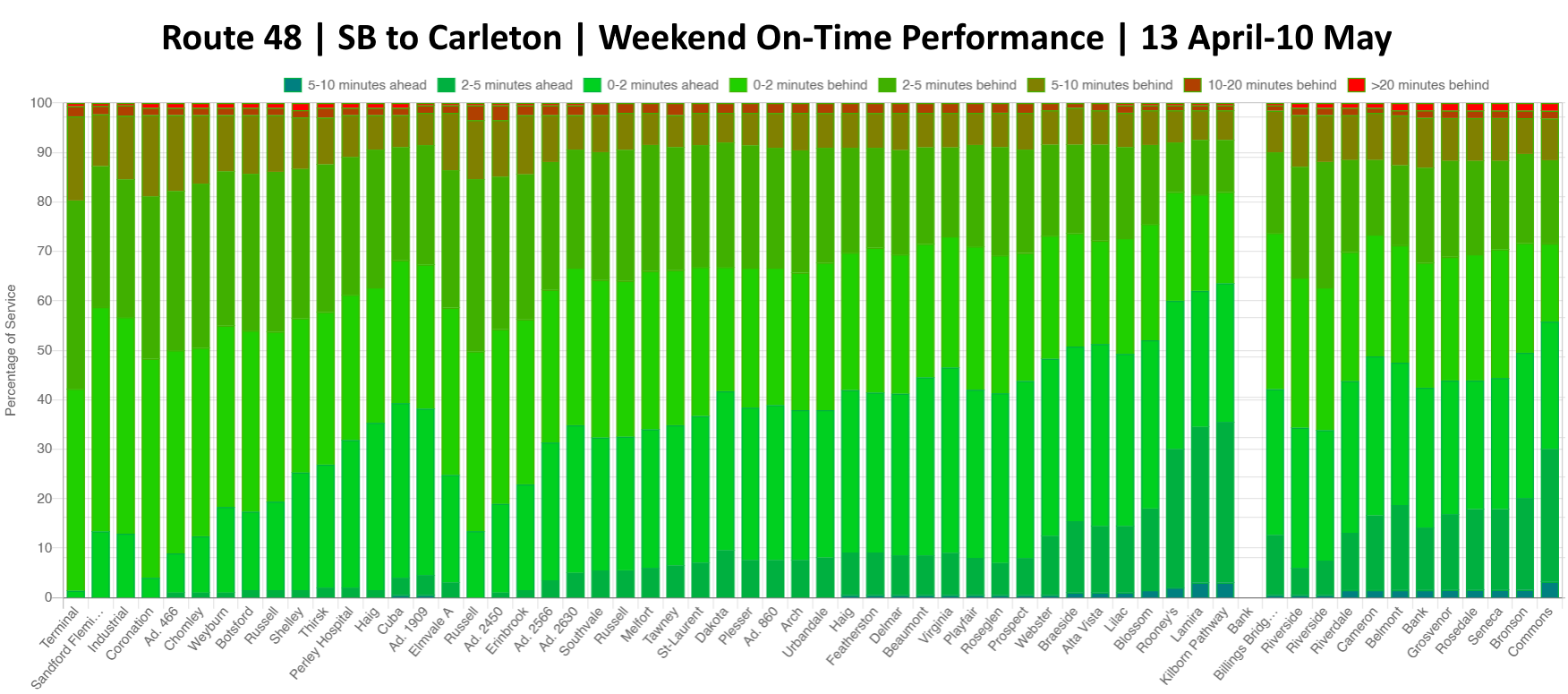
Weekend service has a similar pattern, albeit with better reliability. Northbound service is still underscheduled with 25% of trips arriving late at Hurdman. Meanwhile, minor bunching appears on the latter half of the southbound route, with both very late and very early trips appearing past Billings Bridge.
Headways
The bunching on Route 48 is par for the course on OC Transpo. Generally, half hourly service does not have the opportunity to bunch, but peak period service operates every 15 minutes and the usual problems rear their head.
Southbound bunching is high in both peak periods, pushing average wait times above 20 minutes in the PM Peak. AM bunching is less serious, but still problematic.
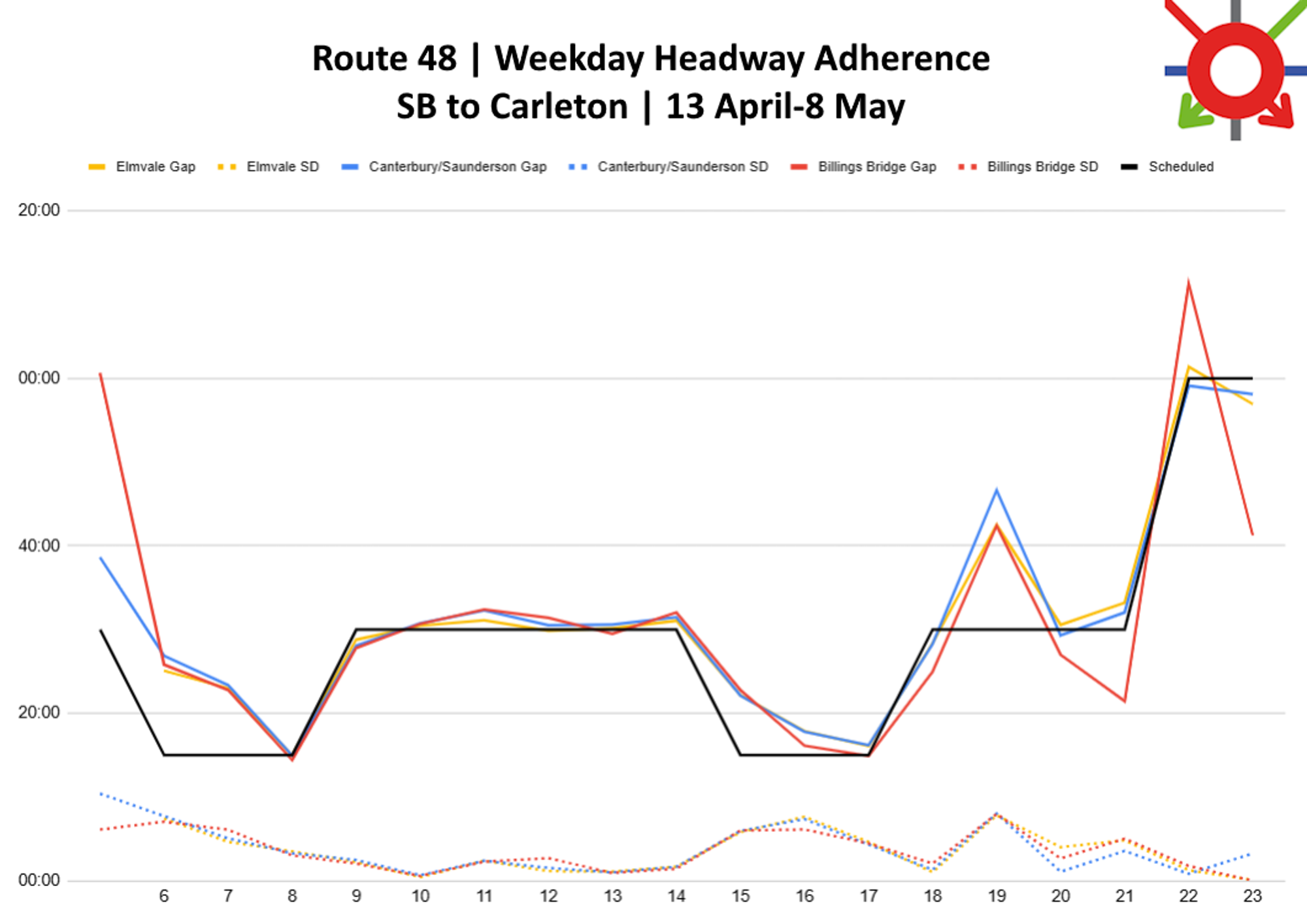
Northbound service bunches at Billings Bridge at all hours of the day. However, this dissipates further north, as Old Ottawa South is highly congested.
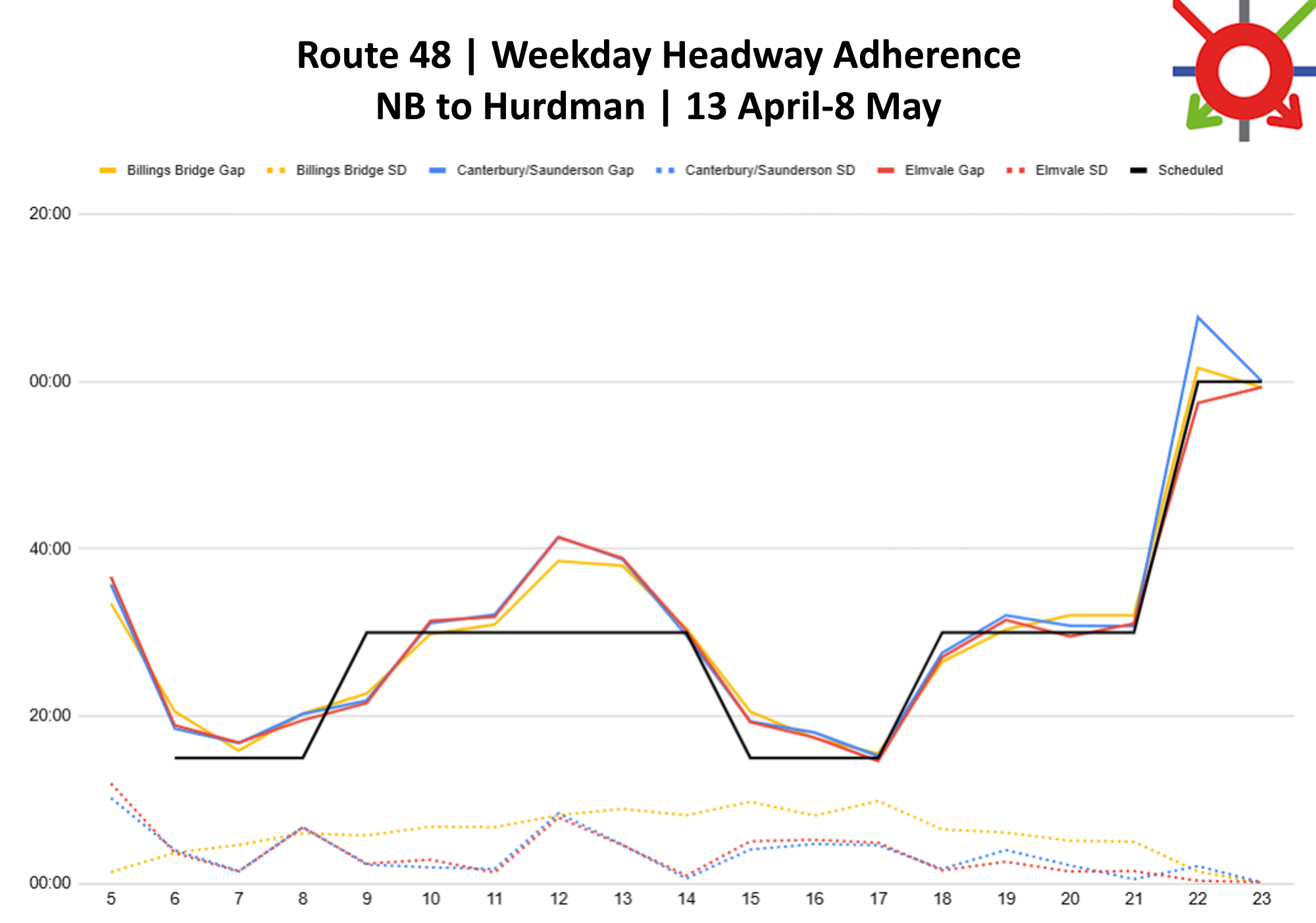
Notably, the effect of cancelled service, especially TCTs, is visible in both charts.
String Diagrams
The chosen week for the string diagrams is week 4, from May 4 to 10. The entire week's charts enclosed in the following PDF.
This snapshot will focus on 4 May, a Monday.
Bunching is a problem on this date in both directions during peak periods. In both peak periods, service starts well-spaced, but due to late departures and erratic travel times (observe a pair of trips leaving Hurdman just after 0800 diverging or several PM trips converging), bunches begin forming. Trips pulled out of service at Billings Bridge are also visible in the charts.
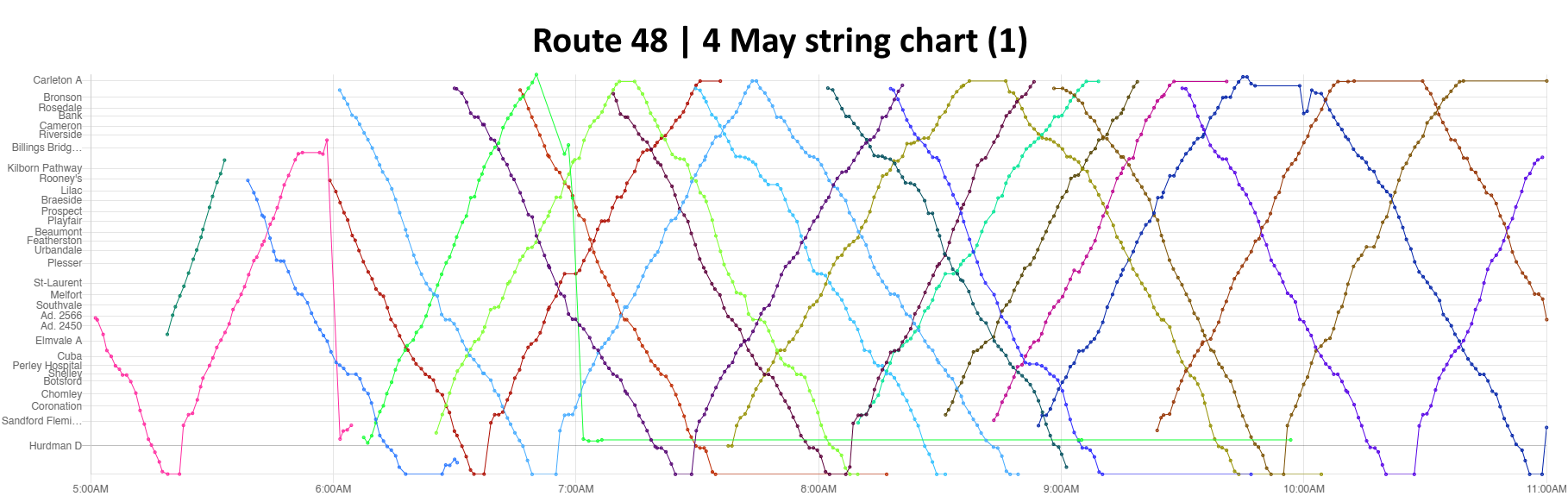
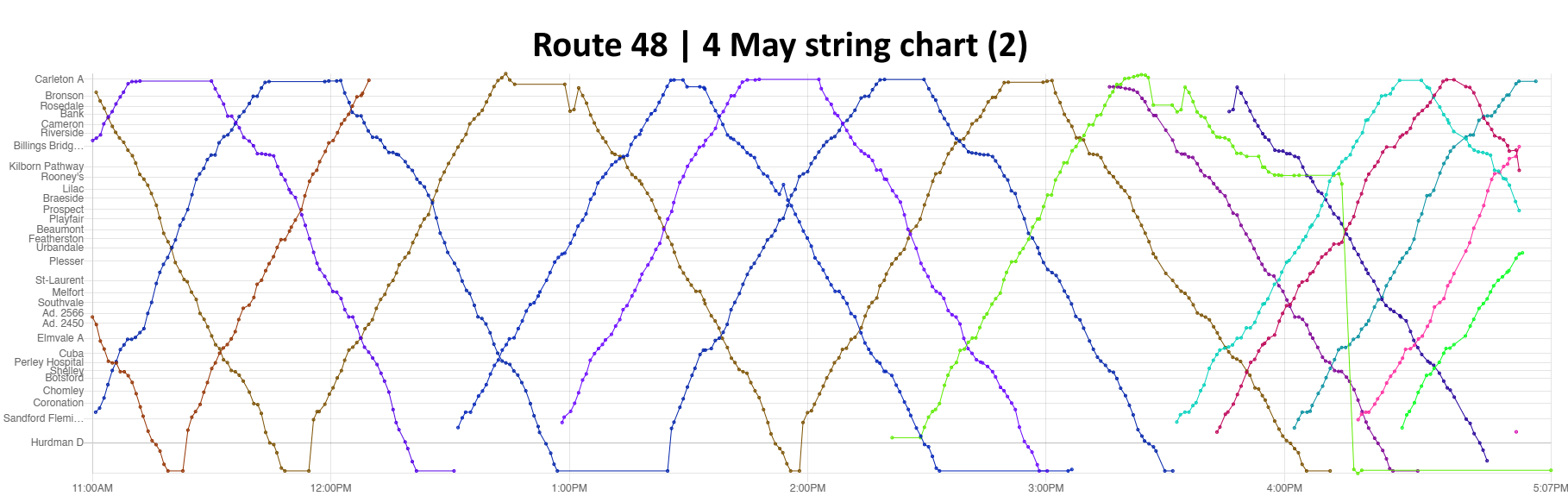
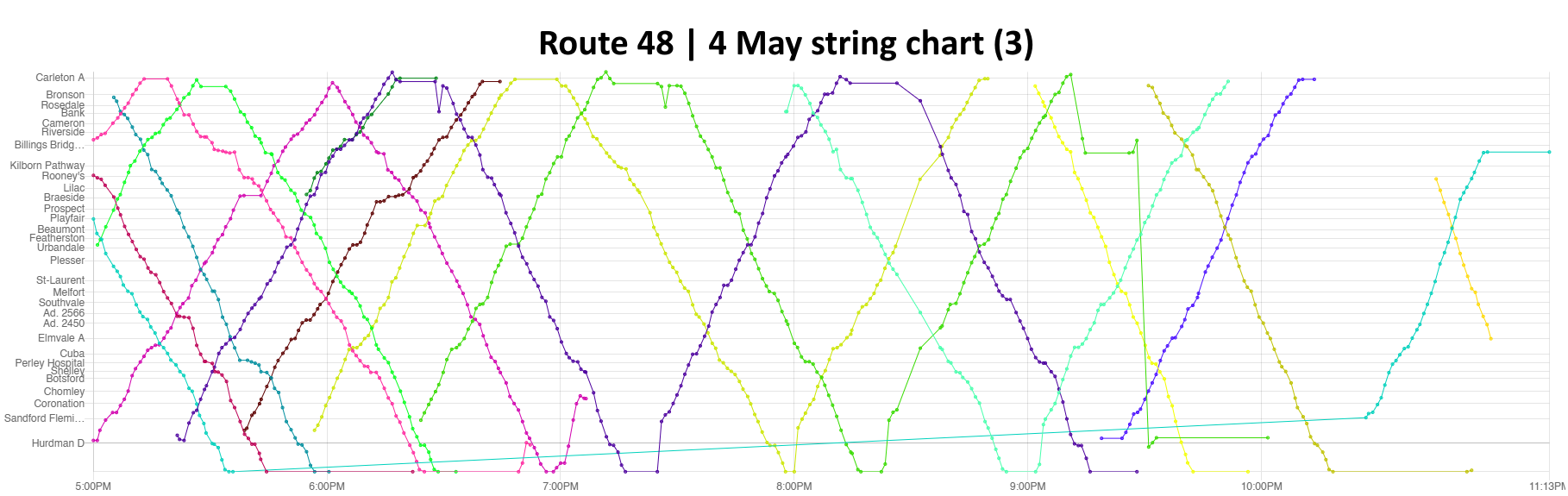
There are several chokepoints: Old Ottawa South is slow in both directions, as is Russell Road going northbound, the southbound approach into Elmvale, both directions on Southvale, and the segment between Billings Bridge Station and Lamira/Bank.
Service Quality, Quality Service?
Unreliable service is not the result of a single cause and cannot be fixed with a single trick, but is highly complex with many confounding factors, which must be managed as best as possible to provide a quality service. There is a commendable and visible effort to manage the service, but these cancellations result in service gaps and only occur because of delays in the first place. Route 48 has a high cancellation rate leading to large gaps and underscheduling towards Hurdman which bleeds into the other direction, resulting in bunching. The route also has several slow spots with few attempts at transit priority, and one councillor sabotaging efforts at such on Bank Street.
Understanding how delays appear and spread is an essential part of understanding why Route 48, the busiest local route in the system, is so unreliable for riders, and why OC Transpo bus service is unreliable.
Until next time.