
TRANSIT SERVICES IN VILLAGES AND RURAL AREAS – REVIEW AND RECOMMENDED CHANGES
Report to/Rapport au:
Transportation and Transit Committee/
Comité de transport & des services de transport en commun
and Council/et au Conseil
April 7, 2003/le 7 avril 2003
Submitted by/Soumis par: R.T. Leclair, General Manager/Directrice générale,
Transportation, Utilities and Public Works/Transport, services et travaux publics
Contact/Personne-ressource: G. Diamond, Director/Directeur,
Transit Services/Service du transport en commun
842-3636 ext. 2271, gordon.diamond@transpo.ottawa.on.ca
| Ref N°: ACS2003-TUP-TRN-0003 |
SUBJECT: TRANSIT SERVICES IN VILLAGES AND RURAL AREAS – REVIEW AND RECOMMENDED CHANGES
OBJET: SERVICES DE TRANSPORT EN COMMUN DANS LES VILLAGES ET LES SECTEURS RURAUX – EXAMEN ET MODIFICATIONS RECOMMANDÉES
REPORT RECOMMENDATION(S)
That the Transportation and Transit Committee recommend Council approve:
1. The following changes to the rural transit network to enhance service coverage and frequency where warranted and to improve productivity:
Village | Route | Recommendation |
232 | Extend route to start in Bearbrook before serving Vars and Carlsbad Springs, and increase service to two morning trips and two afternoon trips | |
Cumberland Village | 221 (now 720) | Extend route to downtown Ottawa and increase to two morning and two afternoon trips |
Manotick | 71 and 186 | Extend peak-period service to downtown Ottawa, extend peak-period service to serve more of Manotick, increase midday and evening service to every hour, and remove Saturday service |
196 | Remove midday, evening, and Saturday service between Earl Armstrong Road and Manotick | |
North Gower and Kars | 45 (now 796) | Extend route to downtown Ottawa |
Richmond | 183 | Remove midday, evening, and Saturday service |
Sarsfield | 23 (now 231) | Extend route to start in Sarsfield before serving Navan and Notre-Dame-des-Champs |
South Gloucester | 199 | Remove service south of Leitrim |
45 (now 296) | Re-route buses to serve Riverside South | |
Stittsville | 262 and 263 | Increase service to four morning trips and four afternoon trips on each of the two routes |
2. The reduction in the price of the monthly rural express pass from $108.50 to $95.00, the student rural express pass from $92.75 to $77.00, and the Para Transpo fare from Zone 4 to the Urban Transit Area from $20.00 to $16.00, from July 1, 2003; and,
3. The confirmation of the rural conventional transit route network and Para Transpo service as recommended, to be subject in the future to continuous performance monitoring and adjustment through the annual Transplan and budget processes.
RECOMMANDATION(S) DU RAPPORT
Que le Comité des transports et des services de transport en commun recommande au Conseil d’approuver :
1. Les modifications suivantes au réseau de transport en commun rural afin d’accroître l’étendue et la fréquence du service aux endroits nécessaires et d’améliorer la productivité:
Village | Circuit | Recommandation |
232 | Débuter le circuit à Bearbrook avant de desservir Vars et Carlsbad Springs et passer à deux trajets le matin et deux l’après-midi. | |
Village de Cumberland | 221 (actuellement le 720) | Prolonger le circuit jusqu’au centre-ville d’Ottawa et passer à deux trajets le matin et deux l’après-midi. |
Manotick | 71 et 186 | Accroître le service aux heures de pointe jusqu’au centre-ville d’Ottawa, accroître le service aux heures de pointe pour mieux desservir Manotick, passer à un service horaire en milieu de journée et en soirée et supprimer le service le samedi. |
196 | Supprimer le service en milieu de journée, en soirée et le samedi entre le chemin Earl Armstrong et Manotick. | |
North Gower et Kars | 45 (actuellement le 796) | Prolonger le circuit jusqu’au centre-ville d’Ottawa. |
Richmond | 183 | Supprimer le service en milieu de journée, en soirée et le samedi. |
Sarsfield | 23 (actuellement le 231) | Débuter le circuit à Sarsfield avant de desservir Navan et Notre-Dame-des-Champs. |
Gloucester Sud | 199 | Supprimer le service au sud du chemin Leitrim. |
45 (actuellement le 296) | Modifier le trajet des autobus afin de desservir Riverside Sud | |
Stittsville | 262 et 263 | Passer à quatre trajets le matin et quatre l’après-midi sur chacun des deux circuits. |
2. La réduction du prix du laissez-passer express rural de 108.50 $ à 95 $ par mois, du laissez-passer express rural pour étudiants de 92.75 $ à 77 $ et du tarif de Para Transpo entre la zone 4 et le secteur de transport urbain de 20 $ à 16 $ à compter du 1er juillet 2003;
3. La confirmation que le réseau de circuits du transport en commun conventionnel en milieu rural et le service de Para Transpo, tel qu’il a été recommandé, soient assujettis à l’avenir à un contrôle du rendement continu et à un rajustement dans le cadre du projet Transplan et des processus budgétaires annuels.
BACKGROUND
Following a widespread public consultation program and extensive discussion at two joint Committee meetings of Transportation and Transit Committee and Agricultural and Rural Affairs Committee on March 20, 2002, and April 3, 2002, and at its meeting of April 10, 2002, Council approved the provision of transit services in villages and rural areas of Ottawa to begin in September 2002.
Council approved the establishment of two new areas where service would be provided outside the Urban Transit Area: Rural Transit Area A, where residents would have access to regular transit services and Para Transpo service, and Rural Transit Area B, where only Para Transpo service would be available. Rural Transit Area A and Rural Transit Area B are shown in Exhibit 1. Based on the estimated costs and revenues for the period from September to December 2002, a monthly transit levy on a $150,000 property of approximately $14.31 in Rural Transit Area A and $2.16 in Rural Transit Area B was approved.
Fares were set on the basis that they would cover approximately 50 percent of the costs of regular transit service and 20 percent of the costs of Para Transpo services.
The approved plan included a provision that the bulk of the new services would be supplied directly by OC Transpo, and the local bus service in Stittsville and the rural connector services would be acquired through a tender process. Cooperation with private intercity bus companies to enhance the services they now provide to residents outside the City and in Rural Transit Area Zone B was also a part of the approved plan.
Council directed staff to provide a status report concerning ridership, operating experience, costs and recommending any immediate changes needed. This was presented to Transportation and Transit Committee on January 15, 2003. It included some minor adjustments in the rural transit services, including the elimination of service on Route 730 and one trip on Route 720. These changes were made on February 17. Approval was also given at that time to adjust the routing and timing of Route 163 in Stittsville, in consultation with the community, to improve its performance. This has been done and the changes will be introduced on April 21, 2003 (see Exhibit 7). In the January 15, 2003 report it was projected that, for a $150,000 residential property, based on existing service levels, the costs on taxes would be $64.54 in Rural Transit Area A and $6.51 in Rural Transit Area B.
At is meeting on April 10, 2002, Council also directed staff to present a second status report, before final tax rates were set for 2003, which would include recommendations for changes to services, transit area boundaries, and/or funding strategies. This report responds to that direction and provides information about ridership on each service, Park and Ride lot usage, operating experience and costs, as well as providing the results of customer surveys and an attitude survey of a random sample of rural residents.
At its meeting of February 6, 2003, the Health, Recreation, and Social Services Committee referred the following motion to the Transportation and Transit Committee.
That the introduction of Para Transpo services throughout the rural areas of the City of Ottawa be reviewed, in particular to identify:
· (Through the use of a map) the various fare zones;
· User costs (one-way fares) for each zone;
· The number of users within each zone, by rural ward (from inception of service to December 31, 2002);
· Any recommendations that staff might have as to any changes that might be introduced to improve services in the rural areas;
· Any recommendations regarding a review of the affordability of Para Transpo services in the rural areas; and
· That there be consultation with the People Services Department on the health aspect of this issue and the accessibility of the service.
This report responds to the direction from the April 10, 2002, Council meeting and to the Health, Recreation and Social Services Committee motion of February 6, 2003.
DISCUSSION
Regular Transit
Service Provided
Rural transit services consist of six rural express routes, four local services connecting to Transitway stations inside the Urban Transit Area, a local service in Stittsville, three connector routes, and the extension of Transitway Route 97 to Stittsville. These are listed in Exhibit 8. In total, 99 hours of service per weekday are provided, 81 by OC Transpo and 18 hours by contractors.
Eleven of the new services (Routes 97, 183, 186, 196, 199, 231, 232, 262, 263, 283 and 296) are operated by City employees. A small part of the new service was offered to private contractors through an open tender process. The contracted services operate mainly in the rural areas, and are not designed to carry passengers for trips starting and finishing inside the Urban Transit Area.
Eight new Park and Ride locations were established, where village and rural residents can drive their cars and then board buses for travel toward the central part of Ottawa. The Park and Ride locations at Leitrim, Manotick, Navan, Notre-Dame-des-Champs, and Stittsville (Carp Road) are within City-owned parking lots, generally at arenas and community centres. The location at Carlsbad Springs is within the parking lot of GreyHawk Golf Course, the location at Richmond is within the parking lot of the Richmond Promenade shopping plaza, and the location at Vars is at a carpool lot owned by the Township of Russell. Staff entered into agreements with the owners of these lots for their use by transit customers.
The scheduled bus requirements for City-provided services are nine on a weekday, which means that eleven buses are needed in the fleet to ensure service reliability. Seven new articulated buses were approved to be used on busy routes in the urban area, and thus free up the eleven 40-foot buses to operate the rural services.
The fares were set with the objective of users covering about half of the operating costs, recognizing that a higher cost recovery would be expected from the express services than the local routes.
Ridership
A summary of ridership counts taken on each of the new services is presented in Exhibit 8. Overall, ridership on the six rural express services that run directly to downtown at peak periods has grown quickly, and has, in most cases, met or exceeded expectations. In January and February 2003, average weekday ridership on the rural express services was approximately 740, compared with the projection of 750.
Ridership on the six all-day services has not grown in the same way, and on four of the routes ridership remains low. In January and February 2003, average weekday ridership on the all-day services was approximately 430, compared with the projection of 900.
Ridership on the connector buses has not achieved the expected level but has been encouraging, with the exception of Route 730, which was eliminated in February. In January and February, average weekday ridership on the three remaining connector routes was approximately 60, compared with the projection of 100.
Park and Ride Lot Usage
The use of the eight rural Park and Ride lots in January 2003 is shown in Exhibit 10. This shows that, together, the lots were used by approximately 80 cars each day. (Some of these cars would have used the Stittsville and Vars lots for carpooling and not to ride transit service.) The cost to operate these lots is very low, as most are City-owned lots at arenas and community centres, and the others are owned by private companies or adjacent municipalities and are made available at no cost to the City (except for a contribution to snow removal costs at one lot). Though use of some of the lots is very low, the lots serve to extend the reach of the transit service into areas that the routes do not serve directly. All of the park and ride lots should be retained, and staff will search for opportunities to establish more park and ride lots in convenient locations along the rural transit routes.
Customer Survey
As part of the monitoring program, an on-bus survey was carried out on the rural services on November 28, 2002. Bus operators issued forms to all boarding passengers and 348 completed forms were returned.
The survey results showed that, in general, customers were satisfied with the service provided. However, some riders suggested that service should be more frequent and there was concern that fares are high.
The results were used in the service analysis and development of options for change.
Options for Change
Service
The experience gained from rural service ridership, operations and customer feedback has been used to develop recommendations for improvements that would increase ridership and the cost-effectiveness of the service. As noted earlier, ridership levels on the rural express routes and connector routes have generally met or come close to expectations, but ridership on some of the all-day routes is lower than planned.
Options were evaluated to reduce costs on the services with low ridership, or to remove service entirely where ridership was very low. It is recommended that the all-day service in South Gloucester be removed entirely at the end of the one-year trial period, and that the all-day services from Richmond to South Nepean and from Manotick to South Keys be reduced to operate in peak periods only.
Experience with the ridership levels on the rural express routes and the connector routes indicates that per-capita ridership is two to three times higher on the express services that run directly to downtown using OC Transpo buses than on the connector buses that are operated by contractors using their own buses. Two of the three remaining connector routes, Route 720 from Cumberland Village and Route 796 North Gower, have had high enough ridership that the expected increase from converting the routes to become OC Transpo rural express services supports the small additional cost that will result. The change from connector to express services would mean that these two routes would be changed from contracted operation to operation by City employees in June 2003.
The rural express services from Stittsville have been very successful, in that ridership from Stittsville approximately doubled when service was doubled from three trips to six in each peak period. This indicates that there is likely a large latent demand for transit service in Stittsville, and that previous ridership levels were being limited by the few choices of travel time available rather than by the number of potential customers. To allow this growth to continue, it is recommended that the service be increased so that there will be eight rural express trips in each peak period, beginning in September 2003.
The experience with the connector buses from smaller villages, comments that have been received from customers, and the results of the on-board survey have indicated that a substantial proportion of the ridership on rural express routes is from smaller villages that do not have direct service, but from which customers are using the new park and ride lots. It is recommended that the rural express service from Navan be extended to start in Sarsfield, and that the service from Vars be extended to start in Bearbrook. These two extensions would allow residents of the surrounding areas to use transit service more easily and could be made at a low cost. Both extensions would start in September 2003.
It is recommended that the rural express route from Manotick be changed to serve the residential area of Riverside South, rather than to bypass it as it does now. Also, peak period service on the route between Manotick and South Nepean would be combined with an express route from South Nepean to downtown Ottawa, so that there would be two routes offering direct service from Manotick to downtown, one on each side of the Rideau River.
The all-day service from Manotick to South Nepean, which is recommended to continue, would be changed so that it operates every hour, rather than every two hours as at present. The cost to operate this improved service would be the same as is now being incurred to operate two all-day services from Manotick, one to South Keys and one to South Nepean, each running every two hours. The consolidation of the operating resources onto a single, more attractive, service is expected to lead to higher overall ridership.
The specific route change recommendations are detailed in the following two tables. These recommendations would require two additional peak period buses and would maintain the weekday hours of service at 99. These changes would be implemented in September 2003, with the exception of the new rural express routes from Cumberland and North Gower, which it would be possible to introduce in June 2003.
Village | Route | Recommendation | Rationale | Comments |
Richmond | 183 | Low ridership: 20 customer-trips each day | Peak-period service to downtown on Route 283 would continue | |
Manotick | 196 | Remove midday, evening, and Saturday service between Earl Armstrong Road and Manotick. | Low ridership: 4 customer-trips each day. | Peak-period service to downtown on Route 45 would continue to operate. Service would continue to operate north from Riverside South. All-day service from Manotick would continue on Route 186. |
South Gloucester | 199 | Remove service south of Leitrim | Low ridership: 34-45 customer-trips each day, of which 10 are from points other than Rideau-Carleton Raceway | Rideau Carleton Raceway operates its own bus service from Greenboro Station |
45 (now 296) | Remove service on River Road between Earl Armstrong and Limebank | Low ridership: 4 customer-trips each day | Service would operate instead through Riverside South, where ridership is expected to be higher. | |
SERVICE ENHANCEMENTS | ||||
Village | Route | Recommendation | Rationale | Comments |
232 | Extend route to start in Bearbrook before serving Vars and Carlsbad Springs (see Exhibit 6) | Ridership forecasts indicate 5-10 customer-trips each day on extended service. Extension possible at low cost. | | |
232 | Increase service to two morning trips and two afternoon trips | Ridership has been higher than projected, at 50-60 customer-trips each day. | Enhanced service expected to accommodate continued growth and attract new customers. | |
Cumberland Village | 221 (now 720) | Extend route to downtown Ottawa and increase to two morning and two afternoon trips (see Exhibit 5) | Enhanced service expected to double ridership from the present 30 to 60 customer-trips each day. | New direct-to-downtown route would be operated by City employees. |
Manotick | 45 (now 296) | Revise route to operate directly east on Bridge Street; express service on Long Island would be provided by Route 71 (see Exhibit 4) | Reduced travel time for customers travelling from North Gower, Kars, or the western part of Manotick. | |
71 and 186 | Extend peak-period service to downtown Ottawa via South Nepean, and extend route to serve the south part of Long Island. Increase midday and evening service to every hour. | Ridership on all-day services from Manotick has been 75-80 customer-trips each day, but these have been divided between two routes. New direct service to downtown is expected to attract new customers. Hourly service is expected to attract more customers. | Service would operate as an extension of Route 71 in South Nepean. Friday-only trip on Route 186 from North Gower to Carlingwood would remain. | |
North Gower and Kars | 45 (now 796) | Extend route to downtown Ottawa (see Exhibit 3) | Enhanced service expected to double ridership from the present 15 to 30 customer-trips each day. Conversion to City operation possible at low cost. | Service would operate as an extension of Route 45 (now 296) in Manotick, operated by City employees. |
Sarsfield | 23 (now 231) | Extend route to start in Sarsfield before serving Navan and Notre-Dame-des-Champs (see Exhibit 2). Revise to operate in both directions on Orleans Blvd. in Chapel Hill South. | Ridership forecasts indicate 10-20 customer-trips each day on extended service. Extension possible at low cost. | |
Stittsville | 262 and 263 | Increase service to four morning trips and four afternoon trips on each of the two routes route | Ridership on Stittsville express service has been good (310-340 customer-trips each day). | Enhanced service expected to accommodate continued growth and attract new customers. |
Fares
When the overall revenue/cost ratio for rural transit was targeted to be around 50 percent, it was recognized that the rural express services would have a higher cost recovery than the all-day services, and targets of 70 percent and 30 percent were planned for express and all-day services, respectively. In reality, because of the success of the rural express routes, they are covering approximately 90 percent of their operating costs through fares. With the recommended service changes, it would be possible to reduce the price of rural express passes and still cover 50 percent of overall operating costs through fares. This price reduction would address the concern that rural transit fares are too high raised by customers through the on-bus survey and in their comments to the OC Transpo customer service office.
It is recommended that the price of a monthly rural express pass be reduced from $108.50 to $95.00 per month, and that the price of a student rural express pass be reduced from $92.75 to $77.00, starting with the fare change on July 1, 2003. These prices compare to $76.00 and $59.25 for monthly and student express passes in the urban area.
Currently, in the morning peak period, fares on rural express services are charged according to the stop location. Customers boarding rural express routes in the rural area pay a rural express fare and inside the urban area a regular express fare applies. In the afternoon, all customers boarding rural express services must pay a rural express fare. Several rural express routes pass through urban areas that do not have frequent or convenient transit services. Charging the full fare upon boarding in the afternoon discourages the use of rural express services by suburban residents in these areas. To increase ridership and improve cost-effectiveness, a change in the fare collection procedure is recommended on these routes. The fare collection on these routes would be changed to allow customers to travel to points in the urban transit area in the afternoon peak period for a regular express fare. The existing policy would be maintained for Stittsville rural express services since other services are available to Kanata residents, and also on the Richmond and Vars rural express services, which do not serve stops within the urban transit area.
Para Transpo
Service Provided
Prior to September 2002, Para Transpo was available in only some areas outside the Urban Transit Area. In September 2002, the service was made available across the entire rural part of the City of Ottawa. Rural Para Transpo service, like the service inside the Urban Transit Area, is provided by both Para Transpo contractors, FirstBus Canada and Westway Taxis, with 87 percent of the trips provided by FirstBus Canada.
Service was priced with the objective of recovering 20 percent of the service costs from the user. To do this a zone system was developed as shown in Exhibit 11. The Para Transpo Rural fare zone chart by origin and destination is shown in Exhibit 12.
Ridership
Ridership on the new Para Transpo service in the villages and rural areas has been lower than expected, but the average trip length has been greater than expected. There have been very few trips within Stittsville, Richmond, and Manotick. From September 1, 2002 to February 28, 2003, 2,183 trips had been made on Para Transpo to, from, or within the villages and rural area, with an average trip length of 26 kilometres. The number of trips between zone pairs are shown in Exhibit 13.
Because the average trip length has been greater than was expected, the costs of operation per trip have also been higher. For most trips, the fares covered only approximately 10 percent of the cost, not the 20 percent that was projected.
For 2003 and subsequent years, ridership of approximately 4,600 trips per year is expected.
Feedback from Customers
Feedback from Para Transpo customers has been positive, except that a few customers have suggested that the fares are too high.
Options for Change
It is recommended that the target for Para Transpo service in the villages and rural areas be changed, to set fares to cover approximately 10 percent of the costs, as has been the experience during the first several months. The remaining 90 percent of the costs would be covered by property taxes. This is the same subsidy level as is used for Para Transpo service within the Urban Transit Area.
It is recommended that the fare from Zone 4, the outermost of the Para Transpo zones, to the Urban Transit Area, be reduced from $20.00 to $16.00. This will cover approximately 10 percent of the cost to provide these trips. The other zone fares do not require changes to meet the 10 percent target.
Rural Residents’ Attitude Survey
A telephone survey was carried out of rural residents to learn about their knowledge and use of the rural transit services and their support for funding the service through property taxes. A random sample of 774 rural residents was interviewed in November 2002, drawn approximately equally from Rural Transit Area A and Rural Transit Area B.
Overall, 65 percent of respondents supported the introduction of rural transit services: 72 percent of residents in Rural Transit Area A and 59 percent in Rural Transit Area B. Thirty percent of respondents did not support the initiative, 22 percent in Area A and 37 percent in Area B. Approximately 21 percent of respondents in Area A and 9 percent in Area B reported that someone in their household had used transit in the last two months. Overall, 73 percent of respondents supported the expansion of Para Transpo into the rural areas, and 10 percent were opposed.
Questions were asked about whether or not taxes should be used to support the services. When asked whether spending taxes to improve rural transit services is a good idea, 58 percent of respondents agreed, and 25 percent disagreed. When asked to respond to a statement that rural taxes should not be used to support public transportation, 40 percent of the respondents agreed, and 40 percent disagreed.
When asked who should pay for the rural transit services 36 percent thought that users should pay, 30 percent thought the costs should be covered by all property taxpayers (rural and urban) and 26 percent thought that the costs should be covered jointly by transit users and rural property taxpayers.
Cooperation with Intercity Bus Companies
Seven intercity bus companies provide commuter service to Ottawa, from towns to the east, south, and west. The OC Transpo system map and web pages now provide basic descriptions and contact information for these companies, so that customers can easily get in touch to find out more about the companies’ services.
Staff are working on agreements with these companies to integrate their fares with those of OC Transpo, to encourage new ridership to areas in Ottawa that these companies do not serve directly. The intercity bus companies have found that ridership on their services has increased based on the improved information, and are expecting further increases made possible by the fare integration and possible Transitway access.
Cooperation with Neighbouring Municipalities
Staff have been providing information to the City of Clarence-Rockland, as that municipality considers how best to provide an attractive transit service between Rockland and Ottawa. Staff have also provided information to other municipalities working to improve transportation to Ottawa, including the Township of North Grenville, the Town of Smiths Falls, the Township of Russell, and the other member municipalities of the Canada’s Capital Municipal Gateway Association.
The City of Clarence-Rockland has issued a request for proposals for the operation of a transit service between Rockland and downtown Ottawa and between Bourget, Cheney, and downtown Ottawa, and specifically requested the City of Ottawa to make a proposal. Staff have prepared estimates of the costs that would be incurred to provide these services as an extension of the OC Transpo network, and have advised the City of Clarence-Rockland that these costs would need to be covered in full either by customers’ fares or by a payment from Clarence-Rockland.
ENVIRONMENTAL IMPLICATIONS
The new transit services in the villages and rural areas of Ottawa have led to increased use of transit for local and long-distance travel. This has led to reduced use of automobiles, and thus to reduced emissions.
RURAL IMPLICATIONS
The services described in this report provide new or improved public transportation in the villages and rural areas of Ottawa. The nature of the service that is provided in each area varies according to the population of the villages and rural areas and the travel needs of the people who live there. The largest villages now have direct OC Transpo service to downtown during peak periods and local service at other times, and several smaller villages have new connector bus service. The villages and rural areas, which are more distant from downtown, have access to commuter service provided by private intercity bus companies and to park and ride lots in the larger villages and in the urban area. Para Transpo service has been extended to all parts of the City.
CONSULTATION
The recommendations of this report have been discussed with the Mobility Issues Advisory Committee’s subcommittee on transit service. The subcommittee’s comments will be available at the Committee meeting at which this report is being considered.
Extensive consultation has been carried out over the last two years in the planning and operation of transit service in the villages and rural areas:
- Advertisements, brochures, and public open houses in June 2001
- Advertisements, brochures, and public open houses in November 2001
- Councillors’ public meetings in March 2002
- Consultation with community associations and transit users’ groups in May 2002
- Bus visits to villages in September 2002
- Comments from customers since September 2002
- Surveys of customers and residents in late 2002
- Comments from community groups arising from the January 2003 report
- Presentation of the January 2003 report to the Agriculture and Rural Affairs Advisory Committee
The report was also reviewed by the Public Health and Long Term Care and Employment and Financial Assistance Branches of the People Services Department.
TRANSPORTATION MASTER PLAN
The City’s Transportation Master Plan establishes a principle that travellers will be encouraged to use transit in preference to individual automobiles. The plan calls for park and ride lots and rural bus services to promote transit use by rural residents.
The new services in the villages and rural areas of Ottawa support the aims of the Transportation Master Plan, by providing new transit service connecting the largest villages and the parts of the surrounding rural areas directly with the central part of the City. Customers who travel on these services now have a choice that they did not have previously, and are no longer required to use automobiles for their travel.
FINANCIAL IMPLICATIONS
The financial situation for 2002 and recommendations for 2003 and 2004 are summarized in Exhibit 14.
Operating Costs
2002 Actual Results
The first four months of the improved rural service, from September to December 2002, cost more to operate than the revenue that was available from fares and taxes. This was mostly because of the free fares that were offered in September and partly because of changes that were made to the boundary between Rural Transit Area A and Rural Transit Area B after the tax rates were calculated. The 2002 operating deficit of approximately $80,000 was funded from the Transit Reserve Fund.
2003 and 2004 Operating Budget
As shown in Exhibit 14, subject to Council approval of the recommendations, the 2003 net operating budget for the rural service is $1.288 million. Funds are available for this purpose in the approved 2003 Operating Budget of the Transit Services Branch.
In 2004, gross costs are projected to remain constant with 2003, while revenue projections are increased. Net adjustments will be finalized with approval of the 2004 Operating Budget.
Capital Costs
The recommended service changes included in this report require the addition of two standard buses to the fleet. The 2003 Capital Budget approved by City Council forecast a system growth requirement for purchase of 28 standard buses in 2004, in project 900874. Recommendations in this report increase the 2004 growth forecast by 2 buses. Approval of the additional requirement is subject to City Council deliberation of the 2004 Capital Budget and forecast.
Beginning in 2003, property taxes collected in the Rural Transit Area A will contribute a proportionate amount to the total transit fund annual capital budget and debt servicing costs for fleet growth and replacement. The recommended proportionate contribution from rural taxpayers for 2003 is $440,000, and is projected to be $530,000 in 2004. This allocation is based on proportionate use of bus fleet in the urban versus rural area, and an estimate of direct capital costs for rural service such as additional shelters.
Tax Requirement
The estimated net tax requirement from rural taxpayers for 2003, and the projection for 2004, is summarized as follows:
Total Rural Transit Service | 2003 | 2004 Projected |
| | |
Net Taxation Requirement (Exhibit 14) | $1,728,000 | $1,669,000 |
| | |
Estimated Tax Impact on Rural Residential Property Assessed at $150,000 (Note 1) | ||
| | |
Rural Transit Area A | $48.79 | $46.94 |
| | |
Rural Transit Area B | $7.12 | $7.12 |
Note 1) Projections of average taxation vary from January 15, 2003 report to Committee due to impact of reassessment, and reduction in tax requirement from the previous estimate.
ATTACHMENTS
Exhibit 1 – Map – Rural Transit Areas A and B and Urban Transit Area
Exhibit 2 – Map – Recommended extension to Route 23 from Sarsfield
Exhibit 3 – Map – Recommended extension of Route 45 from North Gower and Kars
Exhibit 4 – Map – Recommended route changes in Manotick
Exhibit 5 – Map – Recommended new Route 221 from Cumberland
Exhibit 6 – Map – Recommended extension to Route 232 from Bearbrook
Exhibit 7 – Map – Revised Route 163 in Stittsville
Exhibit 8 – Average Daily Ridership on Rural Routes
Exhibit 9 – Fares for Rural Express, Transitway, and Local Services – July 2003
Exhibit 10 – Use of Rural Park and Ride Lots
Exhibit 11 – Para Transpo Fare Zones
Exhibit 12 – Para Transpo Rural Fares
Exhibit 13 – Para Transpo Trips in the Rural Area by Zone
Exhibit 14 – Financial Summary for 2002, 2003 and 2004
DISPOSITION
Following the approval of this report, staff will consult with councillors and community groups to confirm the details of the revised routes, will continue to cooperate with intercity bus companies and neighbouring municipalities, and will implement the recommended fare changes and service changes.
Exhibit 1
Map of Rural Transit Areas A and B and Urban Transit Area
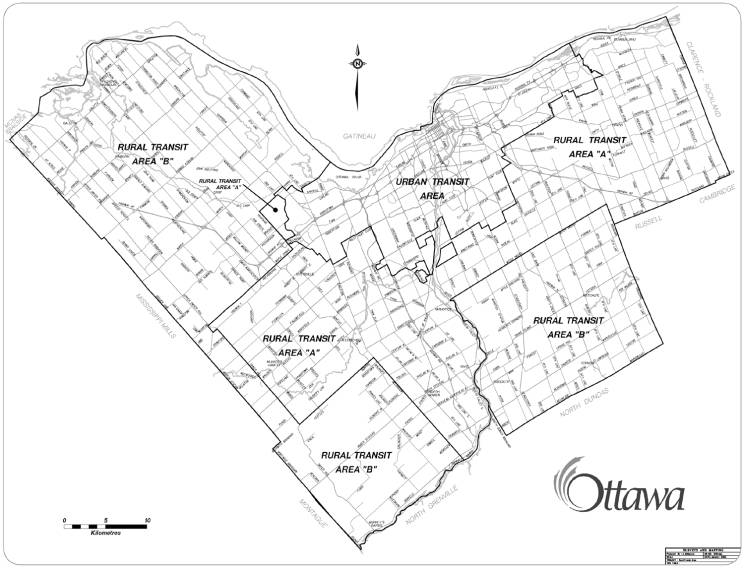
Exhibit 2
Recommended extension of Route 23 from Sarsfield
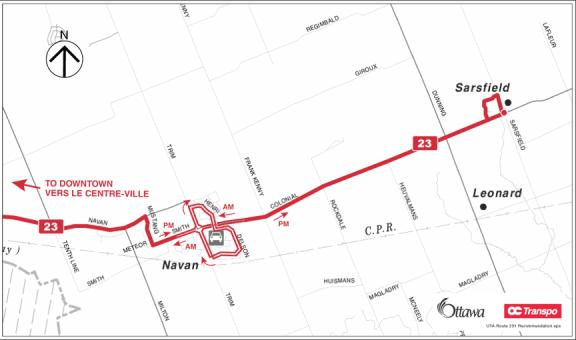
Exhibit 3
Recommended extension of Route 45 from North Gower and Kars
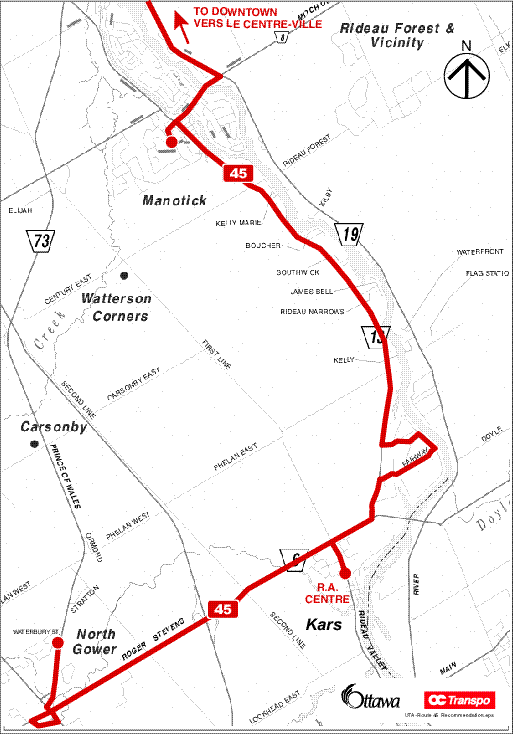
Exhibit 4
Recommended route changes in Manotick
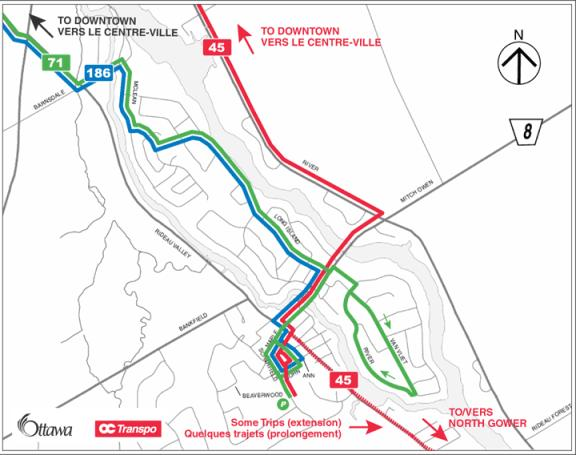
Exhibit 5
Recommended new Route 221 from Cumberland
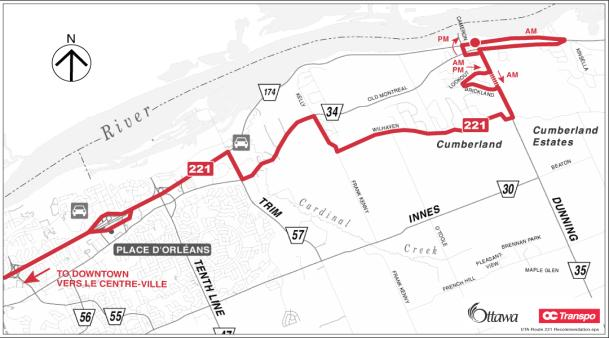
Exhibit 6
Recommended extension to Route 232 from Bearbrook
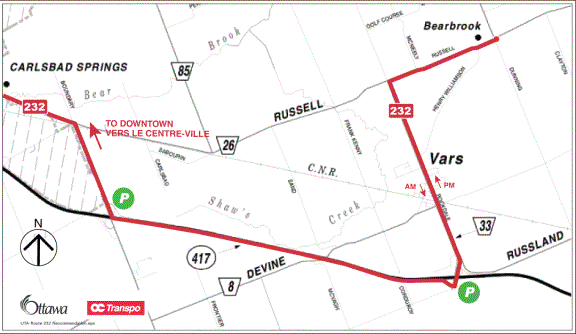
Exhibit 7
Revised Route 163 in Stittsville
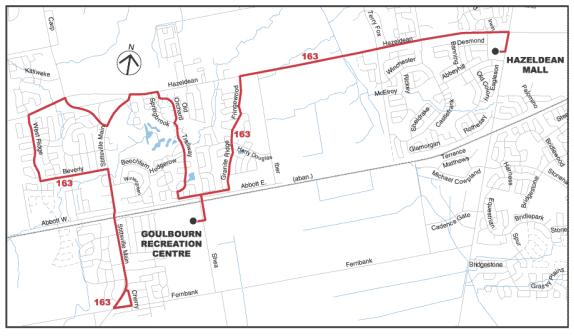
Exhibit 8
Average Daily Ridership on Rural Routes
Route | Type | Villages | Projected ridership | September 2002 Ridership (free fares) | October-November 2002 Ridership | January-February 2003 Ridership |
97 | Transitway | Stittsville | 300 Mo-Fr 300 Sa | 193 Mo-Fr Saturday figures not available | 280 Mo-Fr Saturday figures not available | |
163 | Local | Stittsville | 200 | 33 | 30 | 22 |
183 | Local | Richmond | 100 Mo-Fr 100 Sa | 27 Mo-Fr 34 Sa | 19 Mo-Fr 10 Sa | 19 Mo-Fr 16 Sa |
186 | Local | Manotick (Monday-Saturday) North Gower, Kars (Friday-only) | 100 Mo-Fr 100 Sa | 43 Mo-Th 53 Fr 23 Sa | 37 Mo-Th 61 Fr 13 Sa | 41 Mo-Th 75 Fr 8 Sa |
196 | Local | Manotick | 100 Mo-Fr 100 Sa | 52 Mo-Fr 57 Sa | 42 Mo-Fr 34 Sa | 34 Mo-Fr 23 Sa |
199 | Local | Gloucester South | 100 Mo-Fr 100 Sa | 91 Mo-Fr 71 Sa | 65 Mo-Fr 42 Sa | 35 Mo-Fr 29 Sa |
231 | Rural express | Navan, Notre-Dame-des-Champs | 100 | 131 | 104 | 92 |
232 | Rural express | Vars, Carlsbad Springs | 40 | 65 | 56 | 49 |
262 | Rural express | Stittsville | 180 | 205 | 152 | 172 |
263 | Rural express | Stittsville | 180 | 206 | 165 | 170 |
283 | Rural express | Richmond | 150 | 190 | 175 | 186 |
296 | Rural express | Manotick | 100 | 88 | 66 | 73 |
720 | Connector | Cumberland | 40 | 38 | 27 | 29 |
730* | Connector | Notre-Dame-des-Champs, Navan | 20 | 2 | 2 | 2 |
783 | Connector | Munster Hamlet | 40 | 34 | 23 | 17 |
796 | Connector | North Gower, Kars | 20 | 15 | 15 | 13 |
* Route 730 discontinued on February 17, 2003
Exhibit 9
Fares for Rural Express, Transitway, and Local Services
FARE TYPE | AMOUNT (SEPT 2002 – JUN 2003) | AMOUNT (JULY 2003) | COST PER TRIP (JULY 2003) |
Fares for rural express services | |||
Adult/student/senior cash fare | $4.75 | $4.75 | $4.75 |
Adult/student/senior ticket fare | 4 tickets | 4 tickets | $3.40 |
Adult monthly pass for rural express services | $108.50 | $95.00 pass | $2.38 |
Students’ monthly pass for rural express services | $92.75 | $77.00 | $1.92 |
Children’s cash fare – Valid on all services | $1.25 | $1.25 | $1.25 |
Children’s ticket fare – Valid on all services | 1 ticket | 1 ticket | $0.85 |
Seniors’ monthly pass – Valid on all services | $25.50 | $25.50 | – |
| |||
Fares for local or Transitway service – Regular OC Transpo fares | |||
Adult/student/senior cash fare | $2.50 | $2.50 | $2.50 |
Adult/student/senior ticket fare | 2 tickets | 2 tickets | $1.70 |
Adult regular monthly pass | $60.50 | $61.75 | $1.54 |
Students’ regular monthly pass | $49.75 | $50.25 | $1.26 |
Children’s cash fare – Valid on all services | $1.25 | $1.25 | $1.25 |
Children’s ticket fare – Valid on all services | 1 ticket | 1 ticket | $0.85 |
Seniors’ monthly pass – Valid on all services | $25.50 | $25.50 | – |
| |||
Special local fares (Stittsville local service) | |||
Cash fare – Adults, students, seniors, and children | $1.25 | $1.25 | $1.25 |
Ticket fare – Adults, students, seniors, and children | 1 ticket | 1 ticket | $0.85 |
Passes for rural express services are also valid | - | – | – |
Notes: Upgrades also available from regular and urban express passes and from O-Train tickets. The costs per trip are based on 40 trips per month. The Ecopass cost per pay is based on 26 pay periods per year. The special local fares for Stittsville local service do not allow transfers to other OC Transpo services.
Exhibit 10
Use of Rural Park and Ride Lots
Rural Park and Ride Lot | Average use per day January 2003 |
Carlsbad Springs | 0 |
Manotick | 5 |
Navan | 7 |
Notre-Dame-des-Champs | 1 |
Richmond | 9 |
South Gloucester | 2 |
Stittsville (Carp Road) | 17 |
Vars (Township of Russell ) | 38 |
Exhibit 11
Para Transpo Fare Zones
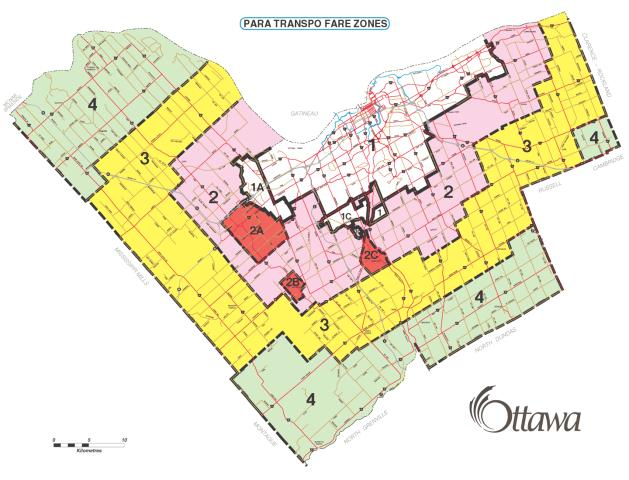
Exhibit 12
Para Transpo Rural Fares
TRIP TYPE | CASH FARE (SEPT 2002 – JUN 2003) | CASH FARE (JULY 2003) | TICKET FARE |
Between Rural Transit Area and Urban Transit Area | |||
To/from Zone A (includes Greely, Manotick, Richmond, and Stittsville) | $8.50 | $8.50 | – |
To/from Zone B | $12.00 | $12.00 | – |
To/from Zone C | $20.00 | $16.00 | – |
| |||
Local service in villages | |||
Within Greely, Manotick, Richmond, or Stittsville | $3.50 | $3.50 | 3 tickets |
Between Stittsville and Kanata, or between Manotick and South Nepean | $5.50 | $5.50 | – |
| |||
Between two points in the Rural Transit Area | |||
Base amount if both points are in Zone A | $1.45 | $1.45 | – |
Base amount if either point is in Zone B | $3.89 | $3.89 | – |
Base amount if either point is in Zone C | $6.33 | $6.33 | – |
Amount per kilometre | $0.41 | $0.41 | – |
Passes: Discounts are available with the use of monthly passes, as follows:
· Regular OC Transpo pass or Ecopass – Discount of $2.50 from the cash fare
· Urban express pass or Ecopass Plus – Local trips within villages at no additional fare; discount of $3.50 from the cash fare
· Rural express pass or Ecopass for rural express – Local trips within villages at no additional fare; discount of $4.75 from the cash fare
· Seniors’ pass – Discount of $1.25 from the cash fare
Notes: Persons travelling as attendants (with an attendant card) pay no fare; persons travelling as companions pay the regular Para Transpo fare of $3.50 or three tickets before 9:00 a.m. from Monday to Friday and $2.50 or two tickets at other times. Customized fares-by-distance for trips entirely in the rural area will be calculated at the time the trip is booked, and have a minimum amount of $8.50.
Exhibit 13
Para Transpo Trips in the Rural Area by Zone
(September 1, 2002 to February 28, 2003)
Zone Pair | Trips |
Stittsville to Stittsville | 3 |
Stittsville (Zone 2A) to Kanata (Zone 1A) | 76 |
Stittsville (Zone 2A) to Zone 1 | 569 |
Richmond (Zone 2B) to Zone 1 | 276 |
Manotick (Zone 2C) to Zone 1 | 151 |
Rest of Zone 2 to Zone 1 | 731 |
Zone 3 to Zone 1 | 333 |
Zone 4 to Zone 1 | 40 |
Zone 2 to Zone 3 | 4 |
Total | 2,183 |
Exhibit 14
Financial Summary for 2002, 2003 and 2004
| AMOUNT | ||
2002 Actual(1) | 2003 Budget | 2004 Projected | |
GROSS OPERATING COSTS | |||
Conventional service operated by OC Transpo | $536,000 | $1,636,000 | $1,673,000 |
Conventional service operated by contractors | 80,000 | 183,000 | 145,000 |
Para Transpo service operated by contractors | 71,000 | 427,000 | 427,000 |
Total | $687,000 | $2,246,000 | $2,245,000 |
| |||
Less: FARE REVENUE | |||
Conventional service | $182,000 | $917,000 | $1,065,000 |
Para Transpo service | 13,000 | 41,000 | 41,000 |
Total | $195,000 | $958,000 | $1,106,000 |
| | | |
NET OPERATING COSTS | $492,000 | $1,288,000 | $1,139,000 |
| |||
CONTRIBUTION TO CAPITAL | |||
Bus fleet | - | $404,000 | $494,000 |
Shelters and radio system | - | 36,000 | 36,000 |
Total | - | $440,000 | $530,000 |
| |||
TAX REQUIREMENT | |||
Rural Transit Area A | $374,000 | $1,572,000 | $1,513,000 |
Rural Transit Area B | 38,000 | $156,000 | 156,000 |
Total | $412,000 | $1,728,000 | $1,669,000 |
| |||
COMPARISON OF COSTS AND REVENUE | |||
Total costs (operating and capital) | $687,000 | $2,686,000 | $2,775,000 |
Total revenue (fares and taxes) | $607,000 | $2,686,000 | $2,775,000 |
Difference | $80,000(2) | - | - |
Notes:
(1) Costs for 2002 are for service between September and December 2002 and do not include the service that was provided in certain parts of the city between January and August 2002. Conventional service fares for 2002 are for service between October and December 2002; no fares were charged in September 2002.
(2) 2002 deficit funded by contribution from the Transit Reserve Fund.